Adagio for organ (op. 21, 1961)
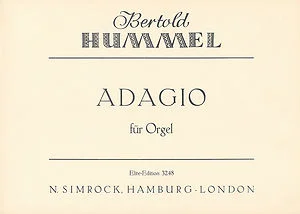
Organ
Duration: 7 minutes
Title: Adagio for organ - Length: 12 pages - Date: 31. X. 61 - Location:
N. Simrock Hamburg-London (Boosey & Hawkes) ISMN M-2211-2070-0
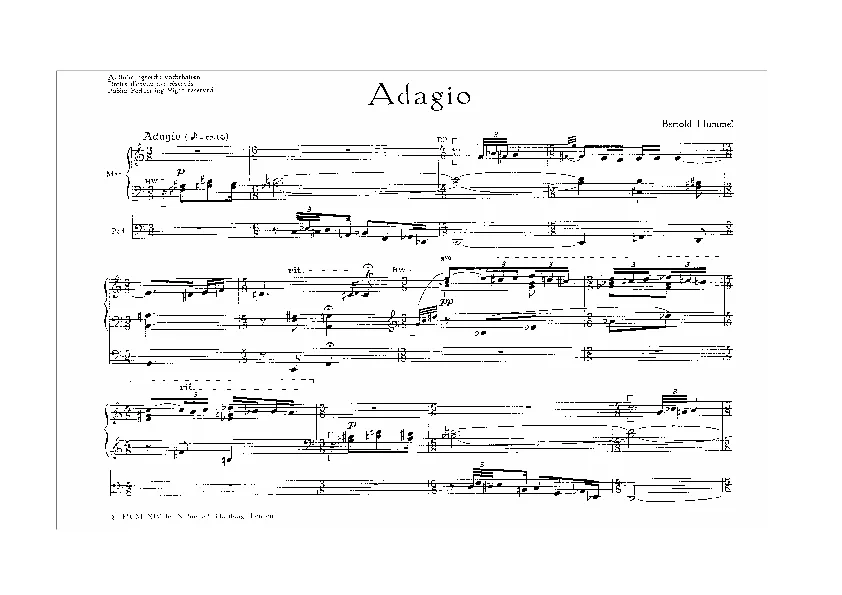
Bertold Hummel's "Adagio for Organ" seems to have been composed more subtly, almost in reflection on the sound possibilities of this instrument. He uses three contrasting, partly horizontal, partly chordal-functional themes, which try to emphasise each other in constant interplay. By means of ever new tensions between these three characters, a constant condensation is achieved, which culminates in intense and tension-filled culmination points. His style is powerful and athletic, not averse to expressions of emotion, but always under control of the intellect and precise acoustic conceptions.




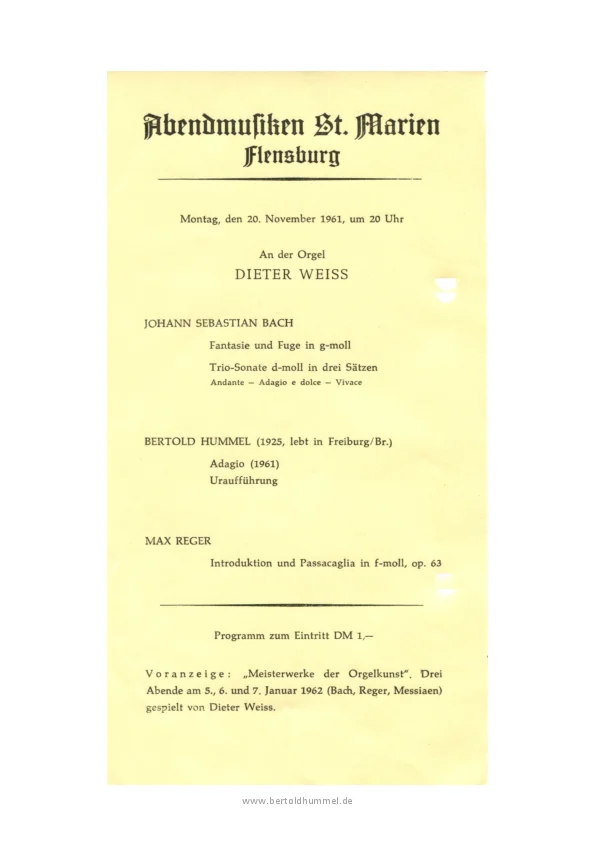
A theme appears above a basic motif, which is then varied in different ways. In contrast to the variations, which are very restrained in tempo and volume, there is a forte insertion twice, which also demands a faster tempo. After this, the original mood is gradually returned to. The basic motif is heard once again in the extreme pianissimo and concludes the work, which was composed on 30.10.1961 following an improvisation on the Markussen organ in Abenrade (Denmark).
Bertold Hummel
On 22 January 1993, Bertold Hummel answered an organist's questions about the score of the Adagio op. 21 as follows:
Is the entered pedal setting binding?
No.
Are all suggestions (even the short ones) ahead of time?
Yes, if possible.
Is the fermata in the final bar over A and F sharp meant as a clear prolongation in relation to D and D, or only as an indication of the normal quaver in relation to the staccato semiquaver?
In a new version, it even becomes a dotted crotchet instead of an eighth.
The composition is based on a three-manual organ. Can I combine RP and BW when transferring to a two-manual instrument (HW, swellable BW) or would you prefer HW and RP on the same manual?
depends entirely on the tonal possibilities of the manuals; it has often been played on two-manual organs.
The playing time is given as 8' in the catalogue of works, but 10' in the score.
6-7 minutes