Wolfgang Osthoff
17 March 1927, Halle – 29 July 2008, Würzburg
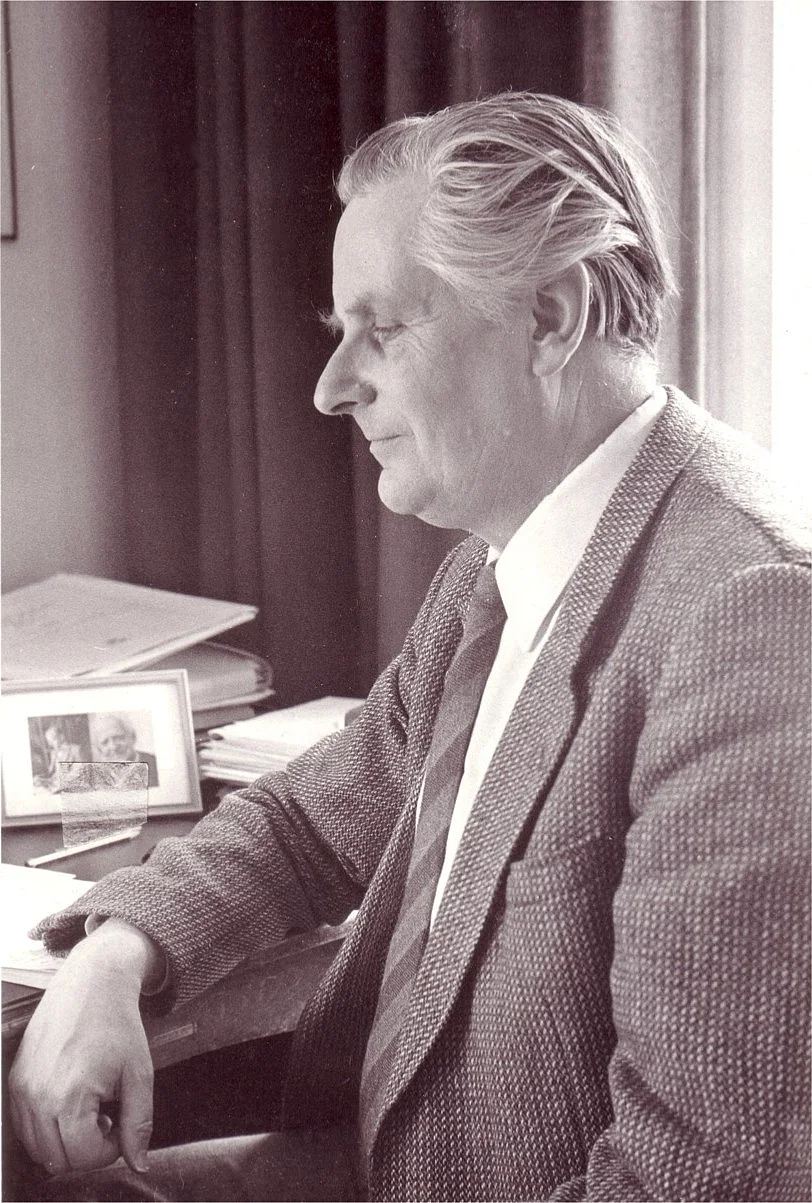
When the musicologist Wolfgang Osthoff began his post at the Julius Maximilian University of Würzburg in 1968, he soon came into contact with Bertold Hummel in his capacity as director of the Studio for New Music. Osthoff often provided the musicological context for the concerts presented there, and he also arranged for his friends Luigi Dallapiccola, Kurt Hessenberg and Gerhard Frommel to be invited to give recital concerts. The personal relationship between Osthoff and Hummel was based on mutual affection and similar ideas about the quality of music. To mark Wolfgang Osthoff’s 60th birthday, Bertold Hummel dedicated the piano song ‘Herbsttag’ (Autumn Day), based on a poem by R.M. Rilke, to the poetry enthusiast. We have Osthoff to thank for two important works on Hummel’s song cycle:
Wolfgang Osthoff: On the Songs of Bertold Hummel
Wolfgang Osthoff: Bertold Hummel’s Final Song Cycle “Kopflos”
Wolfgang Osthoff
On 29 July 2008, one of the most eminent musicologists of our time, Prof. Dr.Dr.h.c. Wolfgang Osthoff, died in Würzburg at the age of 81.
He had a particularly close association with the journal *Vox Humana*. In the issue Vol. 1, No. 2, Nov. 2005, he discussed Bertold Hummel’s song compositions, and in the previous issue (Vol. 4, No. 1, June 2008), he made Schubert’s melody ‘Liebliches Kind’ available for the first time for practical use, with a piano accompaniment he had added himself. Accompanied by the scholarly commentary he wrote during the very last week of his life, along with minor corrections, it is included once again in this issue.
His career in musicology was, so to speak, in his blood from birth. His father, Helmuth Osthoff (1896–1983), worked as a musicologist at the universities of Berlin and Frankfurt. His research focused on vocal music of the 15th and 16th centuries. It was under his tutelage that Wolfgang Osthoff began his studies. At the University of Heidelberg, he then became a student of Thrasybulos Georgiades (Schubert: Musik und Lyrik, 1979), whom he followed to Munich and whose assistant he later became at the University of Munich. His studies in philosophy (under Hans-Georg Gadamer, amongst others) and Medieval Latin enabled him to understand music within a comprehensive context. His two-year period of study in Italy cemented his love of Italian music. For a quarter of a century, he was in charge of musicology at the German Study Centre in Venice. From 1968 to 1995, he held the Chair of Musicology at the Julius Maximilian University of Würzburg. Even after his retirement, he continued to support the institute. He supervised his last doctoral examination in July 2008.
The connections between music and language were a lifelong interest of his. Among his countless publications, musicological analyses of vocal works play a special role. Monteverdi and Verdi were among his main areas of research. Musical settings of works by J. W. Goethe, Friedrich Schiller and Stefan George were a key area of his work. He demonstrated his commitment to the work of Hans Pfitzner not only through his role as a member of the executive committee of the Pfitzner Society but also through an urtext edition of the Eichendorff cantata ‘Von deutscher Seele’. For singers, the titles of these essays alone are likely to arouse deep interest:The two versions of Verdi’s *Macbeth*; Mozart’s cavatinas and their tradition; Monteverdi discoveries; The Credo of the Mass in B minor: Italian models and influences; Richard Wagner’s *Buddha* project *Die Sieger*. Its conceptual and structural traces in *Der Ring* and *Parsifal*; Stefan George and “Les deux Musiques” – Resonant and set-to-music poetry in harmony and conflict; Comicità alla turca, musica classica, opera nazionale – Observations on *The Abduction from the Seraglio*; Poetic and musical gesture in Pfitzner’s songs; The ‘parti serie’ in the ensembles of Mozart’s opera buffa *Don Giovanni*; Schiller and music; Claudio Monteverdi’s dramatic late works; *Das Todtenhemdchen* – traces of a lost Schubert song?; The character of Azucena and the dramatic-musical unity of *Il trovatore*; Pfitzner and Puccini; Verdi and German literature. The edition of the final volume of songs by his friend Gerhard Frommel was the work that occupied him on the day before his death.
Wolfgang Osthoff was a music enthusiast. Not a day went by without him reflecting on musical phenomena in compositions. He delighted in discussing these matters, particularly when those he spoke to did not share his views. Time and again, he urged his students to learn music for themselves on an instrument and to attend concerts and opera performances. He himself always led by example, attending countless musical events, usually with the score in hand and always genuinely interested in the music itself. Successful performances made him happy. In his persistent quest to uncover the composer’s very own intentions, he could not take today’s ‘director’s theatre’ seriously. He was deeply repelled by any kind of social hocus-pocus. Milestone birthdays could only ever be celebrated in an official setting after the event, and even then only disguised as a ‘book launch with music’ in order to secure his consent. There was something endearing about his uncompromising stance on many matters, for it was coupled with self-deprecating humour and a profoundly humane way of thinking. To mark his 80th birthday, a comprehensive collection of texts by Wolfgang Osthoff was published under the title ‘Music from a Free Spirit in the Twentieth Century’. Wolfgang Osthoff sought this free spirit time and again in music and found it in places where one might not have expected it. – For us musicians, is this an incentive to rethink our approach to the ever-same repertoire and set out on a quest?
Martin Hummel (in the journal “Vox humana”, October 2008)
Bibliography of all works by Wolfgang Osthoff