in memoriam Bertold Hummel
Dear Mr President, dear Christoph,
Dear Councillor Mack,
dear guests,
dear Hummel family,
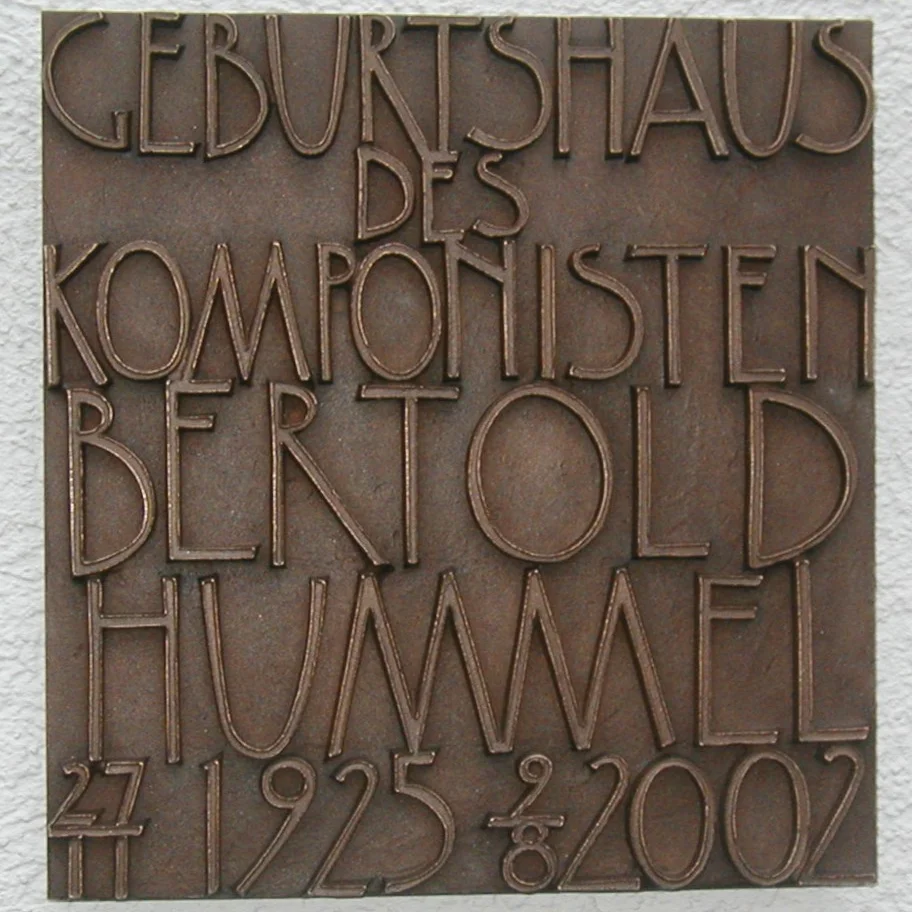
It is quite unusual to be born on 27 November. These final days of November, the first days of the zodiac sign Sagittarius, have the lowest birth rates worldwide, and yet today, of all days, we are celebrating the birthdays of two magnificent composers. Both were born in Swabia (or perhaps in Baden, just a few kilometres away); one grew up in a Protestant vicarage, whilst the other, even as a young boy, would sit beside his father on the organ bench and listen. Hearing a Bruckner symphony for the first time proved to be a defining moment for eleven-year-old Bertold; he resolved to become a composer. Bertold Hummel would surely have spent his birthday – the 100th anniversary of which falls today – making music, just as he did throughout his life and that of his family, even though one of his six sons, the ‘black sheep’, did not become a professional musician but a clergyman instead. Perhaps he simply took a sort of ‘shortcut’ to direct dialogue with God, for whom music is perhaps the dearest of all the arts. ‘Thou shalt not make unto thee any graven image,’ as the second commandment states; yet perhaps the divine is, ultimately, sound: everywhere present and gracious, and as an art of time, transcending time into the realm beyond its fading.
In an age of increasing secularisation, the creative – and indeed the post-creative – artist has the task of drawing his fellow human beings’ attention to the transcendent, to the inexplicable and also the unprovable. The language of music – perhaps the most universal of all – takes on particular significance in this regard. Bertold Hummel, 2001
Bertold Hummel and Helmut Lachenmann, who are separated by just ten years in age, explore through their musical work the vast realm of artistic and musical imagination and critical engagement – including with the catastrophes of the 20th century. Both are united by a deeply felt sense of responsibility, a sense of justice and spirituality.
When I had the privilege of getting to know and appreciate Bertold Hummel personally in the early 1990s, it was, beyond his vast experience and professional expertise, above all his attitude towards the world as a community that made a deep impression on me. His constant willingness to take every person seriously and value them for their individual personality, recognising and discovering talents in everyone, was admirable. At the time, he was chair of the jury at the first European Rhythmics Competition at the Trossingen University of Music, and I was fascinated by how he managed, with cheerfulness and goodwill, to transform the rigorous competition into a kind of celebration, without deviating one iota from his high standards. I was in my early 30s at the time, a novice when it came to organising competitions with an international jury. As I delivered my opening remarks on the grand stage of the concert hall, I could feel my heart pounding very clearly and heard the slightly strained tone in my voice. Bertold, however, praised this performance with the words: ‘You’ll be the principal here one day.’ A remark that only came back to my mind years later. His pupil, the composer Jürgen Weimer, was rector in Trossingen at the time. The acumen with which he, in turn, masterfully articulated a politically critical stance, and the mastery of his rhetoric, which he knew how to wield as a weapon against stupidity and intellectual laziness, were legendary; the radical nature of his aesthetic imagination also shaped his leadership style as headteacher. To witness the two of them together – teacher and pupil, both long-standing and respected rectors – as they interacted with one another, at once familiar and yet distant, challenging yet mutually respectful, was a gift; it remains a precious memory to this day, instructive and profoundly human. When asked by a journalist: ‘Would you sacrifice an idea for the sake of a pleasant sound?’, Bertold once replied unequivocally: ‘I would not do that.’ Helmut Lachenmann and Jürgen Weimer would surely agree with this answer.
Bertold Hummel spent his early childhood in the Black Forest, before moving to the cosmopolitan city of Freiburg im Breisgau when he started school. Music was a central part of family life, as were lively discussions and a decidedly critical view of political events. Bertold was 13 years old when the Second World War broke out. Klaus Hinrich Stahmer writes in his notes on Bertold Hummel (in ‘Komponisten in Bayern’):
“…The budding musician had to endure personal hardships when his long-standing involvement in domestic music-making for a respected Jewish family in Freiburg was denounced. At the age of eighteen, he was conscripted into the ‘Reich Labour Service’ and, six months later, into military service…”
Bear in mind that we are talking about 1943; by this point, the war had already been raging for four years, and Germany had long since been fighting a losing battle. Furthermore:“Taken late in the war as a prisoner of war in France, he sees his first opportunities to make music after all and actively helps to found a camp band, consisting of a string quartet, woodwinds, trombone, trumpet, saxophone, accordion, piano and percussion. It was here that his first string quartet was performed, along with popular works ranging from Wagner’s *Grail Legend* to classical overtures and light music. Fellow prisoners built the missing double bass in the camp carpentry workshop according to his instructions, and, lo and behold: it ‘sounded’! _ After five adventurous escape attempts, he succeeded in 1947 in returning to his homeland via Belgium and Luxembourg, initially to complete his school education by taking a repatriation course at the University of Freiburg and obtaining his Abitur.” I am sharing this passage with you, dear congregation, as it reveals so much about the character of our honouree: his outstanding will to survive, his trust in God, and his unwavering desire for music and making music, even in a prisoner-of-war camp. A black-and-white photograph from that time shows Bertold Hummel sitting at his cello alongside eight comrades from the camp band ‘Erich Horn’. They are all wearing camp uniforms; in the background, one can see a wooden barrack, a sort of barn.
In 1947, Bertold Hummel returned to Freiburg, which – as one of its first measures following the Second World War – had already founded a conservatoire in 1946. Today, we can only imagine the atmosphere of that time to a limited extent. Bertold Hummel speaks of a “catch-up euphoria among the homecoming generation”. Freiburg was located in the French occupation zone, so the returnee and musician experienced exhibitions by Chagall, Braque, Léger, Picasso and Rouault, as well as a performance of Olivier Messiaen’s *Quatuor pour la fin du temps*. His years as a student – during which he studied cello with Atis Teichmanis, chamber music with Emil Seiler, conducting with Konrad Lechner and composition with Harald Genzmer – would shape the course of his entire life. He immersed himself in the musical universe of the Second Viennese School, encountered the music of Igor Stravinsky as well as the musical and aesthetic universe of Luigi Nono, and combined these experiences with his great passion for the Western tradition of church music. In 1981, Bertold Hummel summarised this as follows, forming a grand aesthetic credo:
In my thinking, I feel a kinship with A. Berg and O. Messiaen. The ‘cantus firmus’ approach of P. Hindemith and my teacher H. Genzmer, as well as their spontaneous joy in making music, have also impressed me time and again. What captivated me about my teacher Julius Weismann was his impressionistic musical imagination, as well as his harmonic richness and formal diversity. I have never counted myself among the avant-gardists! Admittedly, I have always followed my colleagues’ experimental endeavours with great interest and have made use of one or two of their approaches in my own work. Thus, I see the current situation as an opportunity to intellectually process these diverse insights – in a sense, as a synthesis of the wide range of inspiration available. My love of tradition and of meaningful (subjectively speaking) progress has always shaped my musical language.
After completing his studies, Hummel took up a post as cantor at St Konrad near Freiburg, but also performed regularly as a cellist with the Südwestfunk Baden-Baden Symphony Orchestra or at the municipal theatres in Freiburg. His skills as an arranger and composer were increasingly in demand. As early as 1952, his ‘Missa brevis’, Op. 5, featured on the programme at the Donaueschingen Music Festival. He met Inken whilst playing in a string quartet, and they married in 1955. With the violinist and teacher, who was born on Sylt, he would be able to share and realise his great passions throughout his life: music and making music, community and family, trust in God and confidence. Florian, Cornelius, Martin and Lorenz, the first four of their six sons, were born in Freiburg.
In 1963, Bertold Hummel accepted a post as a composition teacher at the Bavarian State Conservatoire of Music in Würzburg, where he and his family found a new home. Over the following ten years, until the State Conservatoire was transformed into Bavaria’s second university of music, Hummel carried out truly pioneering work. He provided New Music with the space it needed to flourish, facilitating encounters and experiences: he invited colleagues such as Korn, Genzmer and Hába to Würzburg, as well as Karlheinz Wolfgang Rihm, Peter Eötvös and Helmut Lachenmann. He went on to head the Studio for New Music for 25 years.
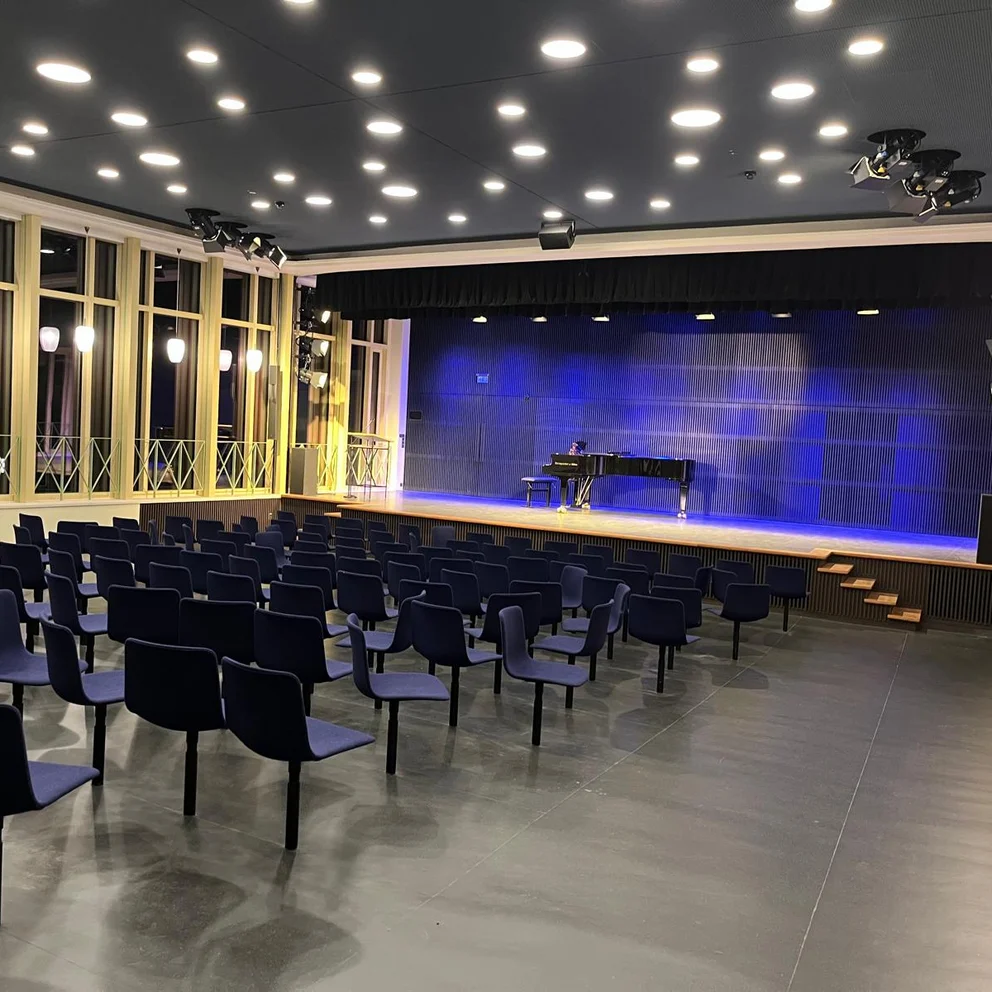
Acute space constraints were resolved in 1966 with the construction of a new building on Hofstallstraße, featuring teaching and concert wings. This gave Würzburg’s musical life a centre once more, supported by the Conservatoire and its Friends’ Association, which organised concerts featuring leading artists. The new concert hall was inaugurated with the performance of Bertold Hummel’s Second Symphony, ‘Reverenza’. In 1968, a scholarship enabled him to spend six months at the Cité des Arts in Paris, which is celebrating its 60th anniversary this year and now offers over 300 residencies annually. Enriched and inspired, Hummel returned to Würzburg, where, in 1973, following a brief transitional period as a specialist academy for music, the institution was upgraded to the status of a Bavarian university of music. Bertold Hummel became a full professor and head of a composition class. When Hanns Reinarzt stepped down from the university’s leadership in 1979, his deputy, Bertold Hummel, took over as President. From then on, he devoted himself with equal commitment to his composition class and to the development of the University of Music. With wit, an open-minded attitude and a commitment to diversity, he made a significant contribution to the institution’s flourishing. For him, art and education were not two separate spheres; on the contrary, musical education meant lifelong learning – something so self-evident to an artist that it scarcely seemed worth mentioning. He values a pre-college ensemble just as much as the world-famous stars of the great stages. The real encounter takes place in and through music. Successful composers such as Jeff Beer, Ulrich Schultheiß, Claus Kühnl, Klaus Ospald, Jürgen Schmitt, Rolf Rudin, Horst Lohse, Jürgen Weimer, Hermann Beyer, Christoph Weinhart, Armin Fuchs, Tobias M. Schneid and Christoph Wünsch – the current president of this institution – form an impressive roster and command attention. Bertold Hummel is to them all a mentor, enabler and patron, a companion on their journey and a critical friend.
In 1987, Bertold Hummel handed over the office of President to his successor so that he could devote himself entirely to composing from then on. In recognition of his services and with great esteem, the Würzburg University of Music appointed him Honorary President. Hummel was at the zenith of his career: as early as 1982, he was elected a member of the Bavarian Academy of Fine Arts; this was followed in 1985 by the Federal Cross of Merit, First Class, and in 1988 by the City of Würzburg’s Culture Prize. Further honours were to follow.
To mark the 1,300th anniversary of the mission and martyrdom of the Apostles of the Franks in Würzburg Cathedral, Bertold Hummel composes the oratorio *Der Schrein der Märtyrer* (*The Shrine of the Martyrs*) based on a text by Bishop Paul Werner Scheele. A breathtaking full-length work for five soloists, mixed choir, boys’ choir, narrator, three organs, percussion ensemble and full orchestra, which was completed and premiered in 1989.
I had the privilege of knowing Bertold Hummel as a subtle, ever-curious man who approached the world with a smile. He was surrounded by a dancer’s lightness and sometimes gave the impression of being constantly on the move. He maintained a warm friendship with his namesake Franz Hummel, though the two are by no means related. Commissioned by the Regensburg Chamber Opera, I wrote the libretto for Franz Hummel’s *On the Beautiful Blue Danube*, based on a text fragment by Ödon von Horvath (*The Teacher from Regensburg, a True Story*). Bertold was moved by the fate of Elly Maldaque, a young, popular, single teacher who bravely and courageously stood up for her convictions in the face of a society that was becoming increasingly radicalised in the 1920s. Because of her political views, and possibly as a result of being denounced by an admirer whose advances she had rejected, she was dismissed from the civil service without notice in 1930 and committed to a psychiatric hospital. Shortly afterwards, she died there of heart failure. The chamber opera premiered in Klagenfurt and was performed in Regensburg. Franz Hummel and I quickly agreed: we would dedicate this chamber opera to Bertold Hummel. Allow me a brief digression into the present day – Bertold Hummel would certainly have played an active part in today’s day of action organised by German music academies against the abuse of power. The Würzburg University of Music, perhaps drawing inspiration from the resistance movement of Persian women, has given today’s event the striking title: Art. Power. Humanity.
As a composer, I feel a sense of duty towards the community in which I live. My aim is to make a modest contribution to the endeavour of making the world a more humane and liveable place. The triangle of composer – performer – listener is a constant challenge for me: a ‘l’art pour l’art’ perspective has always been alien to me.
110901 – Ideas for the Future is the title of a composition for solo percussion and narrator ad libitum, written in the wake of ‘Black Tuesday’, which went down in history as ‘9/11 ’. The above quotation is taken from the publisher’s announcement of the work. Composer–performer–listener: this conceptual triangle (ideally an isosceles one) has occupied Bertold’s thoughts for many years. Composer–performer–listener as equal partners in the creation of music. One can interpret this image as distinct stages, but also as an open field. The listener who seeks out the composer whose work fascinates them and lives on within them; the composer who writes for a performer whose artistry inspires them and from whom they wish to learn; the performer who addresses a particular audience or commissions a composition, and so on… The more I delve into this image and try to shed light on it, the more I become aware of its dynamism and potential for development. Bertold Hummel has taken on this triangle as a challenge. Questions of responsibility, relationship, meaning, community in this world – for one another – and beyond this world form the driving force behind our actions and thoughts – and it is precisely this that brings us back to the here and now: Art. Power. Humanity.
Perhaps two years before his final departure from this world, it so happened that Bertold Hummel and I found ourselves going for a long walk together. We spoke about life and the span of a lifetime as a form – perhaps even as a musical form – and about our possible sense of this form. He then said that he knew full well that the arc of his life was already drawing to a close, but that this knowledge caused him no concern. Ultimately, he said, all was well.
Thank you, dear Bertold Hummel.
Salzburg, November 2025
On 9 August 2002, our dear friend Bertold Hummel, composer and chairman of the Guardini Foundation’s Music Advisory Board, passed away in Würzburg. When he was presented with the German Catholics’ Art and Culture Prize (alongside Petr Eben) by Bishop Karl Lehmann at the State Chancellery in Mainz on 13 June 1998, I said in my laudatory speech:
“What a joy it is to be able to speak of an artist whom one both loves and reveres, whose personal aura has moved one just as much as his work! What a pleasure, too, to deliver a laudatory address for a composer who, throughout his life, remained independent of cliques – that is, of groups which, it is said, exert influence even over award ceremonies (including their media coverage) in the course of the fierce scramble for favours... So today we honour a free artist; and yet a spirit of service is an essential feature of his work.
Bertold Hummel, born on 27 November 1925 in Hüfingen, Baden, was a student of Harald Genzmer in Freiburg im Breisgau, of whom he still speaks with great affection today. ‘Aha,’ the ‘insiders’ will conclude in a flash: Hindemith in the third generation, then. Francis Poulenc would have replied: ‘That is, after all, something’; but it is by no means enough to describe the scope of Hummel’s oeuvre.
In 1997, his Third Symphony, Op. 100, ‘Jeremia’ (inspired by Franz Werfel’s novel), received its world premiere. Hummel gave me the CD, which was released immediately afterwards, with the remark so characteristic of him in its lack of insistence: ‘Well, perhaps you’ll have time to give it a listen.’ I was therefore completely unprepared for the power and depth of the sounds in this great, significant work. What a wealth of colour in the harmonies and orchestration! What density of form and, at the same time, what clarity and distinctness of the musical language! Much the same can be said of Hummel’s full-length oratorio ‘Der Schrein der Märtyrer’ (The Shrine of the Martyrs) for soloists, two choirs, a narrator, three organs, a percussion section and orchestra, which was composed in 1988. To me, this work seems to be a threefold musical portrait: on the one hand, it brings together the composer’s diverse expressive possibilities in an exceptionally successful manner; on the other hand, it is a tribute to Würzburg, where Hummel worked for many years; and, last but not least, it is a sophisticated work of art placed in the service of a spiritual message which has always been a matter close to this artist’s heart and an integral part of his culture.
This is a key point: throughout Bertold Hummel’s extensive body of work – naturally in his liturgical compositions, but also in his instrumental and orchestral music – his religiosity, his connection to the Spirit, shines through time and again. Just as, in Hummel’s case, the spiritual message is found in works intended for the concert hall – that is, in works of artistic merit – so, conversely, he demands such artistic quality from liturgical music as well. He articulated his views on this matter emphatically as early as 1979 in his remarkable lecture ‘On the Situation of Music in the Church Today’.
But let us return to the alert, sensitive musician Bertold Hummel, who is always on the lookout for new combinations of sound: I am thinking, for instance, of his subtle trio for flute, oboe and piano, ‘In memoriam Olivier Messiaen’ – for me, the link between the composer’s spiritually inspired works and his numerous compositions that were, as it were, shaped by an ‘autonomous’ artistic impulse. Here one could mention a wealth of concertante and chamber music works, not least the twenty or so pieces for and with percussion written to date, which have helped to secure their composer an enviable (and indeed envied) number of international performances.
I spoke of an ‘autonomous artistic impulse’, but I shall correct myself at once: It is enough to have caught a glimpse of Bertold Hummel’s kind and humorous gaze to realise that, for him, writing music is always also an act of humanity: to give his contemporaries and future generations something that enhances their share of beauty. Everyone who knows Bertold Hummel is aware of the gentle, discreet devotion with which he helps his younger colleagues, and of the astonishing curiosity with which he – now Honorary President of the Würzburg University of Music and member of the Bavarian Academy of Fine Arts – continues to seek out new experiences."
I find it difficult, very difficult, whenever I come across a verb in the present tense in this text, to be reminded that this present is no longer a reality in this form. Bertold Hummel’s death came suddenly; it took us completely by surprise. As recently as April last year, he was seen at Hirschberg Castle, observing with magnanimity and goodwill the German bishops’ encounter with a range of works from the musical avant-garde, making no great fuss of the others thanks to his masterful discernment. If only I had realised that this was to be our last meeting, how much I would have had to say to him then! And how often I would have longed to seek his gaze once more, from which so much confidence always shone.
Bertold Hummel did a great deal of good not only as an artist but also as a teacher. In 1963, he was appointed as a teacher of composition at what was then the State Conservatoire in Würzburg and, following its reorganisation into the Second Bavarian University of Music, was appointed professor. For eight years (1979–1987), he also held the office of president. Throughout his life, he championed contemporary music: he directed the Würzburg Studio for New Music, founded the ‘Würzburg Days for New Music’ and worked on a voluntary basis for more than 25 years at GEMA, the copyright society for composers. Bertold Hummel received numerous awards for his works and services, including the City of Stuttgart’s Composition Prize (1960), the City of Düsseldorf’s Robert Schumann Prize (1961), the Federal Cross of Merit, First Class (1985), the City of Würzburg’s Culture Prize (1988) and, most recently, the aforementioned German Catholics’ Art and Culture Prize.
On the day before his death, whilst in hospital, knowing that the end was very near, Bertold Hummel sketched a deeply moving piece for solo cello; he dedicated it as a ‘final farewell’ in the truest sense of the word – indeed, as ‘Abschied’ (the title of the work) – to the outgoing managing director of the Guardini Foundation, Dr Hermann Josef Schuster. Here, too, the greatness of this man is evident – in his ability to transform even such a moment of existential crisis into a gift.
Bertold Hummel, our dear friend, is sorely missed...
(Guardini Foundation e.V. – Annual Report 2002, Berlin)
We last met in July in Berlin during the GEMA Serious Music Assessment Committee’s meeting week. When we greeted each other, he seemed to me to have changed slightly in appearance; his face was thinner and more haggard than the year before. That might have been the temporary effects of professional overwork. I didn’t give it a second thought, for during the first few days of the extensive and nerve-wracking assessment work, he took part in our discussions with his usual liveliness and precision. It was not until the third day that he complained of feeling unwell and eventually returned to Würzburg early.
The liveliness of the moment dispels any thoughts that this might be a final meeting, all the more so with a respected, endearing colleague and friend. So the news of his death, just four weeks later, took me completely by surprise and was deeply painful.
We had known each other since 1971. That year, as director of the Studio for New Music in Würzburg, he had invited our ‘Gruppe Neue Musik Berlin’ – which had been enjoying success in West Berlin since 1965 – to give a concert. This later developed into a collegial friendship, which deepened noticeably over time through our meetings at the annual GEMA assemblies, occasional joint concert performances and the discussions that followed.
Right from the start, I was struck by Bertold Hummel’s attitude towards his fellow human beings, which I would describe as goodwill. I have never encountered this trait so clearly expressed in any other educated person. It is the ability to understand others and, with it, the gift of offering encouragement in life. Not in a naïve, uncritical manner. For Hummel, as a devout Christian, was a balanced and discerning mind, yet one always ready to engage in necessary debates.
Yet the philanthropic side of his character – his understanding of those who thought or acted differently, his sense of common ground despite opposing positions – which sounds like squaring the circle – was extraordinary. At the same time, he could be strict, particularly when it came to artistic insincerity, contempt for colleagues or tiresome vanity.
“As a composer, I feel a duty to the community in which I live. My aim is to make a modest contribution to the endeavour of making the world a more humane and liveable place.” Such was the credo of Bertold Hummel, who was born near Donaueschingen in 1925. His ancestors from Baden on both his father’s and mother’s sides were craftsmen, but his father became a teacher, choirmaster and organist. He introduced his receptive and keen son to music at an early age. Somewhat later, whilst serving as headmaster near Freiburg im Breisgau, he gave his son piano lessons. His exceptional musical talent was specifically nurtured at the Oberrealschule in Freiburg through lessons in cello, harmony and composition. When the pupil heard Bruckner’s ‘Third’ at a symphony concert, he was determined to become a composer. His participation in the boys’ choir for performances of *Parsifal* at the Freiburg City Theatre cemented this ambition. In Anton Bruckner and Richard Wagner, he chose two long-term role models for his professional journey. But first, in accordance with the demands of the Nazi dictatorship, he had to don the earth-brown uniform of the Reich Labour Service as part of his pre-military training, only to march off into the Second World War just six months later – this time in an olive-green Wehrmacht uniform. He emerged physically unscathed from these storms of steel; whilst still a prisoner of war in France following the German surrender in 1945, he began writing compositions for a prisoner-of-war camp band. In 1947, he returned to his homeland, was able to resume the school education that had been interrupted shortly before the outbreak of the war, and went on to pass his A-levels. He then immediately began his studies at the Freiburg University of Music, studying composition under Harald Genzmer, amongst others; his cello teacher was Atis Teichmanis, and he studied conducting under Konrad Lechner. Hummel recalls this post-war era of the late 1940s as a time of “catch-up euphoria among the homecoming generation”.
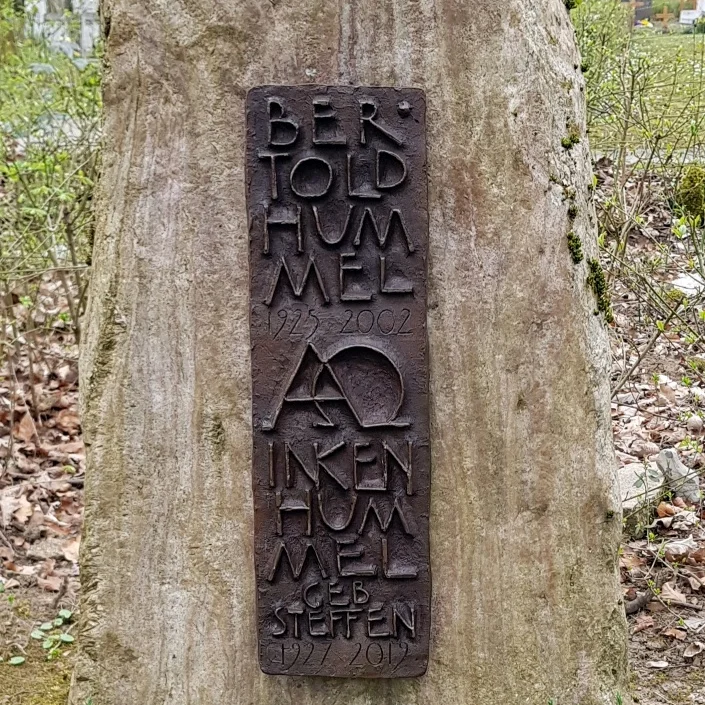
In 1954, as a cellist, he embarked on a concert tour lasting almost a year through the Union of South Africa with a group of young musicians. It was there that he married his colleague, the violinist Inken Steffen. On his return, Hummel initially took up a post as a cantor in Freiburg, whilst continuing to perform as a cellist, including as a regular substitute with the Südwestfunk Baden-Baden Symphony Orchestra. His work as a composer was recognised through numerous awards, including the Culture Prize of the Federation of German Industries (1956), the City of Stuttgart’s Composition Prize (1959) and the Robert Schumann Prize of the City of Düsseldorf (1960). He was appointed as a teacher of composition at the Bavarian State Conservatoire of Music in Würzburg in 1963. Here, he worked tirelessly to promote contemporary music for over two and a half decades.
After Hummel was appointed director of the ‘Studio for New Music’, he presented works by numerous young composers in his concerts, some of whom have since become household names amongst audiences with an interest in the genre throughout Germany. Hummel’s cosmopolitan outlook enabled him to bring together seemingly incompatible aesthetic directions in his programmes, thereby opening up the full spectrum of compositional creativity in the final quarter of the late 20th century to public discussion. He also knew how to convey his flexible understanding of stylistic contrasts to his students with psychological insight, in order to awaken their intellectual alertness and the receptivity of their senses, thereby stimulating their imaginations.
One’s own ideal sets standards, and Hummel’s aim was always to broaden his musical horizons without betraying himself. In other words, he had by then succeeded in finding a recognisable compositional style of his own. This had originally been rooted in the neoclassicism of his teacher Harald Genzmer – and, in turn, that of Genzmer’s teacher, Paul Hindemith. Having long since moved beyond this, he had developed his own musical voice through the influence of the French schools of the early 20th century, and indirectly also of the New Viennese School. Hummel’s inspirations are clearly shaped by the French composer Olivier Messiaen, whose concepts of timbre find their own expression in Hummel’s compositions.
As a composer, however, Hummel always had to show deference to his university professor. This was because, in 1973, the Bavarian State Conservatoire in Würzburg had been transformed into the Second Bavarian University of Music, and Bertold Hummel had been appointed full professor. Finally, in 1979, he was elected President of this institution and, following his retirement in 1988, was appointed Honorary President. Prior to this, he had been elected a member of the Bavarian Academy of Fine Arts in 1982; he was honoured with the Federal Cross of Merit, First Class, in 1985, and the City of Würzburg awarded him its Culture Prize in 1988.
Over the past decade and a half, freed from the burden of time-consuming university duties, Hummel composed tirelessly and with great inspiration, always searching for new means of expression, which he then incorporated into his very own distinctive musical style. “My view now, at the end of this millennium, is that after a century in which experimentation has played a major role, the longing to find a new musical language is gaining ground worldwide. In my view, a new aesthetic of plural possibilities will prevail over the orthodoxy of the respective ‘movements’.”
In order to attend the numerous international performances of his works as a listener, Hummel has travelled to many countries in recent years, including the USA, Russia, Australia, France, Austria, Switzerland, Poland and the Czech Republic. An interesting selection of his compositions has been released as a CD series on the Conventus Musicus label.
His compositional integrity is matched only by his diligence. His body of work, comprising over 200 pieces, did not prevent him from volunteering his services to GEMA, the copyright organisation specific to us composers. For over 25 years, he was one of the most responsible members of the exceptionally important Evaluation Committee. He also taught his students about the vital importance of copyright for composers, encouraged them to attend the GEMA Annual General Meeting, and was always on hand for discussions concerning the interests of serious music. Nevertheless, he remained reserved throughout his life, never sought the limelight and only represented the organisation where it was unavoidable. His inner equanimity had no need for the superiority complex characteristic of some composers, which served as compensation for the cult of genius that flourished in the 19th century but was increasingly lost to society in the 20th.
His family – the lifelong bond with his wife, his six married sons (five of whom became professional musicians, as did four of his daughters-in-law) – and 17 grandchildren evidently gave him the stability and serenity that he always radiated right to the very end, even during difficult ‘discussions’, such as those concerning GEMA issues.
His compositional life’s work spans almost all musical genres and instrumentations. He engaged with the new compositional techniques of the 20th century, from 12-tone music and serial techniques to jazz and the possibilities of electroacoustic music. He utilised the discovery of percussion in our evening music just as successfully as the timbre of the saxophone. Contemporary sacred music, in particular, found in him one of its most important, secularised exponents. When asked to characterise his compositional style, he replied: “I would describe it as a style of metamorphosis of everything that particularly impresses me from the global musical repertoire of the past and present; coupled with a strong personal desire for expression – a kind of creative eclecticism, so to speak.”
We mourn the loss of the composer and teacher, but above all the loss of our dear colleague and friend, Bertold Hummel.
(from: Gemanachrichten No. 166 3/2002, Berlin)
First I got to know the sons: I sometimes went for walks with the youngest ones, the twins, who – as they proudly told me – were eight years old at the time. “My little terrorists,” their father affectionately called them, for they were wild boys, full of original ideas. Mr Hummel always enjoyed hearing me recount how I’d treated the two of them to an ice cream. I asked the mate who was with them if he’d like an ice cream too. “No,” he said. When I asked, in surprise, why not, he told me that he was Protestant. At Mr Hummel’s request, I had to repeat the story quite often, whenever there was someone in the group who hadn’t heard it before.
Mr Hummel loved anecdotes and was a brilliant storyteller himself. At the Wies Adult Education Centre near Steingaden, he spoke of a stay in the United States. He’d been invited to teach American music students and to perform his works with them. When he was rehearsing a piece of music with them and saw that they were nervous because the composer himself was standing before them as the conductor, he said, in a reassuring and encouraging tone, ‘Don’t be afraid! What comes, comes; what doesn’t come, doesn’t come.’ That was very German English, and Mr Hummel knew it as he recounted this experience. He was able to laugh at himself, which is the hallmark of genuine humour. As he told this story, I had to laugh out loud, yet at the same time it dawned on me that Bertold Hummel was a famous man – world-famous. And here we were in the Wies with a crowd of young people who wanted to make music, amateurs for the most part. Mr Hummel, professor and president of the Würzburg University of Music, a widely renowned composer, did not consider himself too good to form an orchestra with children and young people, to rehearse with them for a week, and to let them play a piece in front of the other participants every now and then. He called it ‘Ablass’; for it urged the young people to let loose in front of others what they had painstakingly rehearsed. Towards the end of the week came the grand ‘Ablass’: A public concert in the Wieskirche, at which I – despite my limited musical ability – was allowed to announce the works to be performed. But I also attended church services with the musicians, young and old alike, as this Wies event was a Catholic one, initiated and organised by the Düsseldorf Youth Centre.
While I’m on the subject of church services: the whole Hummel family loved to play at Christmas Mass in the Church of St Bruno, under my father’s direction. At first, everyone took part: my mother and the children; the sons, once they’d married, went off to pursue their careers elsewhere. The family ensemble grew ever smaller. It was like a drawn-out farewell symphony. Music and church services, then. If I were to say that these were the two poles around which Bertold Hummel’s life revolved, that would be wrong – and yet not entirely wrong. In any case, I would be guilty of gross inattention if I were to forget that his wife, his sons, his daughters-in-law and his numerous grandchildren all held a special place in Bertold Hummel’s big heart. Music and worship – he could scarcely have separated the two. The purpose of creation, as the bishop remarked at the requiem, was the praise of God. The silent praise of inanimate creatures, the rustling praise of the trees, the roaring, crowing, singing, bleating praise of the animals, the jubilant, humble, mournful praise of humankind, of humankind making music. For Bertold Hummel – entirely in the spirit of Jesus – praising God was also a service to humanity. In his study hung a saying: ‘No one is here for themselves alone, but also for everyone else.’ He believed in the power of music to bring joy, to heal, to enable people to express both joy and sorrow, and to allow them to praise God and thus find the meaning of life. And he introduced people to music. He did so with humour, cheerfulness and modesty. “Anyone who thinks they are something,” read the inscription above the piano in his study, “has stopped becoming something.”
Shortly before his death, whilst already lying in his hospital bed, Bertold Hummel played the Advent hymn “Wachet auf, ruft uns die Stimme” on a keyboard. First in unison, then in a polyphonic arrangement. The second verse goes:
Zion hears the watchmen singing.
Her heart leaps for joy,
she wakes and rises in haste.
Her Friend comes from heaven in splendour,
strong in grace, mighty in truth;
her light grows bright; her star rises.
Now come, O precious Crown,
Lord Jesus, Son of God.
Hosanna.
We all follow to the hall of joy
And take part in the Lord’s Supper.
Mr Hummel died on 9 August 2002. I am confident that he entered the Hall of Joy.
(in: St Bruno Parish Newsletter, Würzburg, September 2002)
At a commemorative event held on 27 November 2002 at the University of Music in Würzburg, Martin Hummel, the composer’s son, gave the following speech:
Ladies and gentlemen,
who have gathered here today to remember Bertold Hummel.
For most of you, my father’s name is associated with his compositions; many of you fondly recall his warmth and sense of humour; some of you have happy memories of him as a colleague, mentor or friend.
For our family, he is no longer part of our everyday lives. Whether it is the children drawing pictures at school of their grandfather’s flower-adorned coffin, or us adults who – so soon after his death, which came as a surprise to us – are repeatedly overcome by a deep sadness in the midst of our daily lives: we are trying to get used to the fact that we can no longer hear his voice, see his movements or feel his touch.
In this difficult time for us, however, we realise that, unlike some others who have to come to terms with such a heavy loss, we are able to do so within a large community of like-minded people.
The many people who gathered for his moving requiem in the cathedral, the many musicians who approached us quite spontaneously and wished to honour the deceased in many places through their art: they help us to let the pain melt into songs – as Tagore so beautifully put it.
Today, on his 77th birthday, we are particularly grateful that the College of Music is organising this concert in memory of Bertold Hummel as a matter of course. We are delighted that so many students were willing to engage with his work alongside the teaching staff.
This is exactly how my father understood music – as an art that brings people together. Music as an expression of friendship and affection.
We were delighted that the numerous obituaries recognised that he saw his composing as a modest contribution towards a more humane world.
There is hardly a composition that he did not dedicate to someone, be it a child, a great musician or the Lord.
He knew exactly for whom he was writing the pieces. When his grandson Fabian began playing the violin, he composed a short violin concerto for him – in first position, of course. When the Berlin Philharmonic commissioned his ‘Visions after the Apocalypse of St John’, the violin parts demanded a little more.
No doubt some of his fellow composers turned up their noses at this approach to composition. But he felt he was part of the community. “No one is in the world solely for themselves; they are also there for everyone else.” This saying still hangs above his piano today.
There was often a specific occasion that prompted a composition. I still remember well how he was startled on 4 December 1976 when he heard the news of Benjamin Britten’s death on the radio. He withdrew to his room and, after a few hours, played the Adagio we heard at the beginning for us on the piano.
The rapid mental decline of his life-affirming friend Dietrich von Bausznern shook him to the core and directly inspired the ‘in memoriam’ piece we have just heard.
He wrote the ‘Ave Maria’ (in the German version) in 1993, deeply affected by the death of his sister Erika. A year before his own death, he revisited the composition and now considered the Latin version to be the more successful of the two.
I believe one can hear in this work the spiritual clarity with which he was then also able to face his own death.
In the final years of his life, quite contrary to his habit of leaving pieces unpublished forever, he submitted them to various publishers and revised earlier works.
He set about publishing the ‘Tastenspiele’ – which he had repeatedly composed and performed for his grandchildren’s birthdays and christenings – with uncharacteristic alacrity.
His final work was a cycle of songs based on whimsical poems by Hermann Hesse, which I had recommended to him years earlier.
Before I drove him to hospital, he discussed final corrections with me. Whilst he usually agreed with my suggested order of the songs, this time it was important to him that the following poem should come at the end:
Instruction
More or less, my dear boy,
All human words are, after all, a sham,
Relatively speaking, we are at our most honest
and later, in the grave.
Then we lie down with our forefathers,
At last wise and full of cool clarity,
With bare bones we rattle out the truth,
And many would lie and prefer to live again.
He experienced this ambivalence towards death very clearly in his final days.
On the one hand: the rapidly advancing physical decline, which he accepted with stoicism:
When told he would be given blood transfusions, he replied: ‘Please not from a pop singer.’
On the other hand: his mental vitality, clinging to life:
Between medical examinations, he used the time to arrange Christmas carols for two melodic instruments and, shortly before his death, gave final instructions regarding a sketch for a cello solo.
It is likely that some of his works will still be performed long after we, who knew him, are no longer here.
This is a beautiful vision for us.
In gratitude for the admiration and friendship that were repeatedly shown to my father and his work, particularly here in this building, we wish to bequeath his entire printed body of work (no fewer than 185 volumes) to the university library, and we hope that, in the future too, some may take the opportunity to seek to understand the musical universe of this life’s work.
The last book my father read was *The Speeches of Seneca*.
In it, he underlined the following:
Review the days of your life — and you will see how few remain to your credit that truly belong to you … Whoever, on the other hand, lives rightly, makes the most of every moment and organises each day as if it were his last, lives in the eternal now.
There are plenty of teachers in the arts and sciences, but one must learn to live for oneself throughout one’s entire existence, until one becomes a master.
So many rush headlong forward, tormented by a longing for the future and weariness with the present. You are busy; your life is rushing by; yet death will come, and whether you like it or not, you must make time for it …
The greatest obstacle to a happy life is expectation, which depends on tomorrow.
You are losing today; you seek to control what lies in the hands of fate, whilst letting slip what lies in your own. How wrong you are!
Thank you for your attention.