Harald Genzmer
9 February 1909, Blumenthal, Bremen – 16 December 2007, Munich
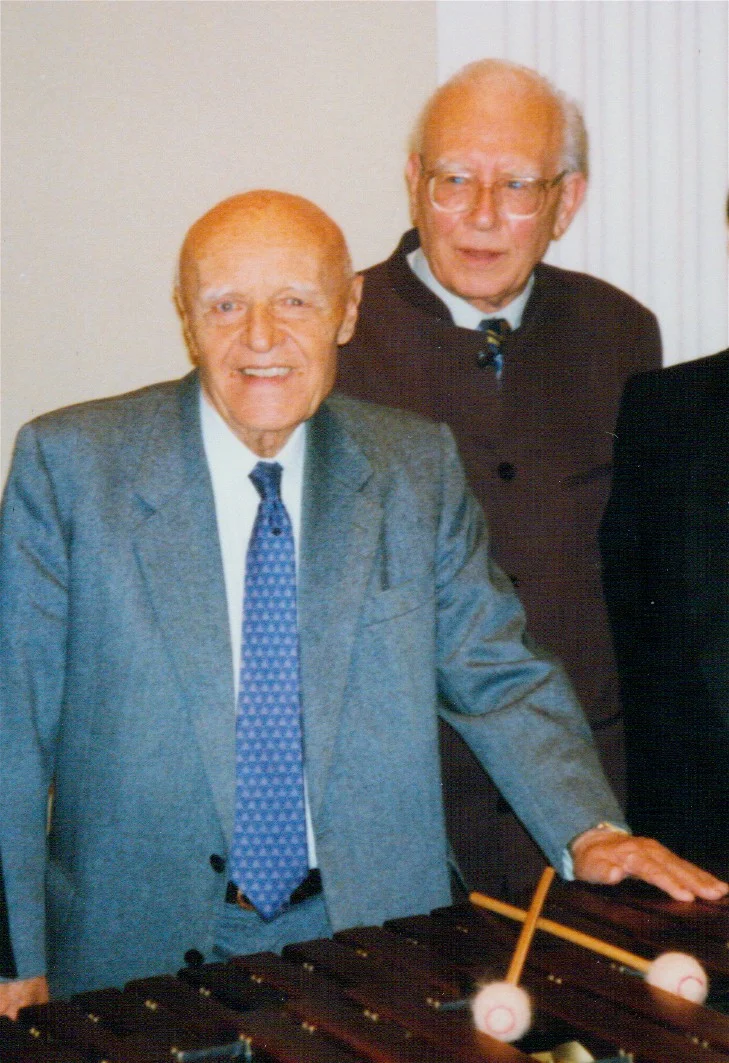
As a former student of Harald Genzmer – I studied under him from 1947 to 1954 in Freiburg im Breisgau – I would like to highlight his universal intellectualism, his agility, his immense erudition across a wide range of disciplines, his deep grounding in literature and the visual arts, alongside his technical mastery of his craft. I would like to speak of his artistic mastery and his tolerance, of his appreciation for the unusual and the substantial, of his eye for the essential, of the rigour of his judgement and, last but not least, of his humanity and the integrity of his character. As a composer, Harald Genzmer has followed – and continues to follow – his creative path unwaveringly, open to, yet critical of, everything happening around him; unimpressed by passing fashions; remaining true to himself and his convictions; and driven by the moral obligation to to express universal truths. On this, his 90th birthday, I wish the esteemed master many more years of unflagging vitality, good health and creative energy.
Bertold Hummel (in a portrait of Genzmer broadcast on 9 February 1999 on Bayerischer Rundfunk.)
What remains decisive is the fact that Bertold Hummel is a talented artist and a personality who has kept a clear head amidst the turmoil of the times.
Harald Genzmer (1 March 1961)
Works by Bertold Hummel associated with Harald Genzmer
- 5 Bagatelles for 6 clarinets, Op. 28 (1965)
- Internet Symphony for large orchestra based on themes by Harald Genzmer, composed by Bertold Hummel, Roland Leistner-Mayer and Moritz Eggert (1999)
Biography
Harald Genzmer is one of the most important German composers of this century. Always sceptical of the dogmas of the avant-garde movements – a view he shares with his teacher Paul Hindemith – he is an artist who advocates music that seeks to speak directly to both performers and listeners. “Music should be vibrant, artful and accessible. As something practical, it should win over the performers; as something comprehensible, it should then win over the listener.” So says Genzmer himself of his approach. Genzmer was born on 9 February 1909 in Bremen. He received decisive inspiration for his artistic path through his encounter with the work of Paul Hindemith, with whom he began studying composition in Berlin in 1928. After extensive involvement in a wide variety of areas of musical life, Genzmer was finally appointed in 1946 as a lecturer in composition at the newly founded University of Music in Freiburg im Breisgau. In 1957, he was appointed Professor of Composition in Munich, where he has lived ever since. Genzmer was and remains a passionate teacher, drawing on an unusual and diverse body of compositional work, an enormous, knowledge of music history imbued with admiration and awe, masterful creative ability and technical compositional skill, as well as a truly astonishing expertise in other disciplines, be it literature, the visual arts or even the natural sciences. Many composers, such as Debussy, Hindemith, Bartók and Stravinsky, have influenced him; yet as a composer he has found his own style, his own language, and has expressed it in an astonishingly wide variety of compositional forms. Indeed, Genzmer’s catalogue of works is unusually extensive, comprising orchestral works, vocal compositions and chamber music for all instruments. What is particularly striking is the significance the genre of the concerto and the concertante style hold for the composer. For Genzmer, it is in the concert form that both the individuality of the performing artist and the distinctive characteristics of the various instruments unfold and reveal themselves most clearly. An admirable understanding of these possibilities, together with a respectful empathy for the task assigned to the musician, are what set Harald Genzmer apart. Added to this are an almost inexhaustible imagination and a vitality in identifying and exploring creative and experimental possibilities, which lend his music its own liveliness and sensuous tonal colour. “The principle of composition is also a service to humanity,” Genzmer once remarked. (Edition Peters)
Prof. Harald Genzmer in conversation with Siegfried Mauser (broadcast on Bayern Alpha on 9 February 1999, 8.15 pm)
Mr Mauser: Ladies and gentlemen, I warmly welcome you to Alpha-Forum. Our guest today is the composer Harald Genzmer. Dear Mr Genzmer, you were born on 9 February 1909, which makes you 90 years old and, in the truest sense of the word, a witness to this century. You have taken an interest not only in music but also in a wide range of cultural phenomena. In our conversation today, I would first like to discuss your artistic development and your life story. Then, interspersed with three musical examples, I would like to turn to your work and your stylistic development. Dear Mr Genzmer, music has shaped your life – and, I believe, from a relatively early age. Did you actually come from a musical family, or from a family that was very strongly oriented towards culture and intellectual pursuits?
Prof. Genzmer: Yes, my mother played the piano well – as an amateur might. But even as a child, I was already familiar with names such as Mozart, Haydn and Beethoven. My mother played the piano, and as a child I would crawl under the grand piano and listen to her. She would play, for example, one of Beethoven’s easier sonatas, and that’s how I took part in it as a child. Of course, at the time I didn’t know whether it was Beethoven, Haydn or Mozart. My father played the harmonium – also just as an amateur plays the harmonium. But he’d had a little tuition in it and also played pieces by Karg-Elert.
Mr Mauser: None of them were professional musicians, though. But there was certainly a very strong fundamental interest in music.
Prof. Genzmer: There was a fundamental interest, both on the part of my mother, who’d had good piano lessons – in the way an amateur could have good piano lessons, that is… My father was actually a lawyer, but he became known for his translation of the Edda. In other words, he was also a Germanist, but back then you couldn’t get a professorship for something like that. So music was something completely natural and taken for granted in my parents’ home; it wasn’t something you had to talk about at all: it was simply done. When my father came home from work, he would play the harmonium.
Mr Mauser: It was part of the atmosphere of the house.
Prof. Genzmer: Yes, it was simply part of the atmosphere at home. We didn’t talk about it much – it just happened.
Mr Mauser: When one studies your biography, one realises that the early years of your life were marked by very frequent changes of residence.
Prof. Genzmer: That was because my father was a lawyer. He was first an assessor in Blumenthal, then in Arolsen, and later in Posen. Then he came to Berlin and subsequently to Rostock. Rostock became important to me because that was where I heard an orchestra for the first time. For me as a child, of course, being allowed to go to an orchestral concert was a tremendous experience. I wasn’t used to such things and didn’t really know exactly what it was all about. To my surprise, I heard Richard Strauss’s ‘Alpine Symphony’ there: That was the first orchestral work I ever heard. Naturally, it made an immense impression on me as a child. I begged and begged, as only a child can beg, to be allowed to go again the following Sunday, because the work was being performed again that day. I went back there again and was completely surprised to find that I recognised every single note. I hadn’t realised at all that I had a talent for music. After all, it wasn’t something we talked about at home.
Mr Mauser: When did you decide to pursue music professionally?
Prof. Genzmer: That came later. As a child, I used to go to organ concerts, which I could get into for free. There I listened to pieces by Bach and Reger. Those were simply the composers you could hear at a church concert. Of course, I also heard *Hansel and Gretel* at the opera, *Lohengrin* by Wagner and *The Tsar and the Carpenter* by Lortzing: I can still remember those, as they were part of the repertoire in Rostock at the time. I went to these concerts full of enthusiasm. But back then, it never even crossed my mind that I would one day make a career out of music. That only came much later. It all started in Marburg. That came about in Marburg because I earned my pocket money by playing dance music. I had a classmate who could play the violin well...
Mr Mauser: Was Marburg your father’s next posting?
Prof. Genzmer: Yes, that was my father’s next posting, because he’d been appointed to the University of Marburg. He later became rector there as well. As I said, I played a lot of dance music there. My parents then realised that I was very interested in music and, for example, attended concerts with great enthusiasm. In Marburg at that time, for instance, the ‘Busch Quartet’ performed, as did Serkin, who played Reger’s Bach Variations and so on especially for me. Those were truly immense experiences for me. I also received excellent theory lessons from the university’s music director, Stephani. I still look back on those lessons with gratitude today, as they enabled me to pass the entrance exam at the conservatoire with ease later on. I was simply very well prepared.
Mr Mauser: You’ve already noticed the extraordinary musical memory you possess whilst listening to the ‘Alpine Symphony’: your ability to retain details and your concentration.
Prof. Genzmer: I was very astonished when I realised this, as I didn’t know it was possible to recognise it. I was completely taken aback that I knew every single note: I knew exactly when this passage was coming, then that one, then an oboe solo, and so on.
Mr Mauser: That was probably a kind of defining moment for you personally.
Prof. Genzmer: Yes, it was a defining moment for me, but I didn’t realise at the time that it was one. I had no idea, because I was as innocent as a child can be – I was perhaps 12 or 13 years old at the time.
Mr Mauser: Berlin became the crucial city for your professional training in the 1920s. Berlin was, after all, one of the world’s cultural capitals at the time, perhaps even the cultural capital of Europe. It was there that you had that decisive encounter, the lessons, the engagement with the music, and indeed the contact with Paul Hindemith.
Prof. Genzmer: Yes, with Paul Hindemith. I’d earned some money playing popular tunes: I earned 1.50 marks an hour every Saturday – that was a lot of money back then. After ten hours, I’d come home at six in the morning with 15 marks, and then, of course, I’d go straight to bed. In any case, that gave me the money to travel to Gießen. I had a few piano lessons with the university’s music director there, and he said to me: ‘Hindemith is coming next week; he’s a very good composer. I think you’ll find that interesting. Why don’t you go and see him?’ As I’d had very good lessons with Stephani, as I’ve said, I was able to read a score – at least a string quartet score by Haydn or Beethoven, and so on. I went along, with the score in my hand, and listened to the performance. Naive as I was as a child, I naturally assumed that all the other members of the audience had a score with them too and would be following along with equal interest. I read the first page with great interest and realised that it was all wrong and different from what I was used to. I was so captivated that I didn’t read any further, but just listened. At the end of the concert, I was of course the most enthusiastic clapper in the hall and shouted “Bravo” and so on: just as a child would react.
Mr Mauser: That was a concert with the ‘Amar Quartet’.
Prof. Genzmer: Yes, that was a concert by the ‘Amar Quartet’. Hindemith himself played the viola there. They also played a string quartet by Schubert and a quartet by Debussy. And by Hindemith himself, they played Opus 22. That is one of the most beautiful string quartets he ever composed. He played the viola marvellously himself. There’s also a lot for the viola in that piece.
Mr Mauser: So you first got to know Hindemith as a performer of his own work.
Prof. Genzmer: Yes, I heard him perform his own works. As I had some money, I bought the sheet music out of sheer curiosity. I bought whatever was available. I also bought a magazine called ‘Melos’, which was published at the time. In it I read the names Bartók, Stravinsky and Schoenberg, and all the others.
Mr Mauser: Hindemith was regarded, particularly in the 1920s, as a musical bogeyman. The String Quartet Opus 22, which you’ve just mentioned, was regarded as one of the pieces in which, as it were, a new musical language and a new world were developed. As a young person at the time, did you have the feeling, when listening to it, that this was a new direction?
Prof. Genzmer: Yes, I realised, of course, that this was something completely different. As I said, I was already familiar with a Reger score. Reger himself had, after all, played the sonatinas on the piano. So these were certainly works I was familiar with at the time. But it was already clear to me that this was something quite different. I was, of course, absolutely hooked on this sort of thing; I bought Bartók’s Piano Suite and played it as best I could. I also played Schoenberg’s Piano Pieces, Opus 19. I was friends with Emil von Behring at the time: he was the son of the famous physician and played the violin very well. We gave a house concert of modern music at Stephani’s. I remember that we played Bartók’s Second Violin Sonata back then: not all the movements, but the first movement. Then we played Hindemith’s Opus 11, the Second Sonata in D major: but only the first two movements of that. I also played Schoenberg’s Piano Pieces, Opus 19, which aren’t that difficult, and two or three movements – I can’t quite remember exactly – from Bartók’s suite.
Mr Mauser: That’s a fine selection of the classics of modern music.
Prof. Genzmer: Yes, but of course I didn’t know any of that at the time. For me, however, they were something very exciting and something I was really engrossed in. Stephani was understanding about it, even though I’d received very good tuition in classical harmony from him. Naturally, he also enjoyed having a young person who was so passionate about these things.
Mr Mauser: How long after that experience in Giessen did it take before you began your studies in Berlin?
Prof. Genzmer: I’d first taken two more semesters at the University of Marburg on the Lahn. That included art history as well. As I’ve already mentioned, I’d also prepared myself in harmony with Stephani – and practised the basics of counterpoint. I did this using *Draeseke*, which was a well-known textbook at the time. Then, if I’m not mistaken, I went to Berlin in 1928. I arrived a little late, in May, to see Hindemith, because I’d been ill, and he said to me – I still remember this exactly: “Listen, there’s one thing I must tell you straight away: I don’t do modern music here; here, we work properly!” I said, quite astonished: “But that’s precisely why I’ve come to you.” “Oh, I see,” he said, “well then, everything’s fine.”
Mr Mauser: What were the composition lessons like there?
Prof. Genzmer: To begin with, we simply carried on working on counterpoint, in a class that also included students taking the subject as a minor. Hindemith, of course, soon realised that I was gifted and interested in composition. I joined the composition class perhaps a year later. There was also a pupil of Zoltán Kodály in the class. Wittelsbach, who was studying piano with Schnabel, was in the class too. He would later become director of the music school, or rather the conservatoire, in Zurich. So there was already a group of young people there…
Mr Mauser: So you weren’t admitted to the composition class straight away, but rather you…
Prof. Genzmer: That’s right; first of all, you had to work properly on counterpoint. I did the set exercises for that, and Hindemith noticed that I was also doing free compositions: I didn’t just do abstract four-part counterpoint, but perhaps for violin, clarinet, viola and cello, or something similar. I did that of my own accord. Hindemith then realised that I was interested in that sort of thing. As a result, I was admitted to the composition class.
Mr Mauser: Two things are, I believe, particularly important in your music. Firstly, the instrument is always taken into account in a fundamental way. Your music, as far as I know it, is always specific to that instrument, in terms of timbre and playing technique. And there is a distinctive quality to it: your pieces always have a very specific character, rooted in a particular style and a particular expressive approach. Perhaps we should now play a short piece at this point to get a sense of the sound. I would suggest that we start by listening to a piece which has a title, namely ‘Meditation’: it is the first piece from the Studies composed in 1965.
Prof. Genzmer: Yes, that was 30 years ago. (Mr Mauser plays Harald Genzmer’s *Studies for Piano for Two Hands, Book II, Meditations*)
Mr Mauser: We recorded this expressive piano piece before our conversation. As you’ve already mentioned, that was over 30 years ago. Nevertheless, it is a typical Genzmer piece, for another defining feature of your musical language and your compositional approach is certainly the great consistency that pervades your entire body of work. Ultimately, like many significant composers, you have remained true to yourself. What you compose today also stands in a certain context with the musical language that existed for you 30 years ago. When, in fact, did you feel that you had found your own musical language, so that you could say you were a composer and had something unique and special to say?
Prof. Genzmer: To begin with, it’s something very simple. When I was a student, I was not only a pupil of Hindemith, but also of Curt Sachs. Curt Sachs was that eminent instrumentologist who, sadly, had to leave in 1933. I simply have him to thank for introducing me to the various instruments. I also had lessons – very good lessons, in fact – on the clarinet. So that means I was familiar with the wind instruments as well. If you can play the clarinet, you soon get to grips with the saxophone and the other woodwind instruments too. I could also play the recorder. For example, I gave the world premiere of Hindemith’s trio together with Hindemith himself in Plön at the Music Festival.
Mr Mauser: And we mustn’t forget the piano.
Prof. Genzmer: I took piano lessons with Rudolf Schmied. That piece you’ve just played, with those hesitant, plaintive chords: I wanted to use it as a model for writing piano pieces that aren’t too difficult, but are also accessible to an amateur who wants to engage with modern music. You certainly played that very beautifully, but it’s also something an amateur who is interested in modern music and can play the piano well could play. After all, there are plenty of such pieces.
Mr Mauser: That’s also something you share with your teacher Hindemith: on the one hand, demanding, virtuosic concert music, and on the other – which by no means need to be mutually exclusive, but might even complement each other fruitfully – music for the enthusiast, for the amateur and also for children, who are, after all, meant to grow into a new musical world. For you, that was never really a problem or a source of tension; rather, it was something that naturally went hand in hand.
Prof. Genzmer: There were reasons for that. After completing my studies, I went to the opera house in Breslau. There I was initially a répétiteur and later a production manager. A production manager is someone who, so to speak, has to look after the entire behind-the-scenes operation. I was also a jack-of-all-trades when it came to the orchestra. I played the organ, harmonium, celesta, piano and harpsichord – in short, every kind of keyboard instrument there was. Often, you only found out in the morning what you were due to play that evening. I remember, for example, that I was once asked to play the celesta in Richard Strauss’s *The Legend of St Joseph*. I didn’t know that piece by Strauss at all. But nobody asked you about that: either you could do it, or you couldn’t – and if you couldn’t, you were of no use. Naturally, I had a look at the score; I sat down at the celesta that evening and played it. And suddenly I realised I had a big solo to play. Of course, at a moment like that, it’s very much a matter of nerves – just carrying on playing without letting on. The whole orchestra was naturally looking at me, thinking: ‘Well, let’s see how he gets on with that!’ As it worked – and worked well, at that – I was, of course, well received. I also became director of studies partly because I was quite simply useful to the institute. I was, for example, quite adept at the piano; that is to say, I could more or less play a piano reduction by Richard Strauss sight-reading. I wasn’t a solo pianist like you, Mr Mauser, but I was reasonably adept at the piano, so I was able to help myself in that regard.
Mr Mauser: That’s something your pupils always particularly appreciated – we’ll come back to your teaching skills later – the fact that you had, as it were, everything at your fingertips from the entire traditional repertoire, either from memory or ‘en passant’ when the sheet music was laid out. I remember that very clearly. However, after studying with Hindemith, your career initially took you, as a director of studies, down the path of what might be called a ‘practical musician’. How did this early career at an opera house or theatre relate to your own compositional ambitions? After all, you wanted first and foremost to be a composer.
Prof. Genzmer: I really did want to become a composer. Of course, I also wrote theatre music for the theatre, because they realised I was useful for that: for example, incidental music for *The Prince of Homburg*, which I naturally conducted myself and which was then performed thirty times. I also composed stage music for other plays, which are of little interest today. Back then, of course, nobody asked what instruments I wanted to use. Instead, it was all about what was available. I remember, for example, *The Prince of Homburg*: two horns, two trumpets, two trombones, a bass tuba and a percussion section. I simply had to write stage music to suit that. Either you can do it, or you can’t. No one asked about it afterwards. Of course I could do it; it wasn’t a problem for me at all. I also remember that a colleague pointed out to me at the time that there was a society for musical performance rights – it was called STAGMA back then – because I had no idea about such things. Hindemith had never mentioned anything of the sort either. I went there and said that this stage music had already been performed thirty times. Whereupon I was told that I could join the society. That was the first time I’d ever been to that organisation. I’d also taken an interest – whilst still in Berlin – in Oskar Sala. Oskar Sala had, of course, developed the Trautonium together with Professor Trautwein. And many of the sounds you’ve just played in the piece were inspired by sounds that can be produced on the Trautonium.
Mr Mauser: Perhaps we should explain that in a bit more detail, as our viewers may not be so familiar with it. Strictly speaking, you were also a pioneer in the development of electronic music. After all, the Trautonium was one of the first electronic instruments. Together with Hindemith, you were one of the first composers to write pieces for this innovative instrument. Back then in Berlin, within that circle, there was certainly a spirit of discovery, a quest for new soundscapes and quite unusual things, as an alternative to traditional instruments. I think that must have been a profoundly formative experience in terms of one’s consciousness.
Prof. Genzmer: Naturally, I was very interested in this. I was friends with Sala. We were the only guests allowed to visit Hindemith at his flat. We often discussed such matters there: what was possible, and how one might develop such an instrument. Hindemith also frequently advised Professor Trautwein. The Trautonium is an instrument with strings that can be tuned in different ways. It can be played from the highest to the lowest registers. At the time, it was a sort of violin that extended down to the level of a double bass. I had already written various pieces for Sala back then in Breslau. I then moved to Berlin, where I finalised the first Trautonium concerto; thankfully, as Sala had turned his attention more towards film music, this has been preserved on record: there is a CD featuring this concerto. The piece was performed to great acclaim at the ‘Berliner Philharmonie’. The artistic director of the ‘Berliner Philharmonie’ was very supportive, and Schuricht, of course, conducted the performance superbly. Sala had been a true virtuoso. He had already been performing piano concertos with an orchestra whilst still at school. As a schoolboy! He played it really superbly back then. Naturally, that caused quite a stir, and it was with this piece, as they say, that I first made a name for myself.
Mr Mauser: Was that a work which also played an important role in terms of raising your profile?
Prof. Genzmer: It was performed in a great many cities back then. Once the Third Reich was over, it was performed again. In 1952 I composed a second piece, a piece for the Mixtur-Trautonium, which also contained novel sounds that could no longer be notated. It’s on the other side of this CD, so that people can still get a feel for this piece today. It was very well premiered at the time by ‘Südwestfunk’, with Rosbaud at the podium. This piece was also performed in many other cities, for example at the ‘Berliner Philharmonie’, where Sawallisch conducted it. So conductors like that were championing it back then. Sala then turned his attention to quite different things: he was so fascinated by this new world of sound that he devoted himself mainly to film. Later on, for Hitchcock’s *The Birds*, he created a kind of new world of sound, because it was no longer music in the conventional sense.
Mr Mauser: Today we call that a ‘soundtrack’. Looking back over your work – we have now inevitably and seamlessly moved on to the composer Genzmer, who is of course linked to your life story – one has to conclude that, as was also the case with your teacher Paul Hindemith, you are one of the few universalists amongst composers. You have composed music for almost every genre and every combination of instruments: there is also orchestral music and, in many cases, concertos. Only one genre is missing – and this strikes me as particularly surprising, given that you were particularly involved with this genre at the start of your professional career, namely opera. Why is there no opera by Harald Genzmer?
Prof. Genzmer: I cannot answer that for you. You know, one always knows very little about oneself; I’ll say that quite openly. Perhaps there is no opera because I haven’t found a subject that would have really interested me. I’ve often been asked why I don’t write an opera. I’ve also been encouraged to do so on several occasions, but I’ve never been able to bring myself to write a proper opera. I did once write a little dance piece, and so on. But I’m quite simply not cut out for opera: it’s a different world. A contemporary composer such as Hans Werner Henze, for example, writes operas because that is quite simply his world. But that is not mine. Henze, of course, also writes pieces for concerts and symphonic works. Richard Strauss is, of course, the famous example of a man who wrote magnificent operas, as well as magnificent symphonic works – but very little chamber music.
Mr Mauser: Instrumental music is your own field, although you’ve also composed wonderful choral and vocal works. Your literary inclination is, of course, a very important factor here, one that lies in the background. Nevertheless, instrumental virtuosity – in both the lyrical and the dramatic – is something quite characteristic of you. Perhaps, as our second audio example, we might now listen to a short and typical virtuoso piece by Harald Genzmer. We’ll hear a Presto from the ‘Dialogues’ of 1963, which we also recorded here before our conversation. (Mr Mauser plays Harald Genzmer’s ‘Dialogues for Piano’, Presto)
Prof. Genzmer: All I can say about this piece is that I simply wanted to write a staccato piece. And you’ve played it marvellously – exactly as I imagined it.
Mr Mauser: This virtuoso two-part texture is actually the principle behind these ‘Dialogues’: an interplay between the two hands, between two voices. Virtuoso two-part writing is also something that greatly interested Hindemith: the transparent texture in which the two voices can be perceived in their distinctiveness and yet in precise relation to one another. I think comprehensibility, audibility and, indeed, the ‘speech-like’ character of the music – the fact that people feel addressed by the music in a human sense and are not overwhelmed by excessive complexity – is surely something that has always played a part in shaping your composing in the background.
Prof. Genzmer: Yes, there is something else to add. I was in Breslau and left Breslau because I did not want to join the ‘brown association’. I then went to Berlin. There, I worked with amateur musicians at the adult education centre and wrote pieces that these amateurs could actually play. For example, for three violins: there’s a collection of pieces for three violins. Or there are also pieces I wrote later, such as the Sinfonietta, which has been performed very frequently. That’s what I learnt back then. You can only learn that by working with amateur musicians. I myself often accompanied Oskar Sala when he played the Trautonium. Back then, there were two gentlemen at the radio station, Bruno Aulich and Willi Stech, who were very interested in this and therefore gave me the opportunity to play there with Sala. I also arranged pieces for Otto Dobrindt, that is, for the light music orchestra – and for the Trautonium and a small orchestra.
Mr Mauser: Alongside your growing success as a composer – both in the fields of education and virtuosity, as well as in the concert sphere – music education was actually the third key area in which you were active, professionally speaking.
Prof. Genzmer: That came later. During the Third Reich, the attitude at the Berlin College of Music – where such a role might have been conceivable – was: ‘He won’t set foot on our premises!’ Once that period was over in 1946, Gustav Scheck – the great flautist who had just founded the conservatoire in Freiburg – asked me if I’d like to join the conservatoire, as he needed a deputy director. I agreed and went there. Whilst there, I also composed all sorts of pieces for Scheck, such as flute sonatas and so on. There was also a flute concerto among them, which Scheck often played. Very good pianists were also brought in there, such as Carl Seemann, who was very supportive of us at the time. I wrote this Suite in C, this virtuoso piece, for him. This actually came about at the suggestion of the French: they didn’t really act like an occupying power, but were culturally interested in us. They behaved in a completely natural, human way and said to us: “Listen, we’re putting on an exhibition of modern painting.” Back then, names that everyone knows today – such as Picasso or Léger, and so on – were still completely new. “Why don’t you write a modern piece for it?” So I wrote this piece in C, which Seemann premiered at that exhibition. And since then, it has been played by many others as well.
Mr Mauser: This brings us to large-scale, virtuosic music – concert music. The Suite in C is one of the virtuoso pieces for piano. You have repeatedly composed important works for the piano. Perhaps we might now listen to the first movement – a slow introduction, moderato and allegro – of the Fifth Piano Sonata from 1985, in which this large-scale concert and virtuoso music is particularly evident and fascinating. (Mr Mauser plays Harald Genzmer’s Fifth Piano Sonata, Moderato Allegro)
Prof. Genzmer: Yes, the composer can only say ‘thank you very much’, because that is exactly how he envisaged the piece.
Mr Mauser: Thank you very much. However, the main focus of your teaching career was in Munich, where you worked for many years as a professor of composition. Did teaching young people actually have an impact on your own composing?
Prof. Genzmer: Yes, certainly. That was the case even aside from that, because I was friends with many colleagues, such as, to name just one representative of many, the organist Professor Lehrndorfer, who premiered most of my organ works, or Professor Höhenrieder, who performed my Suite in C very frequently. There are many other colleagues I could mention here as well. Through conversations with young people, for example, I was inspired to write a Mass that is easy to sing. This Mass was also performed for the first time in Munich at a church concert. The reason for this is that we had been studying the Hindemith Mass. The Hindemith Mass is, admittedly, very interesting and very well composed, but it is so difficult that only a very few choirs are able to sing it at all. I deliberately set out to compose a Mass that could be performed by any good amateur choir and by any organist who can play the organ well – and not just by the great virtuosos. This simply came about through my contact with the students, as I had church musicians from both denominations in my classes. It came about through this contact. The world premiere took place in Vienna.
Mr Mauser: Perhaps as a final question, dear Mr Genzmer, one about the creative process: how do you actually compose? Is the initial idea particularly important, or is it the development? The rhythmic and motoric aspect is, after all, very significant in virtuoso pieces. How does your music come about? Do you make sketches, for example?
Prof. Genzmer: Yes, let me give you an example. I was asked by Ireland to write a piece for the Choral Festival there. I searched for texts for a long time until a friend drew my attention to the poetry collection *The Irish Harp*. I had the collection in front of me and was reading through it until it finally dawned on me that I was going to compose these five pieces. But how was I to go about composing them? I had no idea. I lay down for a while after lunch to rest, and suddenly it came to me – I’d found the style. I already knew exactly how the piece would go. Then I jotted it down very quickly in pencil in a notebook. Over the next few days, it was simply a matter of fleshing it out, which I could do at any time, as I’ve always felt confident in my technical skills. It’s a different matter altogether when you’re writing a piece for a specific instrument. For example, I was once asked to write a piece for bass tuba. The player rang me, and I told him he should write me a letter. The letter was so lovely that I thought to myself: ‘I’d be happy to work with this man.’ So I started by making some sketches for the bass tuba and sent him these ideas. I wanted to write a piece that wasn’t as difficult for the bass tuba as Williams’s famous concerto. I wanted to write a piece that anyone who can play the bass tuba well would be able to play. He then wrote back saying that it was easy to play and that it could even be played faster. But that wasn’t what I wanted at all. And so I simply finished the piece based on the sketches. That’s how this piece for bass tuba came about.
Mr Mauser: Right, so both the inspiration and the development process are of great importance.
Prof. Genzmer: Yes, but that happens subconsciously, because you don’t have control over it. You don’t even know how it happens. You just suddenly have it.
Mr Mauser: Thank you very much indeed for this stimulating conversation, dear Mr Genzmer. Ladies and gentlemen, that was Alpha-Forum. I would also like to thank you very much for listening and watching.