Julius Weismann
26 December 1879, Freiburg im Breisgau – 22 December 1950, Singen am Hohentwiel
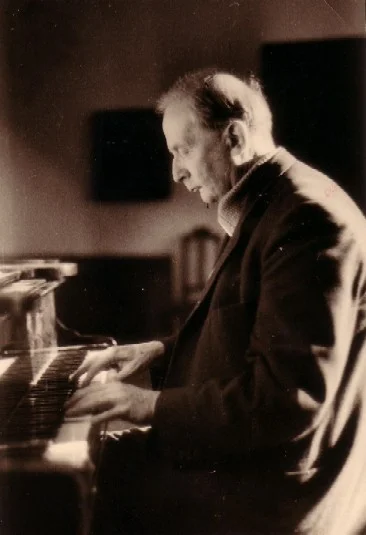
… sent to study under the late Romantic composer Julius Weismann, my compositional instincts soon began to stir; these initially flourished in the late Romantic style, but then gave way to a New Objectivity.
… from a very young age, I took theory lessons with the late Romantic composer Julius Weismann, to whom I have many personal memories. 8 November 1964
… it was under the late Romantic composer Julius Weismann that I took my first tentative steps in composition whilst at school. 1974
... What captivated me about my teacher Julius Weismann was his impressionistic musical imagination, as well as his harmonic richness and formal diversity. 12 July 1981
Bertold Hummel
Dedication on the portrait photograph: “In memory of the Julius Weismann Memorial Evening on 23 February 1951”. On the reverse of the photograph, the Weismann family thank Bertold Hummel for his participation as a cellist at the Freiburg concert. The programme included, amongst other works, Weismann’s String Quartet in A minor, Op. 133, and the “Tagore Songs” for alto and piano trio, Op. 67.
Julius Weismann – His Life
Julius Weismann was born in Freiburg on 26 December 1879, the son of the famous zoologist and geneticist August Weismann, a professor at the University of Freiburg and the founder of neo-Darwinism. As he was frequently ill during his youth, he was educated by private tutors and by his father. At the age of just eleven, from 1891 to 1892, Julius Weismann took lessons in composition and counterpoint in Munich with Joseph Rheinberger, a Liechtenstein native regarded as conservative. From 1893 to 1895, he took piano lessons in Freiburg with Hermann Dimmler, a pupil of Liszt; this was followed by language studies in Lausanne (1896–98), and for one semester (1898/99) he studied in Berlin – yet he was put off by the “musically arrogant, academically pretentious – and Brahms-influenced – atmosphere” (Weismann) under Friedrich Stumpf and Leopold von Herzogenberg. The following three years with Ludwig Thuille, Rheinberger’s successor in Munich, furthered Weismann’s development, but they also reveal his pronounced tendency to go his own way: “It is strange that I so often grew closer to those people with whom I came into contact through my love of the mountains – music, on the other hand, usually acted as a dividing force, and I avoided those circles more often than I sought them out. Had I not found such a warm welcome in my future wife’s family, I would probably have been very lonely. In Thuille’s circle, there was but one supreme god, namely Richard Wagner – and two living gods: Max von Schillings and Ludwig Thuille! What was a ‘classical’ person like me to make of that! Despite my genuine enthusiasm for Thuille’s opera *Lobetanz* and his wind sextet, I soon sensed a rift opening up that would separate me from the ‘Munich School’. Nevertheless, I worked diligently under Thuille. To many later critics of my music, I seemed to belong to the Munich School. A great mistake! Admittedly, after a while my music did bear some of its traits – but far more through the supreme god Richard Wagner than through the lesser gods!”
In 1902, Weismann married the concert singer Anna Hecker and settled in Munich as a freelance composer – perhaps one reason why he wrote so many solo songs with piano accompaniment during his early creative period. In 1906, he returned to his hometown of Freiburg and also worked as a pianist and conductor. The 1920s became the most productive period of Weismann’s life: five of his six operas were composed within ten years. He had made his breakthrough. In 1929, he became a member of the Prussian Academy of Arts and, a year later, was awarded its Beethoven Prize. In 1930, Weismann founded the Freiburg Music Seminar together with Erich Doflein, which evolved into the Freiburg University of Music after the Second World War. There he taught composition and led the masterclass in piano. In 1939, he was made an honorary citizen of Freiburg and received the Leipzig Bach Prize. However, in the same year he moved to Nussdorf (near Überlingen) on Lake Constance and gave up teaching two years later. Weismann, who was in any case a rather shy loner, albeit warm towards his friends, gradually withdrew from public life. The final years of Weismann’s life were characterised by illness borne without complaint, scepticism, but also by diligent composing and numerous private concerts amongst his closest circle of friends, right up until his death in 1950. On 22 December 1950, shortly before his 71st birthday, Julius Weismann died in Singen am Hohentwiel.
Stylistic Position
Julius Weismann’s body of work is as extensive as it is multifaceted: it extends to Opus number 157a (though there are numerous works without an opus number), and it encompasses (apart from sacred music) virtually every musical genre – from operas, incidental music, choral works and lieder, through to symphonies, concertos and piano pieces of all kinds, right up to chamber music, which occupies a central place in his oeuvre and provides the key to understanding his entire body of work. A catalogue of his works is available from the Julius Weismann Archive in Duisburg.
There are two reasons for Weismann’s impressive and sustained productivity: until 1930 and from 1941 onwards, he was able to concentrate on his work largely unhindered by official duties, as he worked as a freelance composer, pianist, conductor and song accompanist. His sketchbooks, which he took with him on every walk, show that Weismann fluently jotted down the ideas that came to him whilst out in the open air. He composed without a piano, relying on what was evidently an outstanding inner sense of sound and a fully formed internal conception.
This abundance and diversity also presents a challenge when it comes to classifying his work stylistically. The pianist Franzpeter Goebels has attempted to categorise Weismann’s piano works as follows: up to Op. 68 (1917), he identifies a ‘Romantic’ or ‘naive’ phase, influenced by Schumann. From Op. 76 (1918/20) to Op. 87 (1923), ‘the influence of Debussy becomes apparent’ through the differentiation and concentration of the harmony and compositional techniques. From Op. 93 (1926) to Op. 109 (1931), according to Goebel, “constructive features streamline the form”; he sees “a kind of new music emerging” and the “polyphony becomes harsher”. He dates the beginning of Weismann’s late style—which is characterised in particular by contrapuntal thinking and a turn towards Bach—from Op. 114 (1933/34), but adds: “One is, however, reluctant to periodise such a multi-layered body of work in this sense. The transitions are fluid, and each individual work demands to be heard and understood in its own right.” Attempts to categorise Weismann’s work can be found throughout his career. As early as 1907, Thomas-San-Galli remarked (on the Symphony in B minor, Op. 19): “If we were to cite historical parallels, we might find echoes of Schumann here and there. Now and then, Brahms also passes by in indistinct outlines. Weismann’s true affinity, however, lies with Franz Schubert.” Alexander Berrsche, the doyen of Munich music criticism, highlights in Weismann “the gift of a rich, carefree imagination” and “the ease with which he always commanded it”. Adolf Weißmann, one of the most significant Berlin music writers of his time, also mentions Julius Weismann in his book *Musik in der Weltkrise* (1922): “And now one could list a long series of those who, in various ways—some of them straying from the fractured path of modern art—are seeking solutions. … Julius Weismann is hard at work, seeking a style somewhere between the Brahmsian and the modern, but in any case one that is coherent … He is no revolutionary, but rather an outsider who, particularly in his chamber music works, professes a reserved nature.” (p. 232)
Richard Wagner’s grandson, Wieland Wagner, who looked after Weismann intensively towards the end of his life, saw Weismann’s music as ‘… rooted in the realm of the metaphysical; he regards himself merely as a mediator of a gift which he receives in a moment of divine inspiration. The most modern harmonies, wandering in the borderlands of tonality, blend organically with the relentless rigour and devout humility of the musical conception.”
After the Second World War, interest in the latest musical developments was so great that, in Germany, composers who did not follow in the footsteps of Hindemith, Stravinsky, Schoenberg and Webern were dismissed as “conservative”. There was little room for individualists such as Julius Weismann. Furthermore, when the first catalogue of his works was published in 1955, his output was scattered across 20 different publishers, and a large proportion of the compositions existed only in manuscript form. Yet the time is long overdue for a rediscovery of Weismann’s music. In 1954, at the instigation of Wieland Wagner, the Julius Weismann Archive was founded in Duisburg. Weismann’s manuscripts, sketchbooks and other materials from the archive were transferred to the Duisburg City Library in 1981 on permanent loan. And from its base in Duisburg, the archive’s office is committed to promoting Weismann’s work.
Gerd Rataj (Published with the kind permission of the MDG label www.mdg.de)