Emil Seiler
5 February 1906, Nuremberg – 21 March 1998, Freiburg im Breisgau
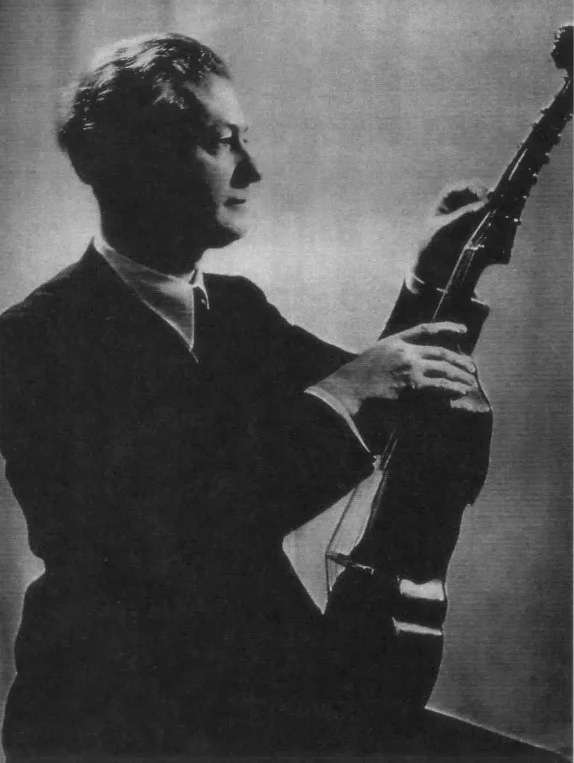
From 1947 to 1954, Bertold Hummel attended chamber music classes with Emil Seiler at the Freiburg University of Music. Seiler encouraged him to focus his talents as a cellist on chamber music rather than virtuosity. Hummel performed with Seiler in public concerts and accompanied him as a continuo player on radio recordings. The two musicians remained on warm terms until Seiler’s death.
In Memoriam: Prof. Emil Seiler
by Kai Köpp (Freiburg)
An era has come to an end. With the death of Emil Seiler on 21 March 1998, we lost a man who, like almost no other, embodied the history of the viola and the viola d’amore in the 20th century. His interest in new music proved to be pioneering, and his contributions to early music are invaluable. Alongside his recordings of contemporary music, it was particularly his more than 16 records of early music released by Deutsche Grammophon that, from the 1950s onwards, made music for the viola d’amore accessible to a wider audience for the first time.
Emil Seiler was inspired not least by Paul Hindemith, who, from 1929 onwards, had inspired him with new compositions for the viola and his experiments with the historical instruments from the Berlin Instrument Collection. As early as 1938, in his doctoral thesis on the viola d’amore, Werner Eginhard Köhler highlighted Emil Seiler’s contributions as an advocate of the viola d’amore and, with regard to Hindemith and Seiler, whom he mentions subsequently, writes:
“Artists of the younger generation… have worked zealously to revive the art of playing the viola d’amore and have rendered a particular service by making the valuable old original repertoire – which still awaits evaluation and publication in libraries – accessible to a wider audience.”
A well-known photograph shows Hindemith and Seiler during a performance at the Musical Instrument Museum, in which both are playing so-called ‘treble violas’ or viole d’amore without resonating strings.
Information on Emil Seiler’s biography can be found in Harry Danks’ book on the viola d’amore (Halesowen 1976, p. 102) and in Maurice Riley’s first volume of his *History of the Viola* (Ann Arbor 1980, p. 360). Nevertheless, it seems appropriate to devote our special attention to the life’s work of this distinguished man. Drawing on the material provided by his widow and daughter – which also includes an autobiographical sketch – we shall therefore trace a detailed account of Emil Seiler’s life.
1. Musical Education
Emil Seiler, born on 5 February 1906, grew up in a music-loving family in Nuremberg. At the age of 8, he received his first violin lessons from members of the Nuremberg City Orchestra. It is interesting to note that his first teacher, Mr Vibrans, actually played the first horn in the orchestra. However, the lessons must have been so good that Seiler later received violin lessons from the first concertmaster, Jean Wagner, and was even allowed to play alongside his teacher at the concertmaster’s desk during the Nuremberg Orchestra’s children’s performances. The lessons with Wagner consisted largely of duo repertoire: Mozart, Pleyel, Mazas, Spohr, etc.
After completing a three-year apprenticeship in banking, Emil Seiler began his music studies at the Nuremberg Conservatoire in 1925 under Seby Horváth, a pupil of Albert Rosé. Seiler soon became his favourite pupil. According to Seiler, the lessons comprised Sevcik’s bowing and fingering techniques, as well as études by Klatt, works by Bach and the sonatas by Grieg and Pfitzner. Horváth also nurtured Seiler’s emerging talent for teaching by allowing him to teach his own son. Seiler remarks on this in his memoirs: “The joy of teaching will remain with me until the end of my life.”
Every week, under Horváth’s guidance, there were class sessions devoted to chamber music, during which Emil Seiler played the viola in a string quartet. Working on Zoltán Kodály’s Trio for Two Violins and Viola became an unforgettable key experience for him. With this work, Horváth not only sparked Seiler’s interest in new music but also his love for the sound of the viola, and Seiler writes, “From then on, it became my very own instrument.”
In 1928, Emil Seiler continued his studies at the Berlin Academy of Music under Prof. Joseph Wolfsthal, who was only 30 years old at the time and had been a pupil of Flesch. Consequently, he had to relearn the Flesch system, moving away from the Viennese Rosé technique. Wolfsthal’s assistant, an elderly lady named Schiemann, helped him with the transition through daily practice sessions. Seiler was particularly moved by the works of modern music which he studied with Wolfsthal (Hindemith, Milhaud, Stravinsky), but his teacher also encouraged him to play Bach’s works according to the original. During this time, Emil Seiler, like almost all of Wolfstahl’s pupils, was a member of the Michael Taube Chamber Orchestra and played in the chamber orchestras of Hans von Benda and Edwin Fischer.
In 1929, Prof. Wolfstahl had Emil Seiler prepare Paul Hindemith’s Viola d’amore Sonata – Hindemith was a professor of composition at the Berlin Academy of Music – and thus introduced him to the composer. This led to an intensive collaboration, particularly in the field of early music, for in the years that followed, Seiler gave numerous concerts as Hindemith’s chamber music partner, with Biber’s Partita in C minor for two violas d’amore regularly forming the centrepiece of these performances. Under the guidance of Curt Sachs, Emil Seiler had the opportunity to learn to play the viola d’amore, viola pomposa, various other viols, the pochette and even the nail violin on original instruments. These instruments came from the former royal collection of musical instruments, which at that time was still part of the Berlin University of the Arts in Charlottenburg and today forms the centrepiece of the Berlin Instrument Museum. (Unfortunately, however, the viola d’amore instruments in particular have not survived to this day, as they went missing during the evacuation in the war and were probably destroyed.) Sachs also produced a film about early instruments at the UfA, in which Seiler took part.
Subsequently, Hellmuth Christian Wolff invited him to demonstrate the viola d’amore at the University of Berlin and enabled him to consult and copy old manuscripts containing viola d’amore literature at the State Library. On this occasion, Emil Seiler also met Vadim Borissowsky, with whom he formed a lasting friendship and whom he visited in Moscow in September 1971.
In February 1932, the violinist Joseph Wolfstahl fell ill with pneumonia whilst on a trip to America and died, aged 34, whilst still travelling. Following the sudden death of his violin teacher, Emil Seiler continued his studies with Prof. Hans Mahlke in Berlin, under whom he now studied the viola exclusively. When, half a year later, Emil Seiler performed a solo sonata by Hindemith and Milhaud’s Viola Concerto, Op. 108 – dedicated to Hindemith – at his final examination, he was met with derisive remarks about his commitment to new music; for in 1932, a year before the National Socialists seized power, ultra-conservative musical views had also gained ground in Berlin. At that time, no one could have imagined that Emil Seiler – not least because of his advocacy of Hindemith’s works – would one day succeed his teacher Mahlke at the University of the Arts in West Berlin.
2. New and old music in Nazi Berlin
After 1933, ‘bitter times’ (Seiler) ensued: the Prenzlauer Berg People’s Music School, where Emil Seiler and the composer Harald Genzmer taught and where Hindemith gave lectures, was closed down immediately. Many leading figures in musical life went abroad: Klemperer, Ullstein, Richter, Fuchs, etc. On Hindemith’s recommendation, Emil Seiler taught Otto Klemperer’s son and Ullstein’s daughter. Curt Sachs, too, had left Germany and was now working in Paris on his “Anthologie sonore”, a collection of records featuring examples from 2,000 years of music history. It was in this context that, around 1935, Sachs planned a recording of Biber’s Partita with Hindemith and Seiler on the viola d’amore. It is regrettable in many respects that this recording never came to fruition for political reasons, as it would have been an extremely valuable audio document of those pioneering achievements in Berlin in the field of the viola d’amore.
At the time, Hans Mersmann was preparing radio programmes featuring new chamber music for Deutschlandsender Berlin in collaboration with Hindemith and Seiler. In 1933, however, he was dismissed from the Technical University of Berlin because of his commitment to new music. In his final programme, which Mersmann was only able to follow from outside as a member of the audience in 1934, Emil Seiler performed Paul Dessau’s Sonatina for Viola and Piano and Paul Hindemith’s Heckelphon Trio. A few months later, Hindemith was banned from performing by the National Socialists. Of all the recordings in which Seiler had taken part, he collected the unique copies which he had received from the radio station on records.
From 1935 to 1943, Emil Seiler was the principal violist in the newly founded orchestra of the Deutschlandsender Berlin. For the first three years, Walter Trampler (died September 1997) played as the second principal violist alongside him under the baton. Outstanding conductors included: Richard Strauss, Herbert von Karajan, Hans Rosbaud, Carl Schuricht, Willem Mengelberg, Clemens Kraus, Karl Böhm, Oswald Kabasta, Robert Steger and Rudolf Schulz-Dornburg. In addition, Emil Seiler taught at the Klindworth-Scharwenka Conservatoire from 1935 to 1943 and at the Academy for Church and School Music in Berlin from 1940 to 1943. From 1941, Seiler was also responsible for chamber music at Deutschlandsender Berlin. The programmes he played were mostly limited to Baroque chamber music featuring the viola d’amore, as new music was not broadcast.
Nevertheless, Emil Seiler continued to perform new compositions, for example at regular house concerts held at the home of the ‘degenerate’ painter Emil Nolde in Berlin, which were organised by Nolde’s wife together with the pianist Mrs Tscharner. He also took part (1942–43) in the three-week series of Sunday matinees at the Berlin-Charlottenburg Music Library, where new chamber music was performed. Together with the pianist Edith Picht-Axenfeld, he performed works by Harald Genzmer, Johann Nepomuk David and Cäsar Bresgen.
3. Happy years in Austria
In 1943, the first bombs fell on Berlin, and the Seiler family’s flat was destroyed. Owing to the unrest caused by the bombing campaign, the radio’s special department for early music, which Seiler headed, was relocated to Austria. For the move to the Bruckner-Stift St Florian near Linz, Emil Seiler selected the following musicians: Walter Gerwig (lute), Lisedore Häge (harpsichord), Thea von Sparr and Werner Tietz (recorder). In his memoirs, Seiler emphasises that none of his fellow musicians were members of the National Socialist Party. Emil Seiler was criticised by Reich Intendant Glasmeier for his hostile stance towards the party.
During this period, numerous recordings of early music were made, particularly for the Deutschlandsender Prague. However, new music was also promoted. The composer Johann Nepomuk David, whom Seiler knew from performances of his works in Berlin, had moved from bomb-ravaged Leipzig to his birthplace, Eferding near Linz. He visited Emil Seiler on several occasions at the Bruckner-Stift, as he himself had been a choirboy at St Florian in his youth. Whilst listening to the early music, he remarked: “I too shall write early music, but in a completely different way.” He dedicated his Solo Sonata for Viola, Op. 31 No. 3, to Emil Seiler and composed further works for the musicians associated with Seiler (Sonata for Lute, Op. 31 No. 5, Duos, Op. 32, for flute and viola, recorder and lute, and clarinet and viola). He also composed for Seiler the Duo Sonata, Op. 31a, for viola d’amore and viola da gamba (1942), as well as the Variations on a Theme of His Own, Op. 32 No. 4 (now Op. posth.), for the same instrumentation (1945).
In connection with David, Seiler recounts in his memoirs an interesting incident that was also a source of amusement in St Florian: in the 1940s, the authorities in Germany found it objectionable that Johann Nepomuk David, as director of the Leipzig Academy of Music, bore an Old Testament name. Consequently, the Lord Mayor of Leipzig strongly urged the composer to drop his name and instead adopt that of ‘Richard Wagner, so greatly revered by Hitler’. It hardly needs mentioning that the Austrian David rejected this proposal.
Three weeks before the end of the war, Seiler, Gerwig and Tietz were conscripted into the military in Linz, the so-called ‘Volkssturm’. Werner Tietz, who was engaged to the harpsichordist Lisedore Häge, was killed in the final days of the war. Emil Seiler was taken prisoner by the Americans and was released shortly afterwards, suffering from a serious illness. On his return to St Florian, which the Americans had by then occupied (they called it the “Happy Abbey”), he found that the radio recordings of his chamber music programmes – including works by Stravinsky and Hindemith – were no longer there. Seiler’s search for his precious audio recordings remained unsuccessful in the years that followed.
4. As a professor in Germany
From autumn 1945, Emil Seiler was under contract as principal violist in the Mozarteum Orchestra in Salzburg. Here he met Johann Nepomuk David, who had by then become director of the Mozarteum. In Salzburg, Emil Seiler once again devoted himself to new music for the viola, which had been suppressed during the Third Reich. Thus, eleven years after the ban on performances of Hindemith’s works, Emil Seiler was the first to perform one of his compositions again on German radio: in 1946, as principal violist of the Mozarteum Orchestra, he performed the ‘Schwanendreher’ from Hindemith’s handwritten parts, as no printed material was available in Austria. A few weeks later, he followed this with Walton’s Viola Concerto.
At Christmas 1946, all Germans were expelled from Austria, and Emil Seiler travelled via Munich and Nuremberg to Freiburg. There, in 1946, he initially became a lecturer at the Freiburg University of Music, before being appointed professor of viola, viola d’amore and chamber music in 1947. Within the chamber music circle centred on the conservatoire’s director, the flautist Gustav Scheck, he once again devoted himself to both new and early music (concert tours featuring the Debussy Trio and solo sonatas by Reger and Hindemith).
From February 1955, Emil Seiler accepted a post at the Berlin University of the Arts as the successor to his former teacher, Prof. Hans Mahlke. There, he sought to recapture the spirit of his own student days in Berlin. In the college’s instrument collection, Emil Seiler discovered a replica of Hindemith’s viola d’amore, which had also been made by Sprenger. He remarked: “Hindemith was very fond of playing the Sprenger viola d’amore, as it held its tuning very well.” In the conservatoire’s archive, he discovered Hindemith’s written estate, containing many copies of works for the viola d’amore and other historical instruments. Seiler’s list, compiled from memory, reflects the repertoire of those pioneering endeavours in Berlin in the field of the viola d’amore: Petzold: Suite for Viola [d’amore] solo Ariosti: at least 3 sonatas for viola d’amore and continuo Biber: 1st Partita for 2 violas d’amore and continuo 2nd Partita for 2 violins and continuo; Rust: 2 sonatas for viola d’amore and piano; at least 6 sonatas for violin and basso continuo by Biber (which Hindemith had frequently performed in concert); Stamitz: Duo Sonata (viola d’amore and violin) Since the 1950s, more than 16 records of early music have been released in the ‘Archiv’ series of Deutsche Grammophon, which have been awarded the ‘Grand Prix du Disque’, amongst other honours. This made music for the viola d’amore accessible to a wider audience for the first time. In addition, 11 records featuring viola music were released by Elektrola and three recordings by Colosseum, on which Emil Seiler plays the original musical instruments from the Germanisches Nationalmuseum in Nuremberg. Even before the war, Emil Seiler had recorded his first record as a viola soloist in Hector Berlioz’s tone poem ‘Harold in Italy’.
Some of his numerous pupils were inspired by Emil Seiler to take up the viola d’amore. Alongside his intensive teaching activities, Seiler devoted many years to working with the Berlin String Quartet, with whom he undertook extensive concert tours abroad. The other members of the quartet were the violinists Rudolf Schulz and Willi Kirch, and the cellist Lutz Walther.
Seiler’s handwritten list of works dedicated to him comprises 13 compositions for viola; Seiler makes no mention of any works for viola d’amore, not even the compositions by David mentioned above. It is possible that another list exists containing compositions for viola d’amore to which he is the dedicatee. The viola list is reproduced here in full:
David Solo Sonata Frank Mich. Beyer Sonata for Viola and Organ Genzmer Sonata for Viola and Piano Tiessen Blackbird Calls for Viola and Piano Hannenheim (pupil of Schönberg) 1st Suite for viola and piano by Theodor Wagner; *Lamentatio* for bass and piano by Wilh. Keller; *Psalmenweisen* for bass and piano by Konr. Roetscher; *Triptychon* for bass and piano by Gottfried Müller; *Canzone* for [bass and piano] Tiessen: *Ophelia* for viola and piano; Ahrens: Sonata for viola and organ; Bertram: Sonata for viola and organ; Gotthold Ludwig Richter: 3 Pieces for Viola and Organ, ‘Es ist genug’
In 1974, Emil Seiler retired and ceased to perform in public. He moved to Freiburg, where he founded the “Pflüger Foundation” music nursery, designed to introduce children to playing the violin through play from an early age. Following the reorganisation of the Pflüger Foundation in 1977, Emil Seiler withdrew from the organisation and has since led a secluded life in Freiburg.
Emil Seiler attended the 1988 International Viola d’amore Congress in Stuttgart as a guest of honour of the ‘Viola d’amore Society of America’. A separate presentation was dedicated to his contributions to the instrument. On 5 February 1996, he celebrated his 90th birthday and received honours from the City of Freiburg, the Berlin Senate and the Viola d’amore Society.
Emil Seiler lived just a few minutes’ walk from the author’s flat in Freiburg; over the past six years, the author had the good fortune to have many stimulating conversations with him and even to receive a few lessons from him. On 21 March 1998, Emil Seiler’s eventful life came to a peaceful end at the age of 92. His death is a loss to all those who hold the viola d’amore dear.