Selected texts on Bertold Hummel
On Bertold Hummel
The breakdown of unity within contemporary music is reflected not least in the fact that musicians risk being left behind. The unity between musical expression and the weight of the message seems to have been undermined. The debate over whether New Music belongs in a subscription series or would be better off seeking out alternative venues essentially addresses this dilemma as well. In the meantime, however, a new generation of young performers is emerging who feel – at least to some extent – let down by their fellow composers. The latter demand the highest levels of technique, flexibility and concentration from orchestral musicians, whilst the need for a comprehensive presentation is met far less readily. Particularly among critics, a verdict is taking shape against ‘performance music’, which is said to revolve solely within its own circle and fails to take account of the more advanced trends in the material.
Yet the shortcoming remained. To address it, a compositional movement emerged in Germany that drew particularly on the work of Paul Hindemith. Today, this movement is once again finding a far more receptive audience. Bertold Hummel also belongs to this movement; through his teacher Harald Genzmer, he can, in a sense, be regarded as Hindemith’s ‘grandson’. There is no reluctance to experiment with musical forms, nor with the pedagogical aspects of music-making. The fact that this strikes a chord is demonstrated simply by the number of performances, which often far exceed those of the avant-garde.
Bertold Hummel, born in 1925 in Hüfingen – close to Donaueschingen, where Hindemith was organising his concerts of contemporary music at the time – does not count himself among this avant-garde with its tendencies towards self-isolation and its self-imposed ghettoisation. He never sought to break out of the framework of traditional concert forms with his music; he regards them as the established form of musical communication, with their wide-ranging possibilities from the grand concert hall right through to the church. Consequently, for Hummel, a Catholic, church music is one of his key areas of activity. It was here that, last year, he composed a monumental, two-and-a-half-hour-long magnum opus, the oratorio *Der Schrein der Märtyrer* (*The Shrine of the Martyrs*), which premiered in Würzburg, where he has been teaching composition since 1963. Between 1979 and 1997 he was President of the University of Music, and from 1963 to 1988 he also directed the Würzburg Studio for New Music.
Many of Hummel’s compositions were created in connection with the concerts organised by the Würzburg Studio for New Music, and also in collaboration with Siegfried Fink’s percussion school. In these works, a pedagogical approach is combined with a highly personal musical style.
Originality and the ‘practicality’ of the music were always at the heart of Bertold Hummel’s compositional thinking. In doing so, he certainly drew upon Baroque or Classical musical structures; the sonatina, the divertimento and even the suite were repeatedly used as the basis for his works, particularly when the focus was on the playful element in conjunction with the pedagogical.
In his more independent, perhaps more substantial works, and in engagement with newer experiences of avant-garde compositions , a “timbral style” emerged that particularly suited Hummel’s extraordinary skills in instrumentation. Here, too, however, he saw himself as an ‘applier’, just as he generally distinguished between two types of artists and composers in history: the ‘inventive types’ (Hummel described them as “beacons”, a group to which he counted Haydn, Beethoven, Liszt, Debussy and Schoenberg, for example) and the “amalgamating types”, a group to which he counted Bach, Mozart and Brahms, for example. Hummel feels a closer connection to the second group in his own work; he constantly endeavours to integrate experiments and their results harmoniously into his compositions, making them available to the performer, as it were, as seen through his own lens. Admittedly, this always carries the risk of schematism, but this is precisely counterbalanced by the element of originality. It is this, ultimately, that determines the success of a work. However, it must withstand the tension between pedagogical impetus, a focus on playfulness, and individual flair. Otherwise, the work falls prey to banality or elitism.
(from the programme notes of the Munich Philharmonic: 2nd Chamber Concert, Munich 1990, pp. 4–5)
Bertold Hummel, whose profession was composition rather than speaking or writing precisely about music, has, looking back on his body of work over the past five years, occasionally described himself as an eclecticist. As he was, of course, aware that this term is generally used in a pejorative sense – ‘eclectic’ meaning: selecting from what is already available, and therefore unoriginal – he sometimes spoke of ‘creative eclecticism’.
In the obituary in the *Frankfurter Allgemeine Zeitung* of 12 August 2002, Michael Gassmann wrote: “He saw himself as someone who ‘had observed and analysed all experiments’.
Bertold Hummel was, therefore, everything that an avant-gardist is not – but he was an enthusiast.”
This seems to me to be somewhat of an exaggeration, but there is a grain of truth in it. So how did Bertold Hummel’s approach to music-making differ from that of the avant-garde of the 1950s and 1960s – for these were the defining years of his generation – and if he was an enthusiast, what was it that he was enthusiastic about?
In his 1952/53 work report, Karl-Heinz Stockhausen formulated the aesthetic approach of the entire musical avant-garde as follows: ‘One can no longer rely on the immediate conception of sound. The conception of sound is shaped by all the music one has heard to date. If it were still valid, one would have to continue to conform to the classical order.” 1
As is well known, the creative alternative to carrying on as before gave rise to serial and electronic music, the genesis of which was initially brought about using serial methods. Bertold Hummel did, in fact, not base any of his works on serial techniques. He once mentioned to me that, in his early days, he had carried out studies involving the total predetermination of pitches, durations and timbres, but had been put off by the results.
Hummel saw no need to deny the validity of classical structures. Nor, however, did he wish to submit to them unquestioningly. Where his creative curiosity demanded it, he sought to expand these structures and enrich them with his own solutions: This was his conception of originality, which he always emphasised at the start of my lessons with him. That is why, from the 1970s onwards with increasing tenacity, he strove to develop a personal style, whilst the avant-garde expressly renounced such endeavours and sought, as it were, to reinvent music with every work. A statement by the young composer Isabel Mundry also points in this direction: ‘To be sceptical, in a creative sense, of what one is capable of – I hope to preserve myself in this way and at the same time keep myself moving. Perhaps one is more likely to achieve authenticity if one avoids cultivating it.’ 2
Are we perhaps seeing two incompatible attitudes pitted against one another here?
The fact is that, right up to the end, Bertold Hummel gave priority in his working process to creative spontaneity, followed by the meticulous elaboration of every detail.
The fact that his conception of sound was shaped by “all the music one has heard so far” was entirely natural to him and no reason to rebel against this reality. Moreover, he was familiar with the achievements of his era, including those whose benefits he did not accept. With regard to the music of his time, one could say he was extremely well-informed, and anyone who knew him is aware that he could be found in Donaueschingen every year, rarely missed an important radio programme in his region, and discussed at length with his former pupils everything that was performed for him. However, like any composer, he had certain preferences. He loved Gregorian chant, the classical composers, Anton Bruckner, Alban Berg, Paul Hindemith and Olivier Messiaen, with whom he also felt a connection through the revitalisation of Catholicism.
He was enthralled by them, and their music permeated his being, giving rise to a new style through the power of his transformative personality.
(Neue Musik Zeitung, November 2002)
1 Karl-Heinz Stockhausen, *Texts on Electronic and Instrumental Music*, Cologne 1963, p. 32
2 Isabel Mundry, booklet text for the German Music Council’s CD, WERGO
----------------------------------------------------------------
In our time, we have become all too accustomed to judging a composer by what ‘new’ things he has invented. New effects are perceived as a sensation, and yet they are meaningless unless they are based on an inner necessity. In this sense, Hummel certainly cannot be counted amongst the avant-gardists. However, the opposite would be just as wrong: namely, to try to classify him as a traditionalist. Hummel has mastered all the essential modern compositional techniques and employs them effectively in his works. This is why his works are particularly well-suited to experiencing new music spontaneously.
Claus Kühnl (1977, record liner notes: LP: Christophorus 73902)
"He composes!" This reputation had already preceded the young cellist Bertold Hummel even whilst he was studying at the Freiburg University of Music in the early post-war years. We school pupils, especially those interested in music, heard this with admiration. At this conservatoire, newly founded after the war, there were quite a few young prodigies; the best known were Fritz Wunderlich and Dietrich Fischer-Dieskau. There were singers, violinists, harpsichordists and organists – but composers? That was something special. What does a composer actually do?
We imagined him trying out chords on the piano and jotting down sketches on a sheet of music; or we pictured him sitting before enormous pages of score with numerous staves and clefs – commanding the music like a ship’s captain commands the sea and the waves. Our respect grew even further when a mass by the then-unknown composer Hummel was premiered at the Donaueschingen Music Festival. The fact that Hans Heinz Stuckenschmidt panned the work and its performance did not bother us. We were proud of Bertold Hummel and furious with Stuckenschmidt (at the time, a sort of Reich-Ranicki of music criticism!).
I remember a performance by Paul Hindemith at the Freiburg University of Music; it must have been in 1949 or ’50. The music enthusiasts from the Bertold Gymnasium had simply played truant from school to see the famous man. There was a huge crowd gathered on the steps of the beautiful Baroque palace on Münsterplatz when the small, lively, plump Hindemith began to deliver an improvised but highly erudite speech on music theory at an incredible pace.
Harald Genzmer, one of Hindemith’s pupils, professor of composition in Freiburg and Hummel’s teacher, was there too. Back then, the thought took root in my mind: Hindemith, Genzmer, Hummel – they must belong together! And it was true, of course; and today I see Stuckenschmidt’s reaction in this light: it simply could not be that, alongside the Viennese School – which he championed in his writings – anything else, anything independent, was taking shape.
Fortunately, Bertold Hummel had strong nerves and, for all his modesty, the necessary self-confidence. After completing his studies, he first embarked on concert tours that took him far afield, as far as South Africa, performing in a dual role as both cellist and composer. He then settled down, marrying the violinist Inken Steffen in 1955, and worked as a cantor in Freiburg and as a freelancer at Südwestfunk in Baden-Baden.
With a twinkle in his eye, he recounted how the musicians had groaned and grumbled whilst rehearsing one of his rather challenging scores: “Mathematical music – we’re absolutely chuffed to bits, sir!” Incidentally, he continued to work tirelessly and gradually absorbed the whole of modernism, including the Vienna School. Even back then, Bertold Hummel astonished people with his stylistic breadth: He was able to write not only highly sophisticated and artistic compositions but also very simple ones for laypeople; he could adapt to different abilities, weigh things up and strike a balance – just as he later did as a composition teacher, spurring on the melodic talents with counterpoint and encouraging the rhythm-oriented students to develop melody.
Bertold Hummel’s moment as a composition teacher arrived in 1963, when the Bavarian State Conservatoire in Würzburg appointed him as a lecturer in composition. Since then, Würzburg has become the centre of his life, that of his wife and his six sons – all highly musical, five of whom are musicians themselves! — the centre of their lives. He founded and directed the Würzburg Studio for New Music; he may be regarded as the founding father of the Würzburg University of Music, to which he belonged—and still belongs to this day—as a professor and later as its long-serving president and honorary president.
But he has, quite naturally, also been actively involved in cathedral music. A real-life bishop, Paul Werner Scheele, wrote the libretto for his magnum opus of church music, *The Shrine of the Martyrs*. This was at a time when the climate was not exactly favourable for sophisticated contemporary church music, leading him as early as 1979 to ask the sceptical question of whether it was still possible, within the Church, “to wage the struggle for spiritualisation, without which no revival can be expected”.
What is so impressive about Bertold Hummel’s body of work, which comprises 100 opus numbers, manuscripts, scores, printed editions, and numerous records and CDs? First and foremost, his extraordinary versatility. The 30-page catalogue of works, completed in November 1995, lists almost every compositional genre: stage works, instrumental works, vocal works, and music for the stage, radio plays and films. A chamber opera, three ballets, three symphonies and numerous works for large and small orchestras, a wealth of chamber music for wind and string instruments, compositions for guitar, harp, piano, organ and – as a particular highlight – percussion. An extensive body of sacred vocal works, comprising an oratorio, six masses, proper texts, motets, cantatas and solo songs, as well as secular vocal works ranging from choral works and cantatas to solo songs.
Although Bertold Hummel is familiar with and has mastered the idioms of modernist music, his work cannot be reduced to a single formula. He is not a musical constructivist, nor a neo-classicist, nor a polystylist, nor an adept of postmodernism. Is he then perhaps – as the pupils of Hindemith and Genzmer are sometimes suspected of being, with a stern look – a ‘musician’ devoted to the rhythmic and the motoric?
Far from it: for as much as his music brims with vital energy, the musical material is treated with such care and deliberation, such wit and lucidity. Technical precision is beautifully complemented by virtuosity and a colourful sense of sound. The solo parts, in particular, often rise to the level of the artistic and the refined.
This music demands a great deal of the listener. Yet it never loses sight of – or out of earshot – the listener. The triangle of composer – performer – listener remains, by Hummel’s own admission, a constant challenge. And, in his view, the parameters of melody, rhythm and harmony must constantly be brought into a dynamic balance. Hummel’s music does not remain trapped in a distant pathos – it demands the listener’s attention. Of course, it does not merely seek to flatter the listener, or even lull them into complacency; it challenges them and seeks to convey a message.
This also applies to Hummel’s church music, which quite naturally has its place within his oeuvre. For the sacred and the secular – the art of singing a Gloria or playing music for dancing – are not separate in his work; they belong together and complement one another. Sacred music forms a continuum in the composer’s work. It links the different phases of his life.
Nothing is lost in Bertold Hummel’s creative process. For instance, as a nine-year-old in Freiburg, he heard Bruckner’s Third Symphony and was convinced: ‘I must become a composer! He jotted down a four-bar chord progression, which he later revisited in his three-movement organ work *In memoriam Anton Bruckner*, premiered at the Gewandhaus in Leipzig in 1989.
Anton Bruckner and Olivier Messiaen impressed the church musician Bertold Hummel as much through their piety as through their avant-gardism. His own sacred music, too, is bold and austere, complex and demanding. Time and again, Hummel has praised and highlighted 20th-century French organ music: he believes it has succeeded in anchoring the contemporary in the consciousness of the congregation and in avoiding the kind of marginalisation that has often pushed sacred music to the sidelines elsewhere.
Bertold Hummel has received numerous honours. As early as 1956, he was awarded a scholarship by the Federation of German Industries. In 1960 he received the City of Stuttgart’s Composition Prize, in 1961 the Robert Schumann Prize from the City of Düsseldorf, and in 1988 the City of Würzburg’s Culture Prize. In 1968 he was a fellow at the Cité des arts internationale de Paris. He has been a member of the Bavarian Academy of Fine Arts since 1982 and gives lectures both at home and abroad. The greatest honour, of course, is the performance of his works all over the world: in addition to European countries, particularly in the USA, South America, Canada, Russia, Japan and Australia.
One would hope for similar record figures in Germany too – and in Bavaria. The prophet is certainly not unknown in his own country – yet he could certainly become even better known. For his music – as Karl Schumann remarked on Hummel’s 65th birthday – “has everything one could wish for: substance and artistry, originality and compositional finesse, technical precision and depth …” Last but not least, this composer also appeals to those “who overlook the details of his consistently idiosyncratic and sophisticated compositional techniques”.
(Rheinischer Merkur, Issue 22, 30 May 1997)
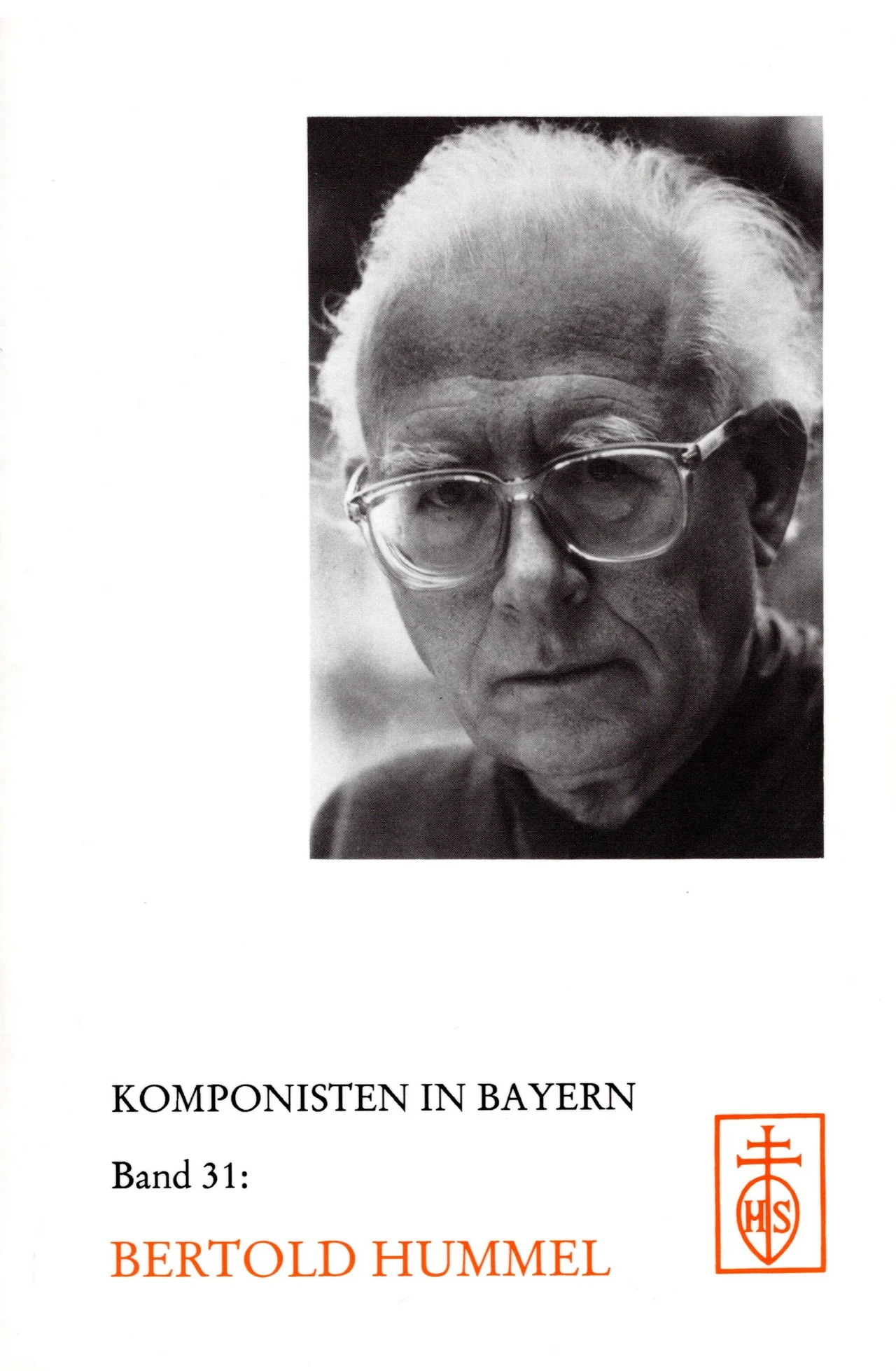
Publication
Composers in Bavaria, Volume 31: Bertold Hummel
with essays by Siegfried Fink, Claus Kühnl, Wolfgang Osthoff, Hans Schmidt-Mannheim, Karl Hinrich Stahmer and Franz A. Stein
published on behalf of the Bavarian Association of Composers (Landesverband Bayerischer Tonkünstler e. V.) within the DTKV
by Alexander L. Suder
Hans Schneider Publishers, Tutzing 1998 / ISBN 3 7952 0944 7