Siegfried Koesler
12 December 1937, Nagold – 1 December 2012, Würzburg
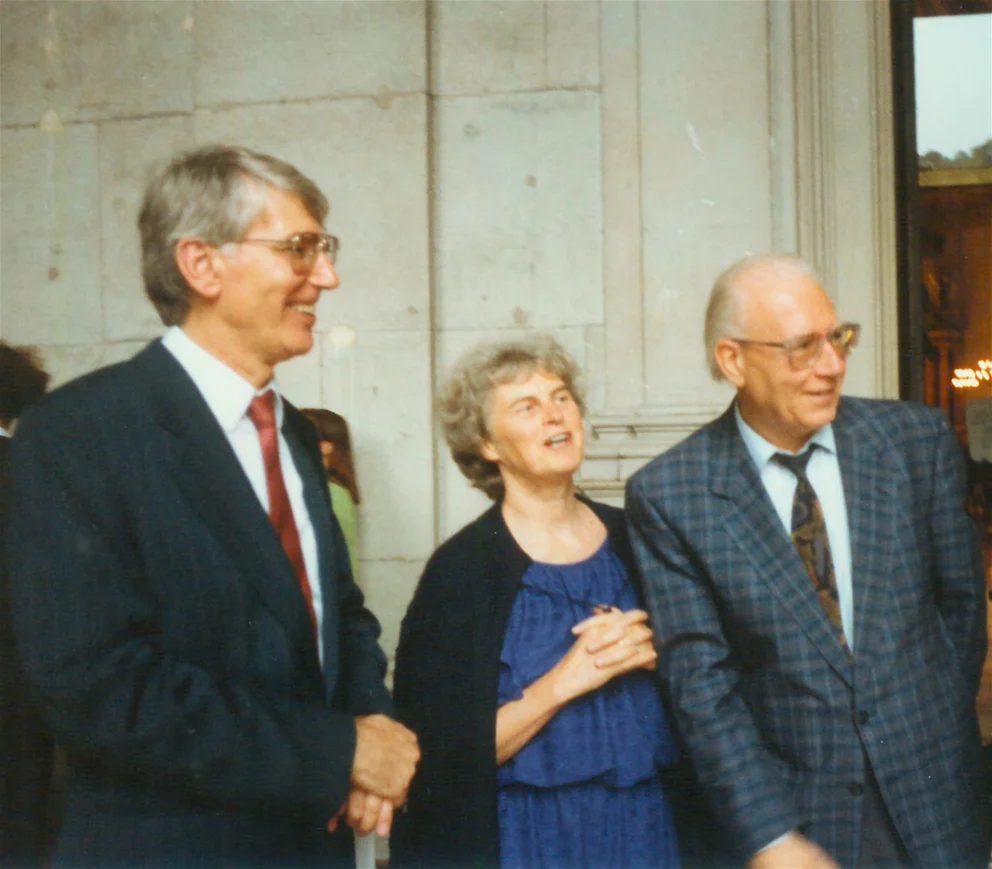
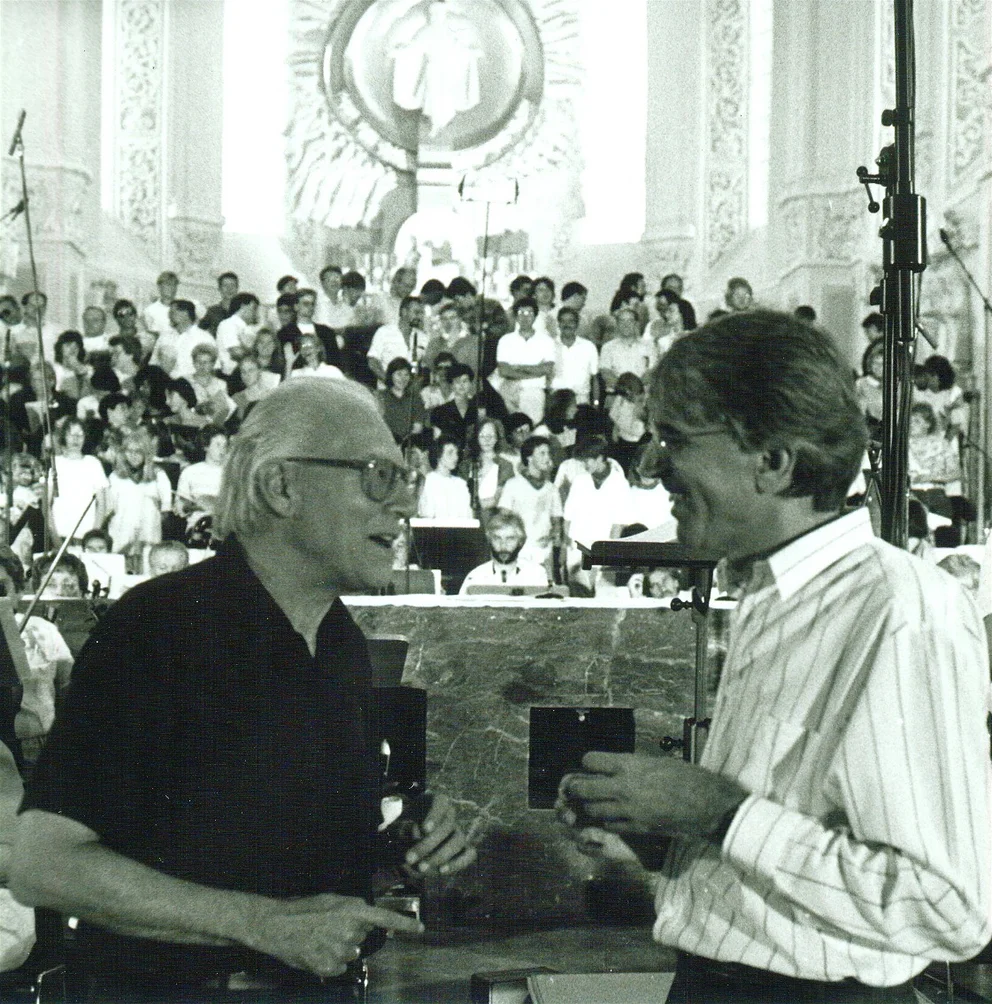
During my time as a cantor in Freiburg and later in Würzburg, my works for the human voice focused on the composition of a large number of liturgical motets, chorales and hymns; in this regard, particular mention must be made – not least – of my personal contacts with the cathedral music directors Franz Stemmer (Freiburg im Breisgau), Franz Fleckenstein and Siegfried Koesler (Würzburg) – who repeatedly commissioned me to write music for their choirs and to compose new chants for the liturgy.
Bertold Hummel 1998
Biography
Siegfried Koesler, born in 1937, studied musicology, art history, archaeology, history and choral conducting in Aix-en-Provence, Freiburg and Tübingen.
He subsequently conducted the boys’ choir in Rottweil (Black Forest) for ten years. He has been Cathedral Choirmaster in Würzburg since January 1971. His appointment coincided with the start of the five-year synod of the German dioceses in Würzburg. Here he conducts the Cathedral Choir (men and women), which has existed since the early 19th century; the Cathedral Boys’ Choir, founded nine years earlier by his predecessor Fleckenstein; the Girls’ Choir (Mädchenkantorei); and the Cathedral Orchestra. The girls’ choir was re-established and developed by Koesler in 1971. During this period, he trained several hundred singers and supervised them in the choirs. The choirs’ main task is to provide the musical accompaniment for festive services and the Sunday convent services in the cathedral, as well as two or three oratorio performances each year at St Kilian’s Cathedral. Further performances outside the cathedral follow, as do recordings for vinyl, CD, radio and television. The Bruckner Festival, which takes place every three years, was founded by Siegfried Koesler together with Bertold Hummel and Erwin Hörn in 1993 and has been an integral part of concert church music in Würzburg ever since. Koesler is a professor at the University of Music in Würzburg, teaching Gregorian chant (until 2001), liturgy, liturgical chant and the history of church music. From 1984 to 1992, he was President of the International Choral Association Pueri Cantores, a movement he has supported and helped shape since 1961, initially within the Diocese of Rottenburg-Stuttgart, then as Secretary, Vice-President and President of the German association. The highlight of this earlier work was the 1970 International Choral Festival in Würzburg, which attracted over 5,000 singers from 14 countries. He served as a jury member at choral competitions in Athens, Nantes and Arezzo. He has been associated with the Loreto Choral Festival since 1962, and has been a member of the artistic directorate since 1979.
Koesler was awarded the City of Würzburg’s Culture Prize in 1986, the European ‘Cesare d’oro’ Prize (Padua) in 1993, the Federal Cross of Merit of the Federal Republic of Germany in 1997, and the Vatican’s Order of St Gregory in 1998.
Publications by Siegfried Koesler ( selection):
“The Formation, Education and Liturgical Role of a Youth Choir”, in: Church Music – a Spiritual and Intellectual Discipline. Guest Lectures at the Catholic Church Music Department of the State University of Music, Stuttgart 5, Stuttgart 1980.
“Church Music at the Episcopal Cathedral in Würzburg / A Statement from 1882”, in: Faith and Community (Festschrift for P.-W. Scheele), edited by K. Hillenbrand and H. Niederschlag, Würzburg 2000.
“Aspects of Church Music in Cathedral Liturgy”, in: Brückenschlag (Festschrift for W. Bretschneider), edited by St. Klöckner, M. Kreuels and G. Massenkeil, Regensburg 2001.
“Johannes Georg Meuerer (1871–1955) – A Late Cecilian”, in: *Organista et homo doctus* (Festschrift for R. Walter), edited by A. Reichling, Sankt Augustin 2008.
“The Conductor Karl Muck (1859–1940)”, in: Mainfränkisches Jahrbuch für Geschichte und Kunst 61/2009, Würzburg 2009.
“Cathedral Music in Würzburg in the First Two-Thirds of the 20th Century”, in: Church Music in the Diocese of Würzburg – Studies and Sources from the 16th to the 20th Century (Sources and Research of the Diocese and the Prince-Bishopric of Würzburg 64), edited by D. Kirsch and U. Konrad, Würzburg 2010.
Works by Bertold Hummel that were premiered under the direction of Siegfried Koesler
- Op. 57b Hymn of Thanks (Wir sagen dir Dank)
Premiere by the Würzburg Cathedral Boys’ Choir on 22 June 1975 - op. 90 The Shrine of the Martyrs
World premiere by the Würzburg Cathedral Choir, Cathedral Boys’ Choir, Girls’ Choir, soloists, three organists, percussion ensemble and Cathedral Orchestra on 14 July 1989 (St Kilian’s Jubilee) - Op. 97d Veni Creator Spiritus
Premiere by the Würzburg Cathedral Boys’ Choir on 7 June 1992 - Op. 97e1 Hail Mary
World premiere by the Würzburg Cathedral Choir on 16 May 1994 - Op. 97e2 Ave Maria
Premiere by the Würzburg Cathedral Choir on 20 May 2001 - Op. 98b Missa Laudate Pueri
Premiere of the first version by the Lyon and Würzburg Cathedral Boys’ Choirs (Favoritchor) and the approximately 4,900 Pueri Cantores at their International Choral Festival in Salzburg Cathedral on 14 July 1996
World premiere of the second version by the Würzburg Cathedral Choir, Cathedral Boys’ Choir and wind players at Würzburg Cathedral on 8 July 2002
Premiere of the Kyrie from the second version on 14 August 2002 (Requiem for Bertold Hummel) - Op. 103h Christus heri
World premiere by the Würzburg Cathedral Choir with organ on 22 June 2000
Works without an opus number:
- Lord our God
Premiere by the Würzburg Cathedral Boys’ Choir on 16 July 1972 - Glory to God (German Gloria)
Premiere by the Würzburg Cathedral Choir on 23 July 1972 - Praise the Lord, O my soul ( Thanksgiving)
Premiere performed by the Würzburg Cathedral Boys’ Choir on 26 July 1981 - Hallelujah with verses (GL 811)
Premiere by the Würzburg Cathedral Choir on 30 January 1983 (1st verse), 6 November 1983 (2nd verse) and 30 September 1984 (3rd verse) - Not by bread alone
Premiere by the Würzburg Cathedral Choir on 20 February 1983 (1st Sunday in Lent) - Praise the Lord
Premiere by the Würzburg Cathedral Boys’ Choir on 18 November 1984 - Lord, how numerous are your works
Premiere by the Würzburg Cathedral Choir on 24 November 1985 - Come, let us rejoice (Coda to GL 525)
Premiere by the Würzburg Cathedral Boys’ Choir on 27 October 1991 - Awake, arise (Coda to GL 117,2)
Premiere by the Würzburg Cathedral Boys’ Choir on 29 November 1992 (1st Sunday in Advent) - Hallelujah (Coda for equal voices to GL 530,7; 530,8 or 531,2)
Premiere by the Würzburg Cathedral Girls’ Choir on 7 May 1995 - We greet you, O Baby Jesus
Premiere by the Würzburg Cathedral Choir on 26 December 1999 - I Will Praise the Lord Always
Premiere by the Würzburg Cathedral Choir on 8 July 2002 (St Kilian’s Day)
Under the direction of Siegfried Koesler, the Würzburg Cathedral choirs also regularly performed psalm compositions from the New Book of Psalms published by Christophorus-Verlag (before 1970), vocal settings for equal voices from the collections of Bonifacius-Verlag (1976 onwards) or more extensive works such as the *Missa brevis* Op. 5 for choir and wind instruments (first performed on 24 November 1985), the *Missa Cantabo Domino*, Op. 16, for mixed choir (premiered 28 March 1971), the *Missa brevis*, Op. 18c, for equal parts and organ (premiered 2 November 1975), the Würzburg Cathedral Mass, Op. 31b (St Kilian’s Day, 1971),"‘Silent Night’ (Christmas concert 1980) or ‘O du fröhliche’ (Christmas concert 1991), the world premieres of which were conducted by others.
Compiled by: Siegfried Koesler, November 2004
Siegfried Koesler
Bertold Hummel as cellist with the Würzburg Cathedral Orchestra
Bertold Hummel and his wife Inken (violin) made their most significant and frequent contributions to Würzburg Cathedral music during the cathedral’s church services. From the time of Cathedral Music Director Fleckenstein (from 1966 onwards) right up until the last year of his life (2002), he and his wife took part in almost all church services where an orchestra was required – which was particularly the case at Easter, Pentecost, the Mozart Festival and Christmas, but also on other occasions. In the process, they built up a repertoire of over 30 masses, including ten by Mozart and eight by Haydn, as well as four by Schubert, Beethoven’s Mass in C major, Bruckner’s Mass in D minor, Liszt’s Hungarian Coronation Mass, Gounod’s St Cecilia Mass and Dvořák’s Mass in D major.
The one or two cathedral concerts a year were another area of activity for Bertold Hummel and his wife, which the composer was commissioned to conduct from 1971 until around his 70th birthday (1995), with a few exceptions. Particular mention should be made here of his solo performances of the Evangelist recitatives in Bach’s Christmas Oratorio, St John Passion and St Matthew Passion, and Haydn’s The Creation. In addition to these concerts, there were ceremonial events, orchestral concerts, and radio and record recordings.
Bertold and Inken Hummel travelled abroad 16 times with the Dommusik choirs: once to Switzerland, twice to France and 13 times to Italy, including seven visits to the Loreto Choir Festival near Ancona alone. On three occasions they took part as guests in tours by the Cathedral Choir without an orchestra: to Israel in 1995, to Rome in 1998 and to Ireland in 2000. The concert tours with an orchestra are listed individually below (concert venues in bold, soloists always present):
April 1974: Loreto with the Cathedral Boys’ Choir (Vivaldi: Magnificat, Pergolesi: Stabat mater, Mozart: Litany of Loreto, K. 195).
April 1977: Verona, Loreto, Venice with the Cathedral Boys’ Choir (Haydn: Salve regina, Mozart: Requiem), Macerata with the Cathedral Orchestra (works by Pachelbel, Marcello, Telemann and Mozart). Honorary member of the ‘Order of Gnocchi’ in Verona.
April 1980: Lecco, Loreto, Vicenza with the Cathedral Boys’ Choir (Handel: Messiah). There was a temporary power cut during the concert in Loreto, and the performance continued by candlelight.
April 1981: Erba, Lecco with the Cathedral Boys’ Choir (Monteverdi: Psalms, Mozart: Requiem).
April 1982: Lecco, Loreto, Darfo Boario Terme with the Cathedral Boys’ Choir (Mozart: Coronation Mass, Te Deum, Litany of Loreto K. 109, etc.).
October 1982: Ebersmünster in Alsace with the Cathedral Choir (Haydn: St Nicholas Mass, St Theresa Mass, Te Deum).
November 1982: Einsiedeln in Switzerland with the Cathedral Choir (Haydn: The Creation), charity concert for the restoration of the basilica.
June 1984: Lecco, Erba, Venice with the Girls’ Choir (Michael Haydn: Vespers, Pasquale Anfossi: Il Sedicia).
April 1985: Lecco, Loreto, Malo near Vicenza with the Cathedral Choir and members of the Cathedral Boys’ Choir and the Girls’ Choir (Verdi: Requiem). Welcome for Pope John Paul II at the meeting of the Italian Bishops’ Conference.
May 1986: Caen, Amiens with the Cathedral Choir (Haydn: Mass in C major, Organ Concerto, Te Deum).
May 1987: Lecco, Mariano near Milan with the Cathedral Choir (Handel: Israel in Egypt).
April 1990: Udine, Loreto and Darfo Boario Terme with the Cathedral Boys’ Choir (Handel: Messiah).
September 1990: Bergamo, Vicenza with the Cathedral Boys’ Choir (Vivaldi: Magnificat, Platti: Mass in A major and Requiem, Hasse: Te Deum).
January 1993: Lecco, Clusone with the Cathedral Boys’ Choir (Bach: Christmas Oratorio, Chapters 4–6).
April 1993: Lecco, Loreto, Udine with the Cathedral Choir (Beethoven: Mass in C major, Bruckner: Te Deum).
April 1996: Udine with the Cathedral Boys’ Choir (Zelenka: Litany of Loreto and three psalms, Platti: Mass in A major and Stabat mater (fragment), Hasse: Te Deum).
(Compiled in November 2010)
Bertold Hummel
The special programme of Würzburg Cathedral Music 1971–2002
Siegfried Koesler, appointed Cathedral Music Director on 1 January 1971, adopted the motto from his distinguished predecessor, Monsignor Franz Fleckenstein: “To praise God is our duty”. He took the repeated biblical exhortation “Sing to the Lord a new song” (Ps. 33:3; 40:4; 96:1; 98:1; 144:9; 149:1; Isa. 42:10; Rev. 5:9; 14:3), as well as the Second Vatican Council’s instructions on the liturgy, as the starting point and cornerstone of his work. Psalm 150, as the keystone of the entire collection of psalms, signals that the ‘meaning of the world is fulfilled in the praise of God’: “Let everything that has breath praise the Lord”. The creative forces of the Western world have heard and taken this call seriously throughout the centuries right up to the present day. This is evidenced by countless masterpieces of the most varied kinds – from Gregorian chant through the early flowering of polyphony to Palestrina, Schütz, Bach and Handel, and from the Viennese Classical period through the Romantic era to the masters of the 20th century. Under the direction of Siegfried Koesler, the Würzburg Cathedral Choir, the Boys’ Choir and the Girls’ Choir – founded in 1971 – exemplarily maintained the standard repertoire customary among larger church choirs; for instance, they repeatedly performed 11 masses by W.A. Mozart (1756–1791) alone, 11 masses, including the Great Mass in C minor, the Requiem and other works (litany, etc.), were performed repeatedly. The works of Anton Bruckner (1824–1896), all of whose major works of church music have long been part of the repertoire in Würzburg, is given special attention at the Würzburg Bruckner Festival, which has been held every three years since 1993 and whose artistic and organisational direction is in the hands of, amongst others, Siegfried Koesler. Oratorio and liturgical compositions by Franz Liszt (1811–1886), Hector Berlioz (1803–1869) and Josef Rheinberger (1838–1901) have also featured regularly in the Cathedral Music programmes. The great works of the 20th century have also found a remarkable home in Würzburg Cathedral, including Edward Elgar’s *The Apostles*, Franz Schmidt’s *The Book with Seven Seals*, Zoltán Kodály’s *Te Deum*, Arthur Honegger’s *King David*, Benjamin Britten’s “War Requiem” and Andrew Lloyd Webber’s “Requiem”. In addition, the programme features many smaller works from the 20th century by J. N. David, J. Alain, J. van Nuffel, O. Dunkelberg and P. Eben.
What makes Siegfried Koesler’s programme at Würzburg Cathedral so special is the inclusion of composers – both past and present – with links to Würzburg or to Koesler himself. First, a look back at the past: even on the very first record released in 1975, the programme featured not only the composers Heinrich Pfendtner (Würzburg court organist until 1630) and Philipp Friedrich Buchner (court Kapellmeister in Würzburg until 1669), the focus was on Valentin Rathgeber (1682–1750), who hailed from the Rhön region, was educated in Würzburg and later became a Benedictine monk at Banz. Five of his masses and other works form part of the cathedral choirs’ repertoire, works that are performed time and again, including the grand ‘Apostles’ Mass’, which was broadcast by Bayerischer Rundfunk in 1988, and the ‘Martyrs’ Mass’, which was sung for the first time in the modern era at the Rathgeber Symposium in 2000 in his birthplace, Obereisbach.
Giovanni Benedetto Platti (1897–1763), the subject of Siegfried Koesler’s study, lived a few years after Rathgeber. Platti arrived in Würzburg in 1722, presumably from Venice, as part of a campaign to recruit Italian musicians, and remained there as a member of the court orchestra. The musical manuscripts held in Würzburg were destroyed by fire, but some works can be found in Wiesentheid; Siegfried Koesler had a Mass and the Requiem transcribed and performed them, both works on several occasions in Italy.
The composers from the Mozart, Beethoven and Schubert eras mentioned below have become known to us and readily accessible thanks to the consolidation in recent years of the sheet music collections from the parishes in the Würzburg Diocesan Archive:
Siegfried Koesler, for instance, included a Mass by the Heidenfeld canon Josef Krafft (1750–1812) in his repertoire, as well as a Grand Mass and a ‘Christmas Hymn’ by Franz Xaver Sterkel (born in Würzburg in 1750, later court Kapellmeister of Mainz, a celebrated piano virtuoso who was acquainted with Mozart and Beethoven, died in Würzburg in 1817); a ‘Peace Mass’ by Stephan Hammel (1756–1830, born in Gissigheim near Tauberbischofsheim, a Benedictine monk at St Stephen’s in Würzburg, highly regarded by the Prince-Bishop as an organist and singer, later a parish priest in Veitshöchheim); a ‘Missa solemnis’ by Friedrich Witt (1770–1836, Würzburg’s last court Kapellmeister, noted for nine symphonies printed in Frankfurt, one of which was mistaken for a work by Beethoven – the “Jena Symphony” – right up until the 20th century); finally, a festive mass and a ‘Salve regina’ by Georg Friedrich Keller (1806–1849, born in Würzburg-Unterdürrbach, court Kapellmeister in St Petersburg and subsequently cathedral organist in Würzburg). Joining them is arguably the best-known composer born in Würzburg, Georg Joseph “Abbe” Vogler (1749–1814, court Kapellmeister in Munich, Stockholm and, finally, Darmstadt; a major innovator of his time, particularly in the fields of harmony and organ building, and teacher to C.M. von Weber), whose eight-part ‘Kilianslied’ has long featured in the cathedral’s programme and whose ‘Hosianna’ – still popular in Sweden today – is sung here in translation. Siegfried Koesler had the aforementioned masses—all of which were composed for choir, soloists and orchestra—notated using the Cathedral Music’s computer programme and has performed them on several occasions during church services.
Turning to the present day: from his earlier time in Rottweil, Siegfried Koesler brought works by two composers to Würzburg that had been written for him and his singers: by Corbinian Gindele (1901–1986, a Benedictine monk, a pupil of Hindemith, and long-serving organist at Beuron Archabbey) – psalms, song settings and the motet ‘Gott spricht zu Moses’ (‘God Speaks to Moses’); and by Karl Michael Komma (born 1913, professor at the Stuttgart University of Music) – the ‘Pfingstsequenz’ (‘Pentecost Sequence’), a “German Ordinarium” and the half-hour-long “St Matthew Passion”, which the boys’ choir performed during the liturgy and in concerts on Palm Sundays in the years designated for the St Matthew Passion (every three years).
Other composers outside Würzburg wrote for Siegfried Koesler or were inspired by him to compose:
Virgilio Mortari (1902–1993, most recently a professor at the Rome Conservatoire), whose “Missa pro pace” was performed in Würzburg, following which he wrote “Marientrauer” for the girls’ choir – a 15-minute piece for soloists, unison choir and orchestra – which was performed on several occasions. Augustinus Franz Kropfreiter (born 1936, organist at the Bruckner organ in St Florian, Upper Austria) is represented in Würzburg by the “Missa choralis”, the “Missa Pueri Cantores”, the “Grazer Messe” (the latter two inspired in part by Siegfried Koesler) and the ‘Missa “O crux ave”’, which was premiered in 2000 by the Cathedral Boys’ Choir.
Wolfram Menschick (born 1937, cathedral music director in Eichstätt), composed at the request of Siegfried Koesler, who, as Vice-President and President of the worldwide Pueri Cantores Association from 1970 onwards, was for many years one of the conductors at the association’s major choral gatherings, a “Missa Pueri Cantores” for the International Choral Gathering in Rome in 1987. It has been part of the cathedral music repertoire ever since, alongside Menschick’s “Missa parochialis” and “Missa de angelis”, his Vespers and various motets. Also worthy of mention is Kees Bornewasser (organist in the Netherlands), who wrote the ‘Missa “Laudate pueri”’ for the Pueri Cantores International Choral Festival in Maastricht in 1990; this has been part of the cathedral’s repertoire ever since. Finally, mention should be made of Peter Planyavsky (born 1947, cathedral organist in Vienna). He was one of the composers of the “Missa nova”, which was premiered by the Cathedral Boys’ Choir on the occasion of the International Choral Festival in Salzburg in 1996. He is known to the Girls’ Choir for his “Salve regina”. Polyphonic continuations (“codas”) for processional psalms and the Hallelujah, settings of psalms and the Magnificat, as well as choral arrangements, are a regular feature of the cathedral’s musical programme.
In addition, the repertoire draws on compositions by the Würzburg Cathedral organist Paul Damjakob (born 1939), as well as works by former colleagues of Siegfried Koesler: Karl-Ludwig Hecht (born 1945, Director of the School of Church Music and the Berlin Boys’ Choir); Franz-Josef Stoiber (born 1959, cathedral organist in Regensburg); Wolfgang Schneider (born 1968, church musician in Munich/Haidhausen), Andreas Unterguggenberger (born 1969, cathedral cantor in Aschaffenburg); Hans Schnieders (born 1970, Professor of Organ at Aachen University of Applied Sciences) and Johannes Maria Strauss (born 1972, church musician in Meerbusch near Düsseldorf).
The following composers in particular have written codas, song cycles, motets, masses and large-scale works for the cathedral choirs, which have been regularly featured in the cathedral’s liturgical and concert programmes: first and foremost Otmar Faulstich (born 1938, 1964–1983 at Würzburg Cathedral, and since then a lecturer in composition at the Regensburg College of Church Music), who had already written his Latin Ordinarium for the 1970 choral festival in Würzburg; then Andreas Boitz (born 1964, at Würzburg Cathedral from 1989 to 1993 and since then Regional Cantor in Darmstadt), who composed ‘Puer natus in Jerusalem’ for the Pueri Cantores gathering in Rome in 1993 “Puer natus in Jerusalem” and, for the gathering in Mainz in 2001, “Christus vincit”, as well as the Mass “Regina caeli” and the multi-choir setting “Veni creator”. Finally, mention should be made of the long-standing collaboration with the author of these lines, Bertold Hummel (born 1925, Professor of Composition and President of the Würzburg University of Music, father of six sons, all of whom sang with the Cathedral Boys’ Choir, and, together with his wife, a long-standing member of the Cathedral Orchestra). This collaboration reached its zenith in the oratorio *Der Schrein der Märtyrer* (*The Shrine of the Martyrs*), lasting almost two hours, for soloists, choirs, three organs, a percussion ensemble and a full orchestra (premiered in 1989, and subsequently performed again in 1992 and 2000). This work, along with three masses and motets, as well as organ music, has been recorded on CD; his “Ave Maria” is dedicated to Siegfried Koesler.
From this – albeit incomplete —overview of the distinctive programme of Würzburg Cathedral music, it is easy and gratifying to conclude that Siegfried Koesler lived up to the motto of his predecessor, Franz Fleckenstein, and to his own objectives to a high degree, with tireless diligence and enthusiasm. I would like to express my personal gratitude for over 30 years of friendly, artistic collaboration, together with my best wishes for many peaceful, healthy and imaginative years to come. To conclude, here is a quote from Cardinal Joseph Ratzinger, who, as is well known, has a very special connection to sacred music. He writes: “The art that the Church has produced is, alongside the saints who have flourished within her, the only true defence she has to offer for her history.” The Church must remain exacting; it must wage the battle for ‘spiritualisation’, without which it becomes a ‘first circle of hell’. That is why the question of what is ‘appropriate’ must always also be the question of what is ‘worthy’ and the challenge of seeking out that which is ‘worthy’.
Professor Bertold Hummel worked as a composer in Würzburg; he was President of the Würzburg University of Music and taught there as Professor of Composition. The author passed away on 9 August 2002 whilst this volume was being printed.
(from: Dommusik Würzburg – A Festschrift in Honour of Professor Siegfried Koesler, Cathedral Music Director in Würzburg 1971–2002, edited by Hans-Georg Ziebertz, Theobald Stangl and Johannes Windmeißer for the Würzburg Cathedral Music Society, ISBN 3-00-010031-8)