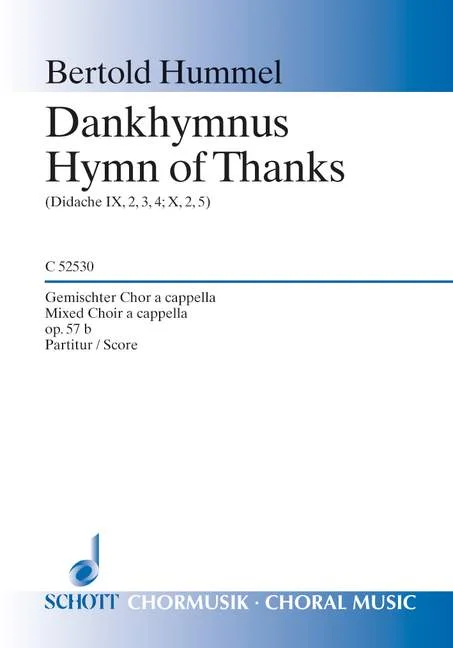
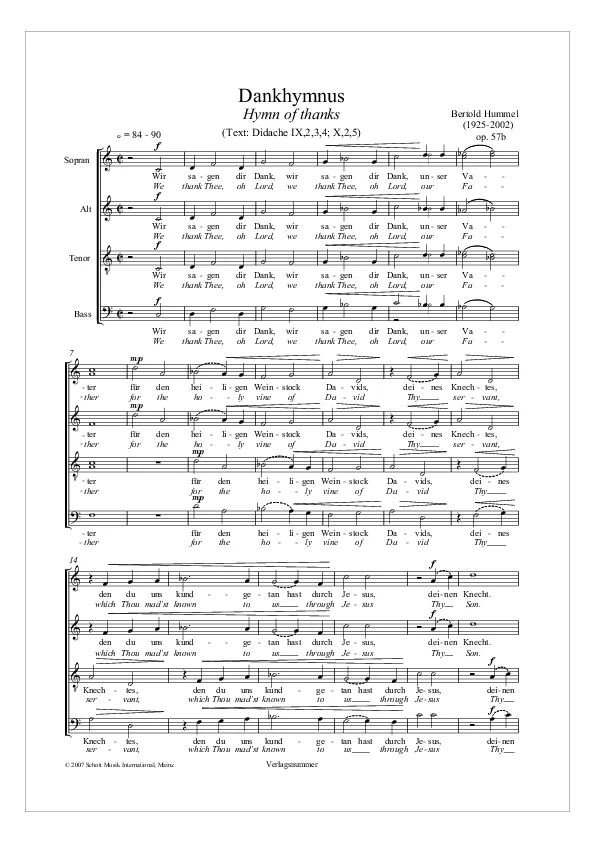
Hymn of thanks (Text: Didache IX,2,3,4; X, 2,5) (op. 57b, 1975)
Motet for 4-8-part mixed choir a cappella
Dedication
written for the Würzburg Cathedral Boys' Choir
Instrumentation
4-8-part mixed choir a cappella
Duration: 6 minutes
Premiere
22 June 1975,
Würzburg, Kilian Cathedral
Würzburger Domsingknaben | Siegfried Koesler
Autograph
Title: Dankhymnus for mixed choir a.c. - Length: 12 pages - Date: 3-7 March 1975 Dorfgastein - Location:
Publisher
Schott Music C 52530 / ISMN: M-001-14794-1
First edition: Coppenrath, Altötting 1984




Foreword (Schott Music)
When I took up my post as Director of Music at the Cathedral of St Kilian in Würzburg in November 2002, I soon realised that the works of Bertold Hummel enjoyed frequent performance in this cathedral. The particular fostering of the works of a composer in his original place of activity is a common practice in Germany - but in the case of contemporary music more an exception to the rule. This fostering surely owes a lot to Hummel's dose ties with the Cathedral of St Kilian in Würzburg through a variety of channels: the friendly association with the former bishop and my predecessor, Hummel's participation in the Würzburg Cathedral Orchestra and his dose ties to the choirs of the cathedral; his children and grandchildren have sung or still sing in the cathedral.
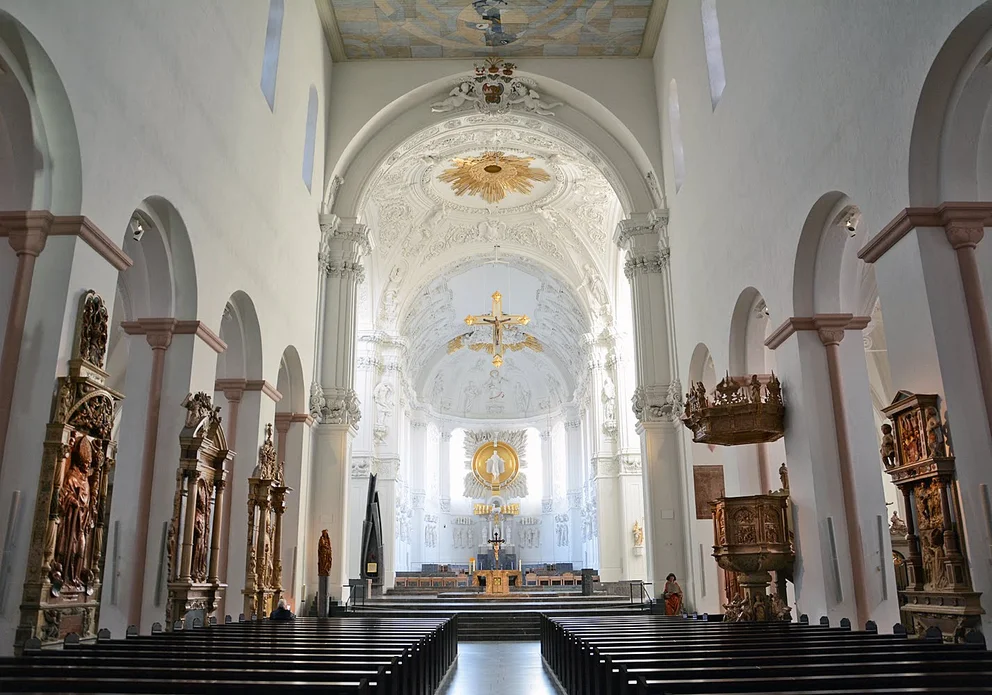
It is therefore quite legitimate to say that Bertold Hummel's Hymn of Thanks, like many of his choral works, is inspired by the architecture and powerful acoustics of the cathedral. It was therefore quite natural that the first performance of this composition should be given by the Würzburger Domsingknaben [cathedral choir] in 1975. The text providing the basis for the Hymn of Thanks is taken from the 9th and 10th chapter of the Didache, a scripture originating in Syria ca. 100-180 AD which can probably be said to be one of the earliest church Orders of Christianity. Hummel sets the emphatic text passages as a Eucharist Hymn of Thanks which will also find its niche in concerts of sacred music. Hummel's characteristic tonal language is coupled with his remarkable intuition for the vocal possibilities of young choirs.
A note on the performance practice: the passages indicated with "etwas freier" [somewhat freer] which are more of a recitative nature are designed to be performed in a fluent manner in the sense of Gregorian chants. The metrical structure of the text is purely intended for orientation purposes.
Würzburg, May 2007
Martin Berger
Many of Bertold Hummel's motets were written at the suggestion of Würzburg Cathedral's Kapellmeister Siegfried Koesler. They were all written for use in church services and were performed for the first time by the choirs of Würzburg Cathedral Music. The Dankhymnus op. 57b for 4 - 8-part mixed choir a cappella is particularly popular and has been performed many times in Germany and abroad, not only by the Würzburg Cathedral Boys' Choir, to whom the work is dedicated. The text, which dates back to the first Christian century, was given a powerful setting by Hummel, partly in unison, then again with imitations or with homophonic chord progressions that lead into hymn-like, soaring sounds. An effective a cappela work that can be studied without particular difficulty and performed in church and concert.