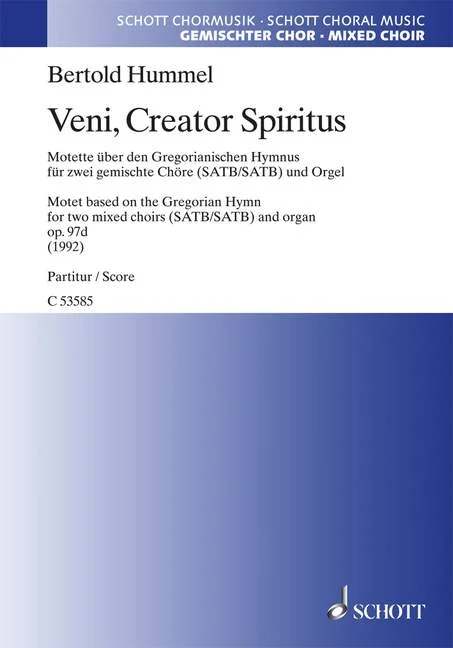
Veni, creator spiritus (op. 97d, 1992)
Motet on the Gregorian hymn for two mixed choirs and organ
Dedication
for Franz Fleckenstein on his 70th birthday
Instrumentation
Two mixed choirs (SATB/SATB), organ
Duration: 4 minutes
Premiere
7 June 1992,
Würzburg, St Kilian's Cathedral
Würzburg Cathedral Boys' Choir | Andreas Boltz (organ) | Siegfried Koesler
First Performance
19 February 1996 (Japanese premiere),
Tokyo, Casals Hall
Tokyo Philharmonic Chorus | Wolfdieter Maurer
Autograph
Title: "Veni creator spiritus" in a setting for 8-part double choir and organ - Length: 8 pages - Date: - - Location:
Publisher
Schott Music C 53585 / ISMN: 979-0-001-16979-0
First edition: Feuchtinger & Gleichauf, Regensburg
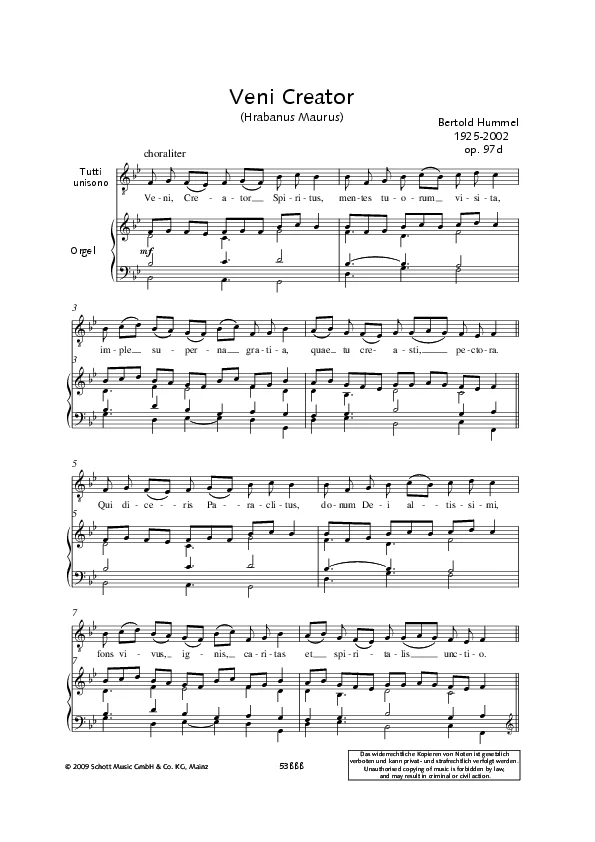




The text of this most famous of all Pentecost hymns is attributed to the great hymn writer and most respected theologian of his time, the Benedictine Abbot of Fulda and Archbishop of Mainz, Hrabanus Maurus (ca. 780-856). The earliest surviving record of the music can be found in the Hymnary of Kempten (around 1000). The hymn is in so-called Ambrosian verse and has its place in the morning and evening praise of the church.
My composition for two choirs and organ retains the hymn melody in all verses. The setting gradually changes in stanzas 5 and 6, with the textual recourse to the first line of the hymn giving these stanzas their special character, right up to the sweeping "Amen", which returns to the original ending of the hymn.
The choirs should be clearly separated:
Organ
Choir I
Choir II
Conductor