Glory to God (Gloria) (1972)
Motet for four-part mixed choir a cappella
Instrumentation
Four-part mixed choir a cappella
Duration: 5 minutes
Premiere
23 July 1972,
Würzburg, St Kilian's Cathedral
Würzburg Cathedral Choir | Siegfried Koesler
Autograph
Title: "Glory to God" (Gloria) - Length: 8 pages / 12 pages - Date: 9 June 1972 / New version: 31 July 72 - Location:
Publisher
Schott Music C 54677 / ISMN: 979-0-001-18011-5
Church music guide, February 1985
Just as the early Dutch and later Monteverdi and Vivaldi composed a solemn "Gloria " for festive occasions in the early Baroque period, Bertold Hummel created a festive "German Gloria" for today. The work, which is just over 5 minutes long, shows all the advantages of modern choral music, is easy to rehearse and can be used for mass and as a hymn for the Liturgy of the Hours, for services of the word and in concerts.




Foreword (Schott Music)
After the Second Vatican Council also permitted the Catholic Mass to be celebrated in the vernacular. Bertold Hummel was one of the first composers in Germany to take advantage of this new opportunity and composed a Great Mass for solo voices, choir, congregation and orchestra in 1967 to mark the re-opening of the Cathedral in Würzburg.
This Glory to God for four-part mixed choir composed in 1972 also exudes this same spirit of optimism in the Catholic Church. Hummel's work not only displays the composer 's own inimitable tonal language, but is also quite naturally orientated to motet compositions of the old masters, exploiting part-writing, changes of tempo and dynamics to the full to produce a spirited interpretation of the text. This composition has a place within the liturgy as the second part of the Ordinary ot the Mass ("Gloria in excelsis Deo") and is additionally suitable tor Inclusion in sacred choral concerts with its vibrant praise ot God.
Martin Hummel 2012
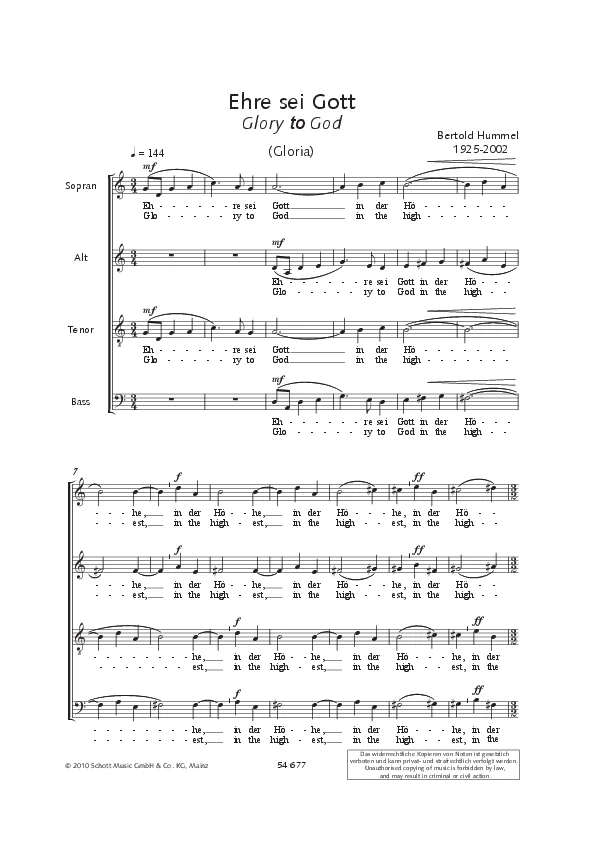
Just a few years after the Second Vatican Council, when it became possible to celebrate the Catholic Mass in the respective national languages, Bertold Hummel wrote his motet "Ehre sei Gott" for four-part mixed choir. It is a "German Gloria", meaning that its text follows the second part of the Mass Ordinary between the Kyrie and Credo. It can be incorporated liturgically into a mass, just as Bertold Hummel never spurned writing music for church use and also for lay people. His German Gloria begins quickly and joyfully in a swinging three-quarter metre and quickly rises to fortissimo before switching to piano and three-half metre for the words "And peace on earth". In his composition, Hummel follows the models of the tradition: the contrasting text is almost formed movement by movement with new musical ideas in each case. The voices are led independently in the old motet style, sometimes coupled together in alternating pairs.
(from the programme of the Usedom Music Festival 2008)