Marion Brown
8 September 1931, Atlanta (Georgia) – 18 October 2010, Hollywood (Florida)
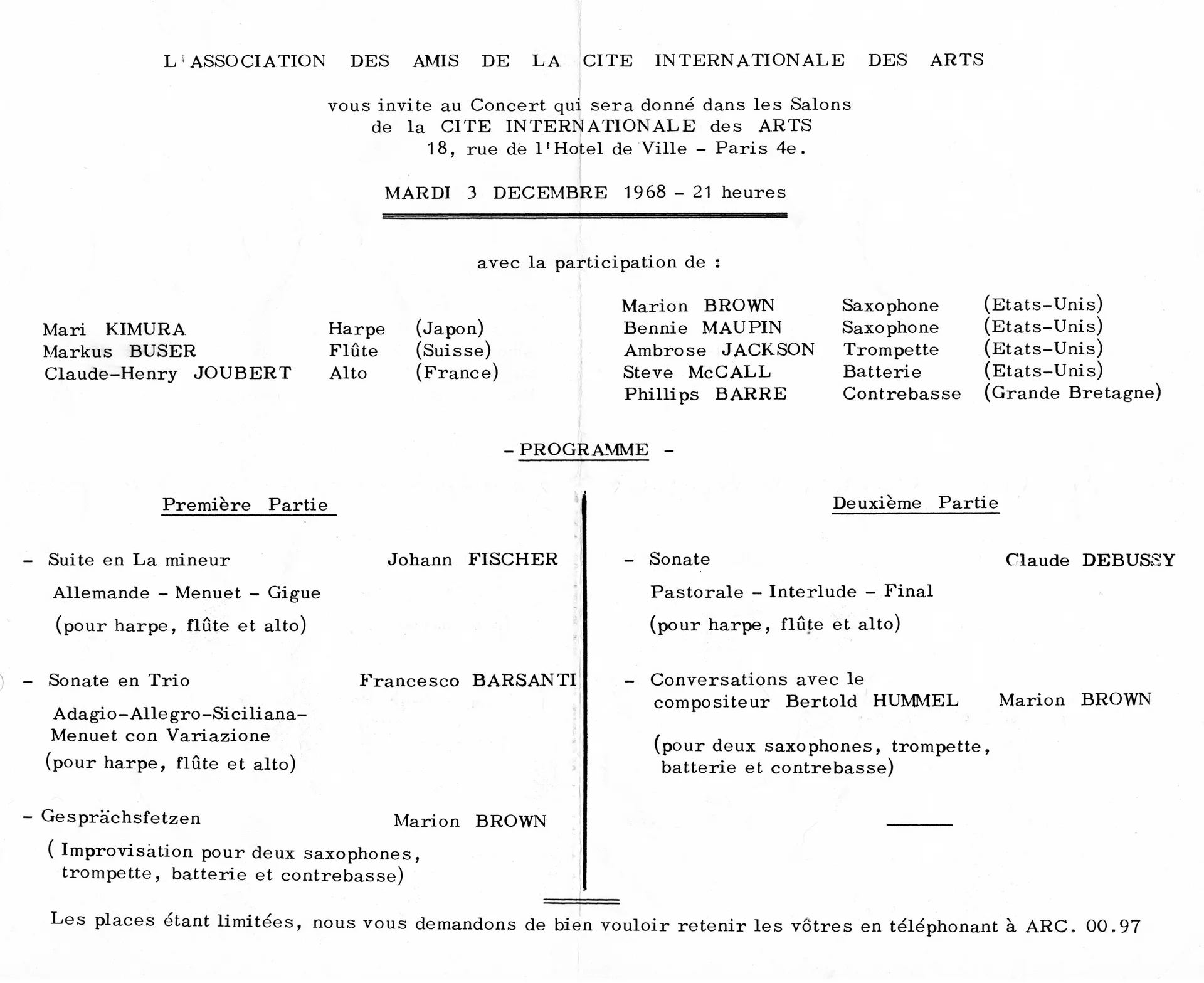

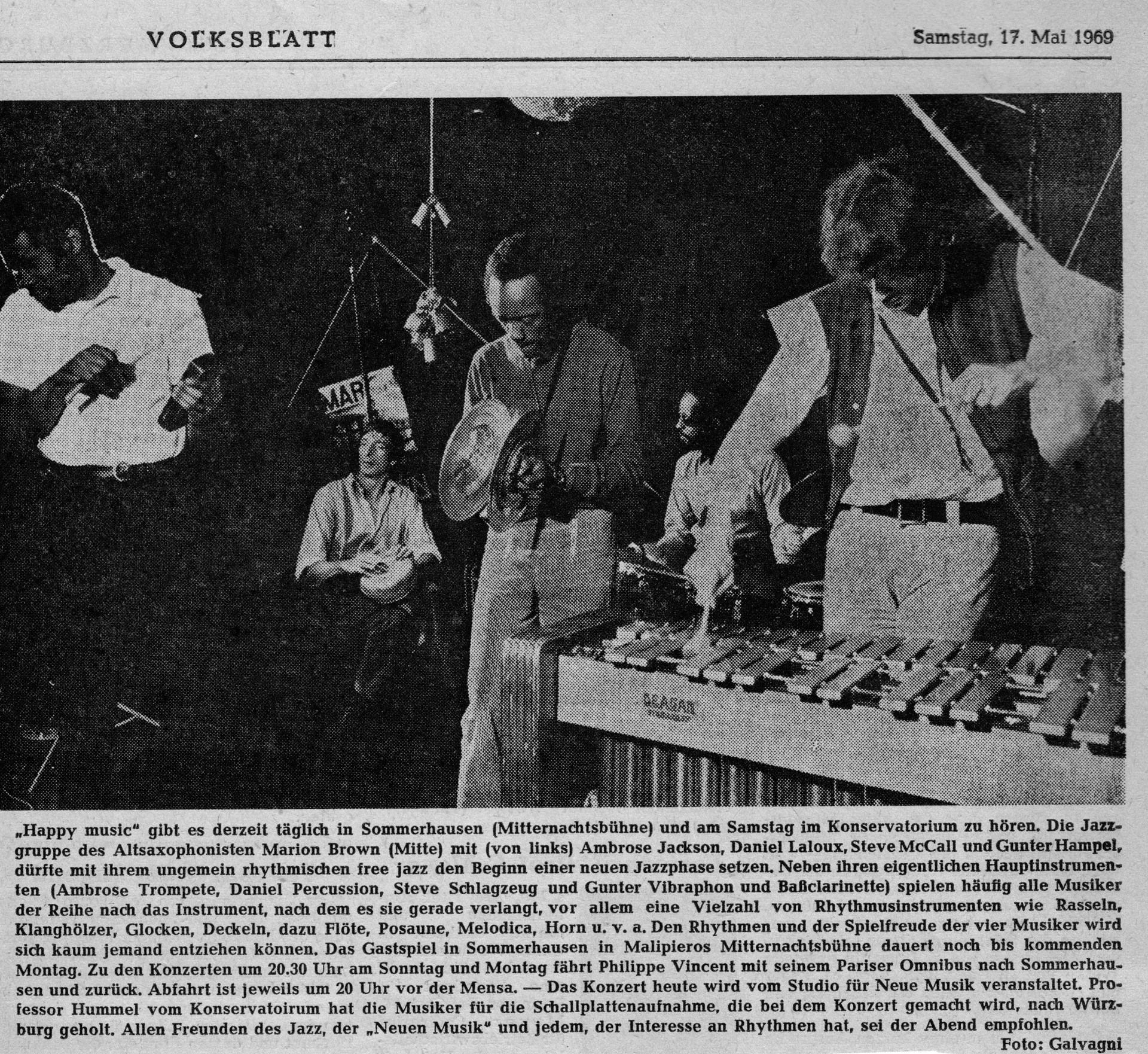
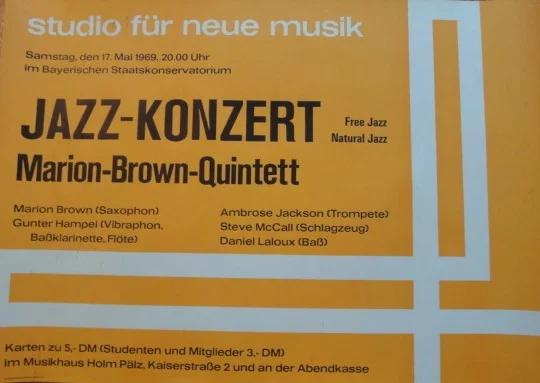
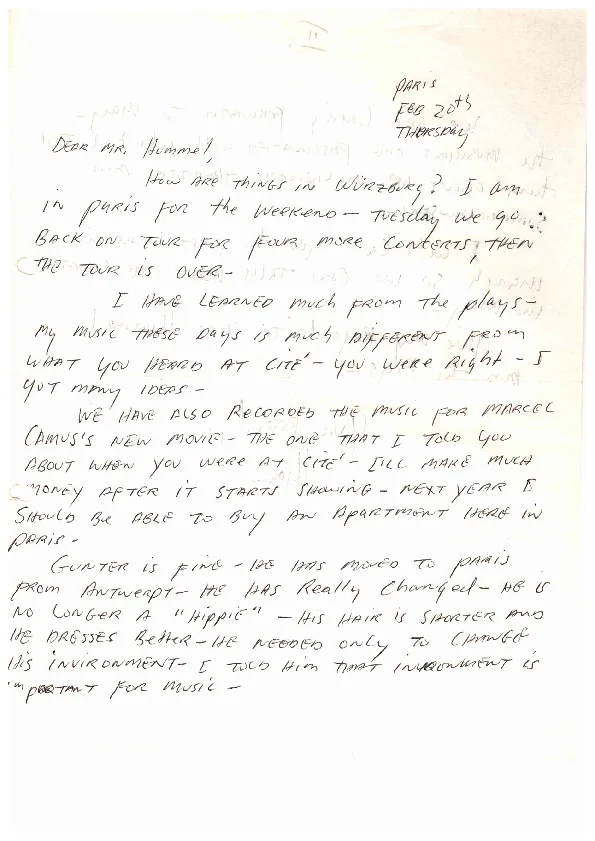
From July to December 1968, Bertold Hummel lived and worked as a scholarship holder at the “Cité internationale des Arts” in Paris. There he met the American free-jazz saxophonist and composer Marion Brown and became friends with him. An intense exchange on music and philosophical topics takes place between the two musicians, inspiring Marion Brown to compose *Conversations avec le compositeur Bertold Hummel *. Together with Steve McCall and Ambrose Jackson, the two improvised live on French radio using Eduard Johannes Stöcklin’s sound sculptures, Hummel’s *Soniles*. Brown spent Christmas 1968 with the Hummel family in Würzburg. In May of the following year, the Marion Brown Quintet (M.B., Gunter Hampel, Steve McCall, Ambrose Jackson, Daniel Laloux) gave a highly acclaimed concert as part of the ‘Studio for New Music’ directed by Hummel. This led to the recording of the LP *Marion Brown in Sommerhausen*, which, like the LP *Marion Brown/Gunter Hampel: Gesprächsfetzen*, was released by Calig-Verlag in 1969 through Hummel’s mediation. A year later, Marion Brown returned to the USA. They remained in written contact, sharing news of their own compositions and family events. The correspondence between Hummel and Brown came to an amicable end in 1978 – ten years after they first met in Paris.
Bertold Hummel wrote the following text for the LP *Gesprächsfetzen*:
Captured words that coalesce into an impression without any specific meaning – language as sound, melody and rhythm. This work presents a new development in ‘free jazz’ that is closely linked to current trends in world music. The break from the musically restrictive principles of jazz has been permanently achieved here. It is now possible to draw upon the full range of musical material developed to date. There is no restriction to the major–minor system, to whole and half-steps, to tonality and atonality – beauty is not contrasted with ugliness, impression is not set against expression, and so on – but rather all these elements are present and are handled in a completely unorthodox manner.
Thus, revolution gives way to evolution. The particular artistic value of this composition undoubtedly lies in the subtle economy of its preliminary planning and the resulting plasticity. The virtuoso performers of ‘Gesprächsfetzen’ —distinguished instrumentalists in their own right—possess the necessary capacity for action and reaction, which, in both the individual and collective improvisations within each of the work’s five sections, leads to magnificent solo and ensemble performances. Hovering over it all, as it were, as a necessary guiding principle, is an artistic sensibility honed over many years, stemming not least from Marion Brown’s passionate love of music itself.
Biography
Marion Brown, who initially played in a house band, completed his military service in a military band; in 1957 he played with Johnny Hodges in Atlanta. He initially studied saxophone, clarinet and oboe at Clark College in Atlanta, then law at the African-American Howard University, as well as music education, politics, economics and history. In 1960, he dropped out of university and moved to New York City, where he became friends with the poet Amiri Baraka and, through him, came into contact with the free jazz scene that was developing in the city. From 1962 onwards, he worked with musicians such as Rashied Ali, Alan Shorter and Archie Shepp (Fire Music, 1965), who became his mentor; he also contributed to Shepp’s album Fire Music. John Coltrane engaged him in the summer of 1965 to record his album *Ascension*. During this period, Brown also worked with his own groups, including one with Stanley Cowell. From 1959 onwards, he taught, wrote poetry and articles on music – including his first article on Ornette Coleman – and appeared in Baraka’s play *The Dutchman*.
With a scholarship from the Cité Internationale des Artistes, he spent some time in Europe from 1967 onwards, where he played with Karl Berger, Steve McCall, Barre Phillips, Alan Silva, Gunter Hampel and Jeanne Lee, and his interest in African music grew. In 1968, he composed the film score for Marcel Camus’ *Un été sauvage*. “Through his collaboration with Hampel, Brown developed a lyrical language with which he definitively established his own voice within the canon of free jazz.” Shortly before his return to the United States in 1970, he recorded his best-known album, *Afternoon of a Georgia Faun*, for ECM with Hampel, Lee, Anthony Braxton, Bennie Maupin and Chick Corea for ECM, “on which he captured the mood of Debussy’s *Afternoon of a Faun* with a percussive soundscape and dynamic collective improvisation”.
In the USA, he focused his research and teaching on the linguistics and compositional techniques of African music. From 1971, Brown was an Assistant Professor of Music at Bowdoin College in Brunswick (Maine), a post he held until he was awarded his Bachelor’s degree in 1974. He also held teaching posts at Brandeis University (1971–1974), Colby College (1973/74) and Amherst College (1974–1975), as well as a research assistantship at Wesleyan University (1974–1976), where he obtained a Master’s degree in ethnomusicology in 1976. He published his thesis in the book *Faces and Places: The Music and Travels of a Contemporary Jazz Musician*. Alongside his teaching, he studied Indian flute playing and African instruments. His playing and compositions are characterised by a particular sense of calm. He arranged works by Erik Satie and wrote the music for Georg Büchner’s *Woyzeck*. He also continued his collaboration with Gunter Hampel. Alongside his teaching role in Northampton (Massachusetts), he performed at universities and worked as a painter.
Due to health problems – he had to have a foot amputated – Brown had hardly performed at all since 1992. He also collaborated with the composer Harold Budd on the latter’s album *Pavilion of Dreams*. Friends and patrons took Brown out of a care home in New York and moved him to a nursing home in Florida, where he died in October 2010.
https://de.wikipedia.org/wiki/Marion_Brown (14 July 2026)