Man does not live by bread alone (1983)
Motet for four-part mixed choir a cappella
Instrumentation
Four-part mixed choir a cappella
Duration: 3 minutes
Premiere
20 February 1983 (1st Sunday of Lent),
Würzburg, St Kilian's Cathedral
Würzburg Cathedral Choir | Siegfried Koesler
Autograph
Title: Motet: "Nicht vom Brot allein lebt der Mensch" - Length: 5 pages - Date: 1 Feb. 83 - Location:
Publisher
Free sheet music download
Reprint authorisation for Marius Schwemmer (ed.): Cantica nova - Contemporary choral music for the church service, Regensburg 2012
ISBN-10: 3000398872 / ISBN-13: 978-3000398872
First edition: Anton Böhm & Sohn Musikverlag, Augsburg 1983
Full score




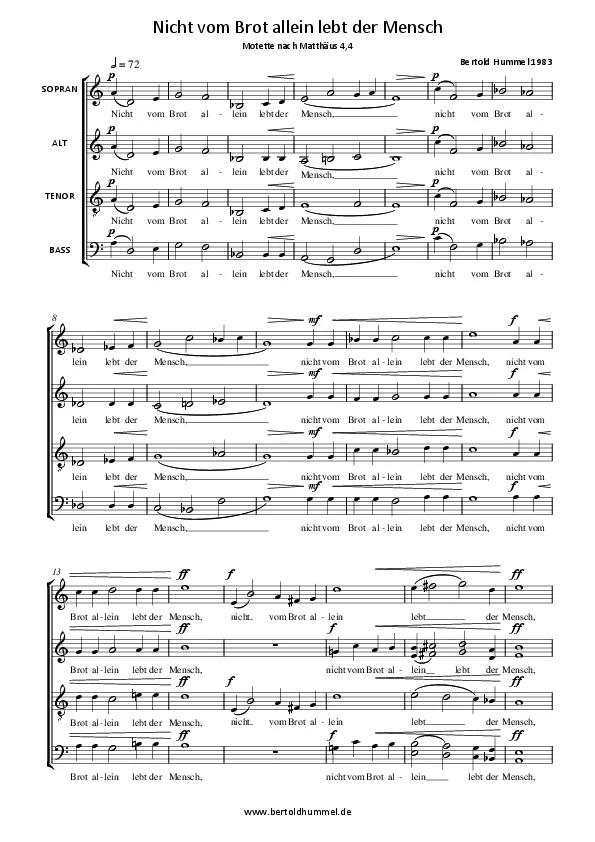
As is already clear from the briefly outlined specifics of the "Agnus Dei" (op. 18c), Hummel makes use of compositional subtleties in spite of his deliberately lay-oriented tonal language, as in his motet "Nicht vom Brot allein lebt der Mensch" from 1983. While three-stage terrace dynamics were used in the "Agnus Dei", additional transitional dynamics play a role in the motet, illustrating the text, for example, up to ff. In general, dynamic shaping is of particular importance in this composition, for example after a sonorous forte with overall highest notes "f sharp"/"g" (in m. 17) with subito pianissimo as an "internalised" means of interpretation for the passage "but of every word ... that comes from the mouth of God" (m. 19 ff); the phrase-related text repetitions are largely intensified up to fortissimo in a terraced dynamic manner. The textual syllabisation of "sondern von jedem Wort..." (but of every word...) is contrasted with extended melismas (e.g. mm. 4/5, 9/10). The non-continuous alternation of 2/2 and 3/2 metre results from the individual treatment of the text (also including syncopations). In terms of movement technique, various registers are used, from pure homophony to paraphony and polyphony. The harmonic range is articulated via consonances, (extended) consonances, assonances, with an explicit renunciation of typical dissonances with minor second tension(s), corresponding to the content of the text.
Hermann Müllich