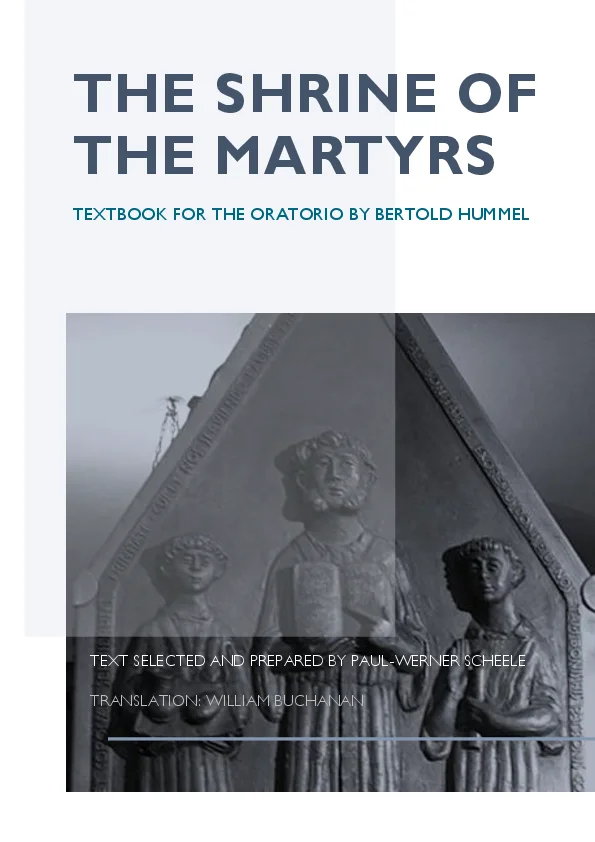
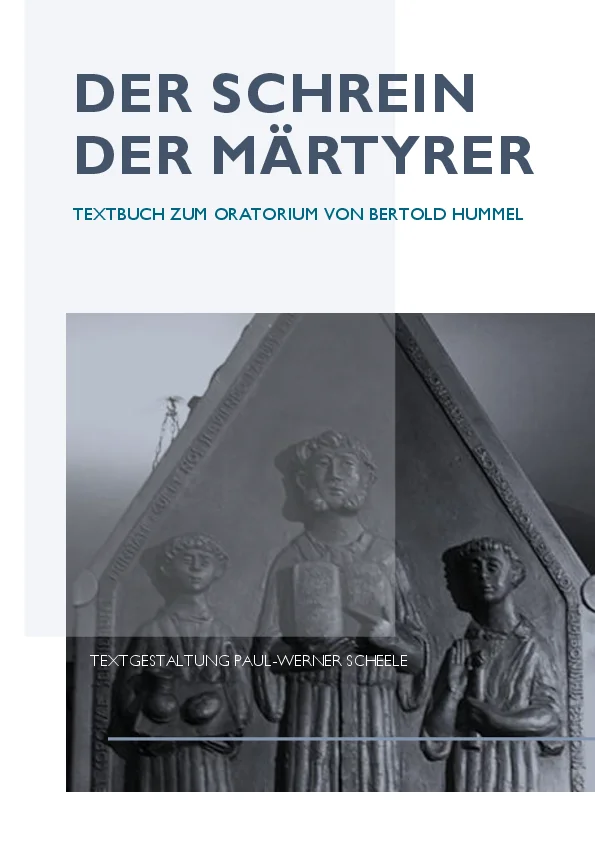
The shrine of the martyrs (op. 90, 1988)
Oratorio (Text selected and prepared by Paul-Werner Scheele)
S.D.G.
Soprano, alto, tenor, baritone, bass, narrator, mixed choir, boys' choir, 3 organs, percussion ensemble, large orchestra
Duration: 130 minutes
Barbara Schlick (soprano), Lioba Braun (alto), Clemens Bieber (tenor), Martin Hummel (baritone), David Midboe (bass), Stephan Rehm (speaker), Würzburg Cathedral Choir with Girls' Choir, Cathedral Boys' Choir (conductor: Franz J. Stoiber), cathedral orchestra, percussion ensemble (conductor: Christoph Weinhart), Paul Damjakob (main organ), Gregor Frede (choir organ), Michael Hanf (organ in the orchestra), overall conductor: Siegfried Koesler
Title: "The Shrine of the Martyrs"
Length: 362 pages
Dating: I. No.2 6.4.88 II. - III. No.14 18.9.88 / No.15 20.Sept.88 IV. No.17 8.10.88 / No.18 14.Oct.88 / No.20 20.10.88 V. No.24 16.Nov.88 / No.25 17.Nov.88 / No.26 19.11.88 / No.27 27.11.88 VI. No.28 13.12.88 / No.29 22.12.88 / No.30 29.12.88 / No.32 2.1.89 / No.33 12.1.89 VII. No.36 4.2.89 / No.37 17.2.89 VIII. No.41 3.3.89 / No.42 3.4.89 D.S.G.
Location: Bavarian State Library, Munich
Schott Music ED 20290 / ISMN: M-001-14995-2 (score and piano reduction available for purchase)
Op. 90-42, Psalm 150

The Oratorio of the Century at Würzburg Cathedral
Bertold Hummel’s *Der Schrein der Märtyrer* (The Shrine of the Martyrs) was premiered to great acclaim.
One could almost say that, for more than two hundred years, music history has indeed referred to choral works of a sacred nature, including those based on biblical texts and the like, and to works that also bear the name ‘oratorio’, in many cases only in terms of their formal structure, so that one also speaks of a ‘secular oratorio’ – which is actually nonsense, even if Haydn includes lengthy ‘Thanks and Amen’ passages in his *The Seasons* – but not of genuine oratorios. We shall not examine here why this is so. However, the thought inevitably springs to mind when one is confronted with a genuine oratorio, such as this work , ‘Der Schrein der Märtyrer’ by Bertold Hummel.
Church musicians are no doubt familiar with the composer Hummel – at least by name – even if they may not yet have sung or played any of his works, as his name appears constantly in recent publications of liturgical music. And a good organist will not only introduce his congregation to contemporary organ music through Hummel’s now-famous ‘Alleluia’, but may also be able to win them over, for the famous Easter Alleluia is clearly audible and ever-present.
Hummel understands what an oratorio truly and originally is. He was a practising church musician for many years and does not confuse the concept of the prayer hall, the ‘oratorio’, with that of the concert hall. He knows how to deal musically with the biblical, legendary and irrefutable texts of Christian doctrine at the end of the second millennium of the Christian era, incorporating tradition whilst doing justice to the present day; and, in keeping with the expressive power of the text, he evidently must do so, for what we heard was simply compelling and convincing.
The text was conceived by Bishop Paul-Werner Scheele, in collaboration with the composer, as was – and indeed still is – customary with all great vocal works. The work was commissioned by the Bishop of Würzburg – that is, the diocese of the Apostles of Franconia – to mark the 1,300th anniversary of the martyrdom of Saints Kilian, Kolonat and Totnan.
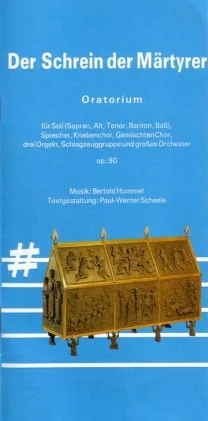
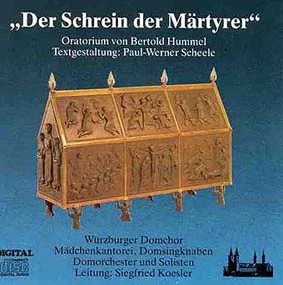
According to Bishop Scheele’s words in the superbly produced programme booklet , the work shares “the meaning and purpose, theme and structure with H. G. Bücker’s Shrine of St Kilian, which has stood in the west crypt of Neumünster Church since 1978.” The relevant sections of the shrine, which inspired the content and textual message, are also illustrated at the corresponding points in the programme booklet. The text itself contains excerpts from the ancient Irish ‘Lorica Patricii’, biblical events and New Testament texts, as well as medieval texts, hymns, sequences and other sacred poetry.
The instrumentation for this work, Bertold Hummel’s Op. 90, is astonishing at first glance. Five vocal soloists, a narrator, a large choir, a girls’ choir, a boys’ choir, an orchestra, a percussion ensemble within the orchestra and on the gallery by the great organ, a choir organ, and an organ within the orchestra. But the work was written for St Kilian’s Cathedral in Würzburg, where these resources are available.
The interplay between space and the work is not a new phenomenon. A prime example of this is undoubtedly French organ music, although in that case the organ itself is also a key element. For a performance in another church, the composer would certainly make adaptations.
Perhaps this is taking things a bit too far, but the work strikes me as so significant that it justifies mentioning the various compositional elements and practices that reflect the entire musical tradition of the Christian West.
The Trinity is honoured with organ and percussion following a spoken text from the Lorica Patricii, and the listener is plunged into the music of our own time. They are then led out by a monumental Trinity stanza—also conceived in unison in an archaic style—from a vespers hymn for the Feast of St Kilian.
During the calling of the first disciples, based on the text from Mark (Mk 1:16–18) concerning the calling of Simon and Andrew, the Evangelist (baritone) is introduced, reciting against a transparent orchestral backdrop, with the recitative elements enriched by grand, demanding melismas. Peter’s words from his First Epistle on the royal priesthood (1 Pet 2:9) are reminiscent of a classical accompagnato. The choir responds with ‘Dominus fecit nos regnum’ (0ff 1:6) in a mysteriously restrained passage of the finest polyphony.
When the Apostles of the Franks are called, Kilian (tenor) is introduced with a beautiful cantilena. From the Gospel of Luke come the following passages on discipleship, culminating in an anonymous 12th-century text with a marvellous depiction of nature and life, illustrating the omnipresence of Christ: a women’s choir of great grace, together with the all-outshining solo soprano, creates a fascinating overall sound.
In the third part , ‘Storm on the Sea’, one is reminded of a depiction of nature from the Baroque or early Classical periods, albeit with two organs and percussion instruments, creating a truly menacing atmosphere, before the Evangelist recalls the pericope of the storm on the sea (Mark 4:37–40) in the recitative.
A central part of the whole work is the Sermon on the Mount, where even the Evangelist’s announcement “et aperiens os suum dicens” (Matthew 5:1 ff.) simply gets under one’s skin. The following eight Beatitudes are distributed amongst a wide variety of solo and choral parts; the combination of alto solo and male choir for the ‘blessed are the pure in heart’, for instance, evokes something as irretrievably beautiful as Brahms’s Alto Rhapsody .
In the depiction of the missionary work of the ‘Apostles of Franconia’, the Duke’s voice (bass) commands attention when he asks God to transform his heart; in terms of instrumentation and musical diction, the secular prince appears, musically speaking, to be thoroughly ‘worldly’.
A highlight, both in its melodiousness and musical clarity and in its interpretation, is the addition to the high-priestly prayer (John 17:1) of the text from the Epistle to the Ephesians , ‘Unum corpus et unus Spiritus’, for alto solo and woodwinds. Here too, as so often in this oratorio, there is an extended vocalise that seems to carry the most beautiful Gregorian melismas into a virtuosic yet deeply internalised infinity. Something very similar follows from the soprano, accompanied by the full orchestra, following the Evangelist’s poignant account of the events at Golgotha, based on the text from John : ‘No one has greater love than this, that one lay down his life for his friends’. This is so perfectly in keeping with the text of the subsequent account of the martyrdom of the Irish monks. This is followed by the sections ‘Resurrection’ and‘Heavenly Glory’: in the ‘Christus resurrexit a mortuis’ (1 Cor. 20–22), the ancient ‘Christ ist auferstanden’ is incorporated into the composition, almost subliminally as a contribution from the faithful congregation.
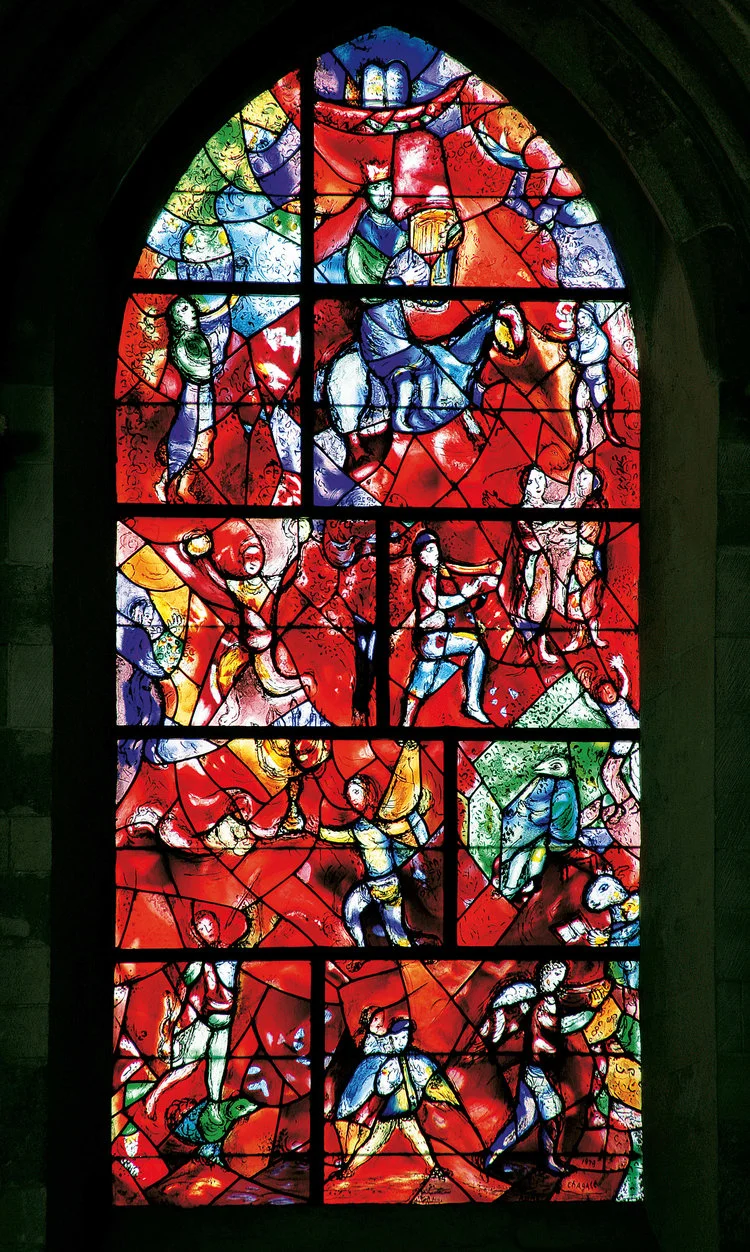
The concluding homage to the three Frankish Apostles, introduced once more by the narrator’s opening prologue, presents the Kilian Sequence through various compositional techniques, ranging from unison to organum to mixed choir. With Psalm 150, which crowns the entire work, the composer allows the piece—lasting over two hours—to build to an apotheosis of indescribable grandeur and compositional density. A density that, given the vast scale of the performance, one might have expected or even feared would pervade the entire work. This was not the case, however, for the richness and monumentality in this oratorio are achieved through a diversity arranged with marvellous transparency, which in turn must have grown entirely out of the equally diverse texts.
Here, however, he interrupts the first psalm verses of the ‘Laudate Dominum in sanctis eius’ following the opening Hallelujah with an awe-inspiring instrumental passage—structured as a sort of ritornello with iridescent string clusters set against massive brass—interrupted by the choir, speakers, spoken-word choirs, a bass solo, a soprano solo and, finally, the entire ensemble, before ultimately the ‘Gloria Patri’ is sung by all, beginning slowly in a diminuendo that encompasses everything , until only the boys’ choir remains for the ‘…in saecula saeculorum. Amen”, which does not fade away in the space but lingers on. A conclusion that radiated a fascination which created a silence lasting several minutes, an inner reflection within the packed St Kilian’s Cathedral, before the thunderous applause broke out.
FAS
Paul Werner Scheele: The oratorio "Der Schrein der Märtyrer" by Bertold Hummel, Würzburger katholisches Sonntagsblatt, Würzburg 18 June 1989




The oratorio *The Shrine of the Martyrs* shares the same meaning, purpose, theme and structure as Heinrich Gerhard Bücker’s Shrine of St Kilian, which has stood in the west crypt of Neumünster Church since 1987. Both works of art are intended to glorify God and proclaim the great deeds accomplished in Christ and the saints. Both commemorate the martyrs who met their deaths here 1,300 years ago, and at the same time the countless others who suffered a similar fate before and after them. Ultimately, both offer guidance for reflection and decision-making.
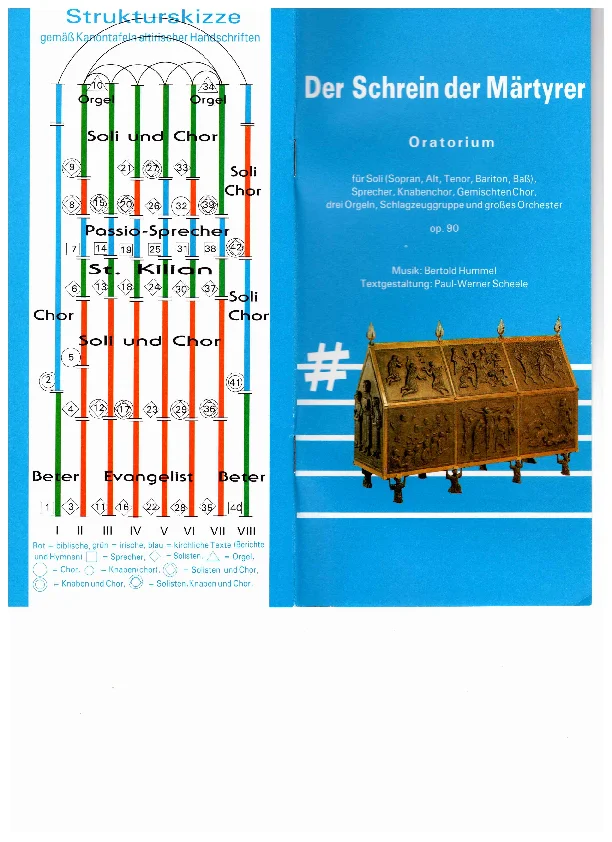
Bit by bit, the oratorio takes up the theme of the shrine by translating its structure into the language of music. At the beginning of the two large-scale outer movements are words from the ‘Lorica Patricii’, which was already part of the daily life of many Irish people in the time of the Apostle to the Franks:
“Today I gird myself with great strength
on my journey towards the Creator:
with the invocation of the Holy Trinity.”
These words are like a foreshadowing that applies to the entire work. They direct our gaze towards the Triune God, who is praised with texts from medieval hymns to St Kilian. He is the “sea, source and mouth” of all that is good. Each choral part is characterised by various three-note motifs which, both individually and in combination, point to the mystery of the Trinity, just as the relief on the throne of grace does in its own way.
This is followed by six movements, each consisting of two interrelated halves: a biblical section and a martyr section. The first is in Latin, the second in German. In accordance with the panels of the shrine, the themes are:
The Calling of the First Disciples – The Calling of the Apostles to the Franks
In the storm on the lake – On the high seas
The Sermon on the Mount – Missionary Work
High Priestly Prayer – Preparation for Death
The Cross and Death – Martyrdom
Resurrection – Heavenly Glory
The biblical event is proclaimed in each instance by the Evangelist (baritone). Soloists and choir take up the message, meditate upon it, give thanks for it and pass it on. Key biblical texts are recited, such as Rev 1:6: “The Lord has made us kings and priests before God, his Father”, Matt 5:3–10: the eight beatitudes, and Eph 4:4–6: the threefold early Christian praise of God-given unity.
Each section of the martyr’s story begins with a short passage sung by Kilian (tenor). It draws on Irish motifs that evoke fundamental human situations. The questions raised thereby find an answer in the Passio Kiliani – statements recited by a narrator from the organ loft. Soloists and choir respond to the events described and sing of them in words largely drawn from Irish testimonies. These culminate in the hymn of praise to which we owe a debt to Columbanus, a precursor of St Kilian:
“You are our one and only. You are our Lord and God.”
The final movement forms a bridge, both formally and conceptually, to the beginning of the oratorio. Once again, the “Lorica Patricis” is heard, now expanded to include a reference to the saints:
“I rise today
in the proclamation of the Apostles,
in the faith of the confessors,
in the witness of the martyrs.”
Verses from the medieval Latin Sequence of St Kilian follow. In them, original choral melodies and archaic sounds are combined with modern forms of expression. Then the Great Hallelujah is intoned, uniting all the performers. Just as Psalm 150 crowns the biblical Psalter, so it forms the glorious final apotheosis in the oratorio. The work concludes with the Doxology. The verse sung at the beginning: “Glory be to the Father and to the Son and to the Holy Spirit” is heard once more; now it is completed with the words: “As it was in the beginning, so now and evermore, and for ever and ever. Amen.”
Bishop Paul-Werner Scheele (in the programme for the world premiere on 14 July 1989)
On 12 November 2000, I heard *The Shrine of the Martyrs*, the magnum opus of my former teacher Bertold Hummel, for the second time in Würzburg Cathedral. The elemental power of this work – comparable in this respect to Orff’s *Carmina Burana* – left me deeply moved. What profound understanding of the nature of the natural world and of humanity has gone into this score: Unforgettable are the weaving and fragrant sounds of “Spring”, the dangerous inner conflict of the Duke, who wishes his wickedness might be transformed into goodness; unforgettable is the beautiful alto solo, in which Hummel has transformed the music of J.S. Bach; unforgettable are the strange sounds following the recapitulation: here a bridge is spanned over 2000 years of Christian faith.
Claus Kühnl (5 December 2000)
After a long time, I listened again to the recording of the world premiere of *Der Schrein der Märtyrer*. I believe that if one wishes to gain an understanding of the composer Bertold Hummel, one must do so through this work. Here we have a subject of great topical relevance which, like all human tragedies, can be detached from its religious context. Martyrdom means sacrificing oneself for an idea and considering whether that idea opens up better prospects for human society. The rulers of the Holy Roman Empire naturally had no interest in burgeoning Christianity. All religions are ideologies and are either accepted or suppressed by those in power. In the music of ‘The Shrine’, I also hear a tension that transcends the ‘religious-ritual’ sphere. It is a distinctive feature of musical language that it can add yet another dimension to the subject matter presented by the text. The stylistic diversity of the musical techniques employed is entirely legitimate and intended by the composer (I am thinking of Gregorian chant and organum). In any case, it was a great surprise and delight for me that your father’s work has remained so vibrant.
Alfred Thomas Müller (email to Martin Hummel, 6 July 2024)