To the King of Glory (op. 18a, 1957)
Motet for 6-8-part mixed choir a cappella
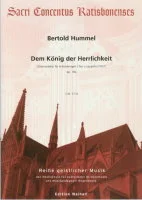
I. Hallelujah / Christ, the Lord, has conquered death, IIa. Hallelujah / Since in the splendour so wonderful, IIb. Hallelujah / To Him who rose from the dead, IIc. Christ, the reason for all praise, III King of glory, Jesus Christ
6-8-part mixed choir a cappella
Duration: 15 minutes
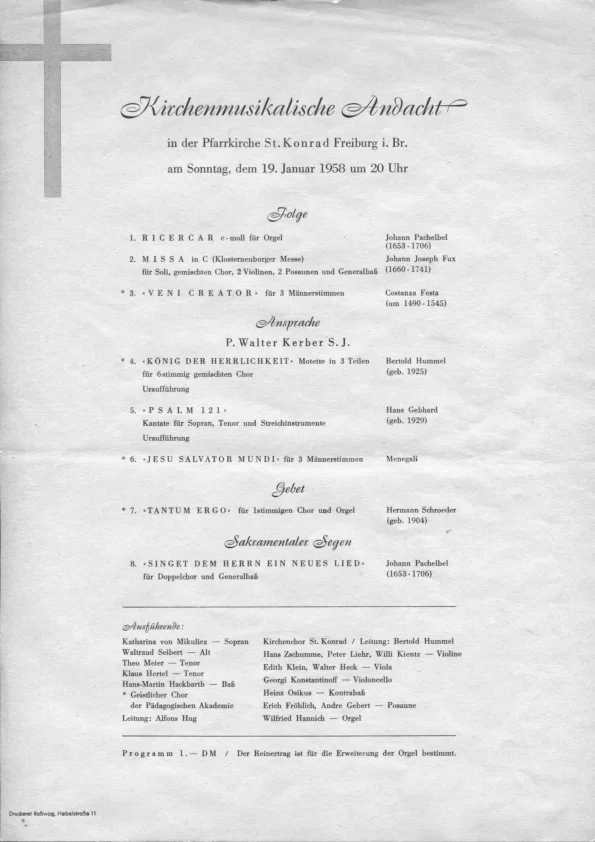
Geistlicher Chor der Pädagogischen Akademie Freiburg | Alfons Hug
Title: "König der Herrlichkeit" for mixed choir a cappella - Length: 33 pages - Date: Jan. 1957 - Location: Bayerische Staatsbibliothek Munich
Edition Walhall, Magdeburg
score EW 674, choral score EW 690
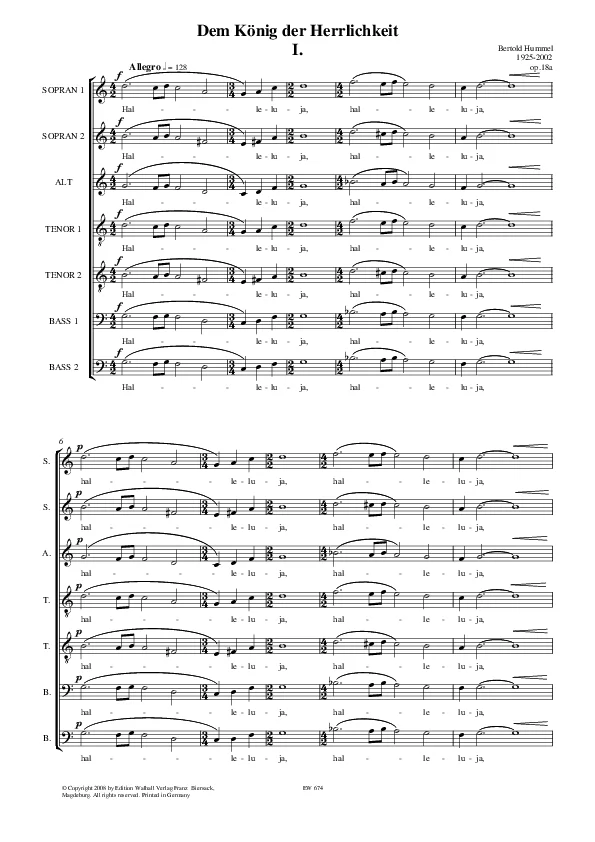
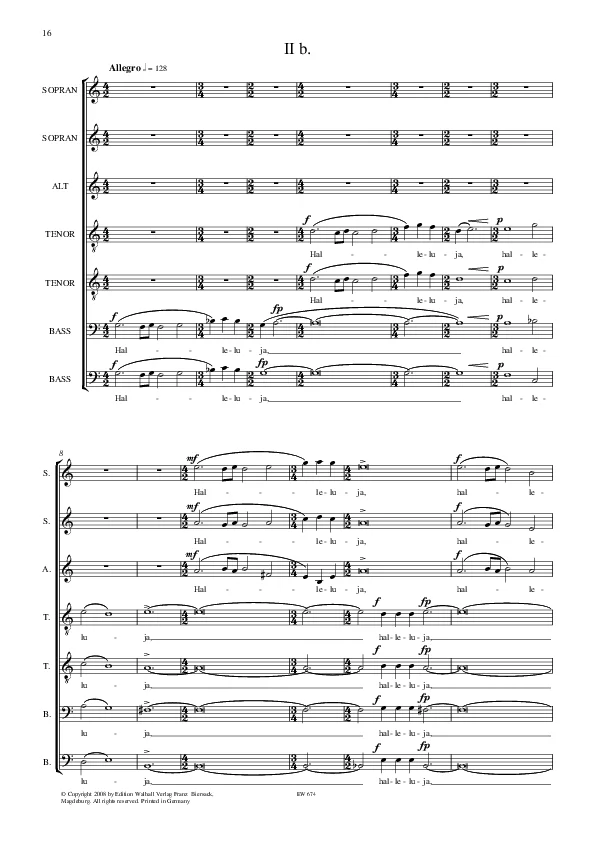
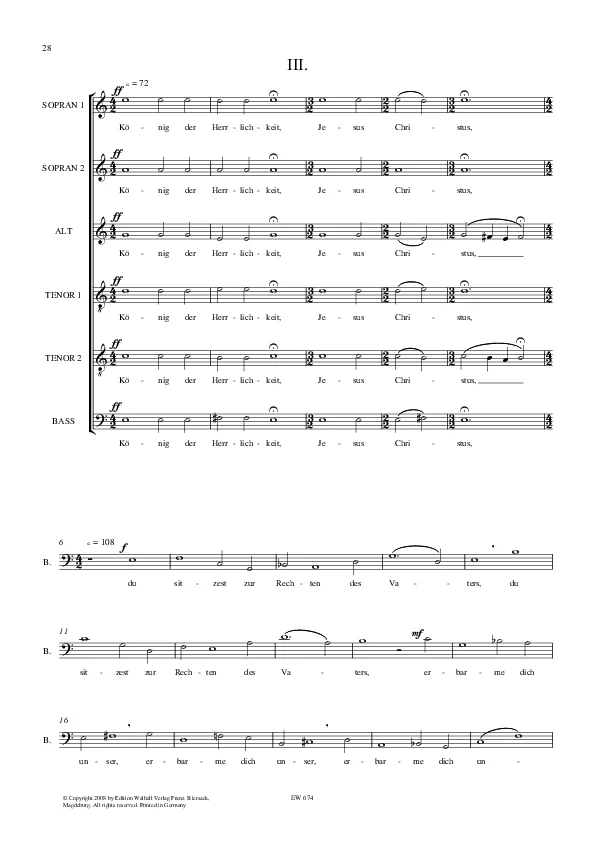
Style/principle: In a predominantly homophonic setting with occasional polyphonic parts, Hummel's Easter motet is characterised by its pleasant voice leading and good singability. The exciting tonal language, characterised by colourful mixed sounds but not overly dissonant, with clear tonal references is demanding and enriching. Hummel implements the compositional principle of the motet with its text-relatedness and dialoguing elements in echo formations between high and low male and female voices. He took his text from the Invitatory of Lauds, an old hymn to Christ and the final section of the Gloria. Opus 18a dates from Bertold Hummel's early creative period and is available here in print for the first time. It already shows in nuce the broad spectrum of expressive possibilities that the composer realised in his later years in his interdisciplinary oeuvre.
Notation: traditional
Form/structure/character: In keeping with the motet form, the musical conception of the work is closely linked to the structure of the text. The three-part structure reflects the context of the Triduum paschale as well as praising the triune God. The internal structure of individual sections is also in three parts, such as the Hallelujah (part 1) and the middle section, whose three sections are each framed by a Hallelujah. Part 3, on the other hand, is in four verses. It thematises Jesus Christ as the King of Glory, who is invoked in the Kyrie. The symbolic number four here stands for the earthly church, an effect that is further emphasised by the increase from one to four voices. Solo and two-part sections lend the Easter motet an oratorio-like character. The verses can also be performed by soloists. The wide range of tempi and the multi-faceted use of dynamic markings give the motet a strong expressive power, which is evident not least in the contrast between organ-point-like sound surfaces and the cantabile parts that unfold above them.
Performance/interpretational requirements: This demanding motet is an appealing task for a large, capable choir that already has some experience with New Music.
Use: Liturgy and concert.
Why you should tackle this piece: Hummel's haunting, modern, but not dissonance-overloaded tonal language is both challenging and beautiful in sound. A combination that should not be missed.
Barbara Stühlmeyer
The composer works with an extremely skilful sound direction ... a demanding but extremely rewarding task.
The artistic centrepiece of this uplifting hour was probably the great three-part motet for six mixed voices "King of Glory" by the young Freiburg composer Bertold Hummel. This composition utilises other values of our contemporary language than we had heard in the morning. Joyful exuberance in bouncing rhythms and shimmering to rich harmonic colourings, which are naturally contrasted with simple diatonic melody lines. Here you can clearly recognise the difference between purely liturgical music and more general sacred music.
This was followed by the magnificent motet for six mixed voices in three parts "König der Herrlichkeit" by Bertold Hummel, whose premiere performance by the Geistlicher Chor had made a lasting impression just eight days earlier in Freiburg's St. Konradskirche. The excellent interpretation made this colourful and chorally virtuosic composition a profound experience here in Weil too. All the rhythmic gestures, the broad melismatics and the changing sound mixtures were ultimately focussed on the proclamation.




Preface (Edition Walhall EW 674)
The composition presented here is addressed to Jesus Christ, the Easter Lord, "The King of Glory" as the title says. The text of Part I "Christ, the Lord, has conquered death. Come, let us sing to him." is based on the Invitatory of Lauds (GL 674,6). This part (T43-59) is framed by a broad Hallelujah (T1-42/T60-80). The text of part II probably comes from a hymn to Christ, the origin of which is unknown to me. The three verses are also structured here by a Hallelujah. Part III takes its text from the Gloria of the Mass, from the end of the middle section ("thou sittest at the right hand of the Father...") and from the final section ("for thou alone art the Holy One...").
The formal conception follows the text very closely. The entire work has a three-part structure. An introductory first section (I) is in itself tripartite (Hallelujah - Allegro / Christus den Herrn... - slow (m 43) / Hallelujah - Allegro (m 60)). The middle section (IIa / IIb / IIc) also shows three sections again, each introduced and concluded by Hallelujah, which also establishes the thematic and motivic link to the introductory section. The third part (III), on the other hand, contains four "stanzas", each framed by the invocation "King of Glory" and the plea "have mercy on us". The "stanzas", possibly also to be performed soloistically, increase from one to four voices (m. 6 / 36 / 65 / 103). A brief, four-bar ff-Amen concludes the entire work.
Hummel's tonal language is memorable and forceful, not overloaded with dissonances and yet full of tension, well-sung in the voice leading, predominantly homophonic with only occasional polyphonic passages (I M 46ff / IIc M 57ff). Again and again there are long sound surfaces over organ points (I M 13ff / Ila M 7ff, M 32ff / III M 21ff, M 50ff, M 88ff, M 125ff), chorus-typical formations such as echo formations (I T 6ff) or lower versus upper chorus (I T 11ff) and clear formal references through the recurrence of individual sections (I T 1ff = I T 60ff / IIb T 1ff = I T 11ff / IIc T 95ff = IIc T 13ff / IIc T 149ff = I T 1ff). Mixtures contribute a great deal of harmonic colour (I M 1ff / IIa M 32ff). Overall, clear tonal relationships prevail (part I in G, part II also in G with certain shading compared to part I, e.g. frequent use of the minor third or the end of Ilb in E Phrygian / part III in E minor).
This work is a rewarding task for a powerful choir and conductor who are familiar with new music and not too small due to the many voice parts. The audience will be grateful to experience an effective and haunting choral composition.
Regensburg, October 2007
Otmar Faulstich
The work is structured by the often repeated Easter Alleluia. For the most part, the full six-part sound is used, which is often stretched into shimmering colour values in three-to-three voice pairs according to differentiated sound gradients. The individual lines of this composition are quite diatonic. The second part of the motet has a melismatic character. The third part, a passacaglia, becomes the climax.
(Introduction to the first broadcast on 8 May 1958 on Südwestfunk Baden-Baden)