Dietrich von Bausznern
19 March 1928, Rastenburg – 20 January 1980, Kirchzarten

The composer Dietrich von Bausznern was snatched from an extraordinarily passionate, productive and successful life by death on 20 January 1980, following a brief but insidious illness. He was at the height of his prolific compositional career – brimming with plans and ideas – a charming, significant and highly respected figure.
Dietrich von Bausznern was born on 19 March 1928 in Rastenburg, East Prussia, the son of a vicar.
His ancestors had held high government posts in Transylvania. Dietrich von Bausznern must surely have inherited his exceptional talent for composition from his grandfather, Waldemar von Bausznern – the eminent composer (1866–1931) and university director.
Due to the war, he first found himself near what would later become his second home in 1943–44: as a grammar school pupil at the Birklehof School in Hinterzarten in the Black Forest. After completing his A-levels in Potsdam, he began studying music in Weimar, where his grandfather (1910–1916) had been director of the conservatoire. In 1949, he moved to Freiburg im Breisgau, where he studied at the University of Music until 1953. His composition teacher was Harald Genzmer, who later praised him as a “distinguished composer” and described him as a “man with clear ideas, a sense of responsibility and a willingness to work hard”. His versatile talents were already evident whilst he was still a student. As early as 1950, he became a permanent freelance contributor to Südwestfunk’s school radio department. A vast number of programmes, which he oversaw at Studio Freiburg until the closure of the organisation, bear his unmistakable musical stamp.
In addition, his successful work as a lecturer in music at the University of Education in Freiburg, and as a cantor, organist and orchestral conductor, is also worth mentioning. In 1969, he was appointed as a composer at the Richard Strauss Conservatoire in Munich.
In 1973, he was appointed as a senior lecturer in music theory at the Frankfurt University of Music. He was promoted to professor there in 1979. Kirchzarten remained his permanent residence until his death. It was here that, in 1971, he founded the ‘Kirchzarten Concerts’, which have since become a household name; from the very beginning, their calibre and programme were shaped by the artistic personality of Dietrich von Bausznern.
The versatility of his work is also reflected in the large number of honorary positions he held: he was section chair for Hesse/Saarland and Rhineland-Palatinate within the German Composers’ Association. He was a member of the DKV’s Executive Committee, a deputy supervisory board member of GEMA, a member of the music committee of the Breisgau Singers’ Association, a member of the parish council of the Protestant parish of Kirchzarten, and a member of the district synod (Freiburg). In the 1960s, he was a co-founder of the “Wuppertal Modern Music Working Week”. His selfless commitment to a wide variety of bodies was always guided by the desire to initiate and help shape meaningful developments, as well as to assist others; however, it also demanded many sacrifices in terms of time and energy, which he was unable to devote to his creative work as a composer.
His approximately 300 extant compositions span almost every genre of music. From simple organ preludes to demanding oratorios, from pieces for children to full-length ballets, D, v. B. realised his compositional visions with the same unwavering commitment. His works were widely performed not only in Germany and on German radio stations, but also in Denmark, France, the Netherlands, Austria, Sweden, Switzerland and the USA. A large number of his works were recorded on vinyl.
In 1966, D. v. B. was awarded the Reinhold Schneider Prize (Freiburg) as a special encouragement award. In 1973, he received the Johann Wenzel Stamitz Prize (East German Music Prize) in Stuttgart.
The renewal of Protestant church music was a particular concern of his. In twelve demanding sacred concertos and oratorios, including such impressive cantatas as “Der Ackermann und der Tod” (1962) and “Die Herrlichkeit des Herrn” (1960), D. v. B. demonstrated the high standard of his compositional skill.
His mastery enabled him to achieve maximum expression and poignancy even with simple means, so that some of his works were spontaneously incorporated into church music practice, with which he maintained close ties throughout his life.
His personal style was shaped by his immense compositional experience, his musical vitality and his openness to all convincing innovations;
Clear thematic development, colourful instrumentation, nuanced rhythm and a pronounced sense of form characterise all his works, which are marked by an original engagement with the tension between tradition and modernity.
We owe D. v. B. a debt of gratitude for his extensive life’s work and for the standards he set as a person and an artist. The friends who must now live without him are grateful for countless hours of cheerfulness and joie de vivre, as well as for hours of serious conversation and reflection, and for his reliable, kind friendship, underpinned by genuine humanism. We do not wish to, and will not, forget him.
Bertold Hummel (published in *Der Kirchenmusiker*, Vol. 31, No. 3, May/June 1980, Merseburger Verlag, Kassel)
Biography
Dietrich von Bausznern was born on 19 March 1928 in Rastenburg (East Prussia), grew up in Stolzenberg (Pomerania) and fled to Potsdam at the end of the war. Here he took music lessons with Hans Chemin-Petit and obtained his school-leaving certificate. He studied briefly (1947 to 1949) with Ottmar Gerster at the University of Music in Weimar, then moved to Freiburg im Breisgau, where he studied with Harald Genzmer from 1949 to 1953. Even whilst still a student, he was appointed as a permanent member of staff in the school radio department of Südwestfunk. Key stages in his professional career included his posts as a lecturer at the University of Education in Freiburg (1962 to 1969), at the Richard Strauss Conservatoire in Munich (1969 to 1973) and, from 1973 onwards, as a senior lecturer in music theory and composition at the State University of Music in Frankfurt am Main. He was appointed professor there in 1979. From 1952 onwards, he also served as cantor and organist in Kirchzarten (in the Black Forest), where he lived and where he was director of the ‘Jugendbildungswerk Musik’ (Youth Music Education Centre) and, from 1971, of the ‘Kirchzartener Konzerte’. He also held leading positions at the ‘Wuppertal Modern Music Working Week’, the German Composers’ Association, GEMA, the Breisgau Singers’ Association and various church committees. Among the honours bestowed upon him were the Reinhold Schneider Prize, the Johann Wenzel Stamitz Prize, the Golden Badge of Honour from the town of Kirchzarten and the Federal Cross of Merit.
His main concerns as a performer and composer included the preservation of the spiritual traditions of Protestant church music and the renewal of this music within the context of its heritage. His varied, tireless and often gruelling activities were cut short by his untimely death on 20 January 1980. His compositional output comprises twelve sacred concertos and four cantatas for soloists, choir and orchestra (or organ), eleven motets, as well as songs and choral pieces, organ music, orchestral works, concertante works for piano and orchestra, chamber music for melody instruments with piano or organ and for other ensembles, as well as a ‘youth opera’, a ‘radio opera’ and a Singspiel for children.
Analysis of the work: Wind Quintet
Dietrich von Bausznern composed his Wind Quintet in 1974.
In this four-movement work, we see the composer at the height of his creative powers, characterised by a vivid imagination and consummate mastery of compositional technique and instrumentation.
Bausznern knows how to make his musical rhetoric – often developed from minute motifs and sonic gestures – have a spontaneous effect. His aim is to make music accessible.
Thus, in the first movement of the quintet (very calm), Baroque phrases and ornaments are employed to shape the form. The constant, captivating variation of the musical ideas fits together like a mosaic to form the whole.
The three-part second movement (lively), strongly characterised by rhythmic impulses, takes up techniques from the first movement – yet leads them to entirely new combinations. Staccatos and accents predominate and define the character of the movement.
In the third movement (calm, firm), tranquil soundscapes provide space for soloistic melodic developments – once again, metamorphoses of Baroque ornamentation are artfully at play.
The concluding fourth movement (very fast) appears, as it were, as a development of the entire work. It acquires a distinctive character through its compelling motoric drive (dotted rhythms, ostinato figures, etc.) and through unexpected, surprising pauses. Rhythmically accented structures predominate in this highly effective finale.
The entire work exudes musical vitality and the spirit of the contemporary musician, who, drawing on the Baroque spirit, has opened up entirely new possibilities for himself and, thanks to his talent, has arrived at a style of expression that is both characteristic of him and unmistakable.
Bertold Hummel
18 March 1990
“in memoriam …” for organ and percussion, Op. 74 (1980)
Dedicated to the memory of my friend Dietrich von Bausznern
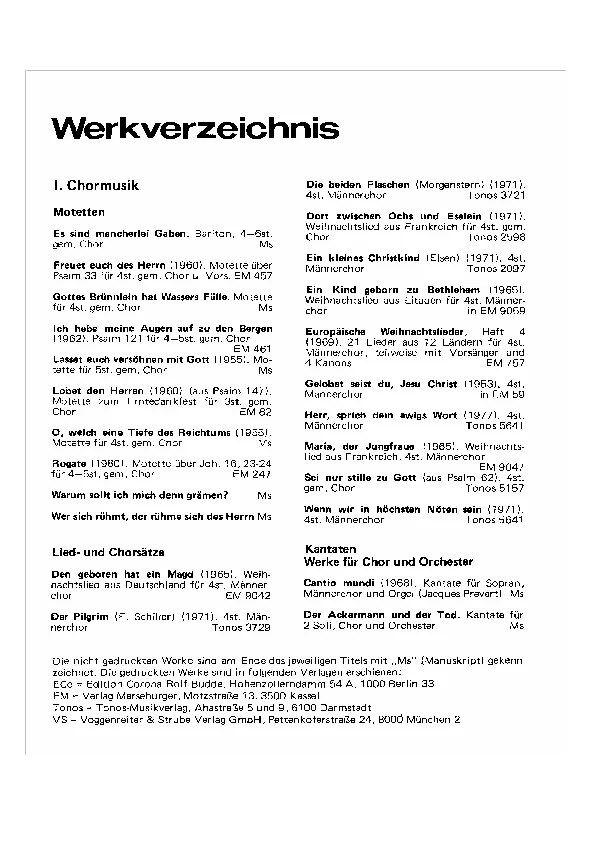
Catalogue of works by Dietrich von Bausznern