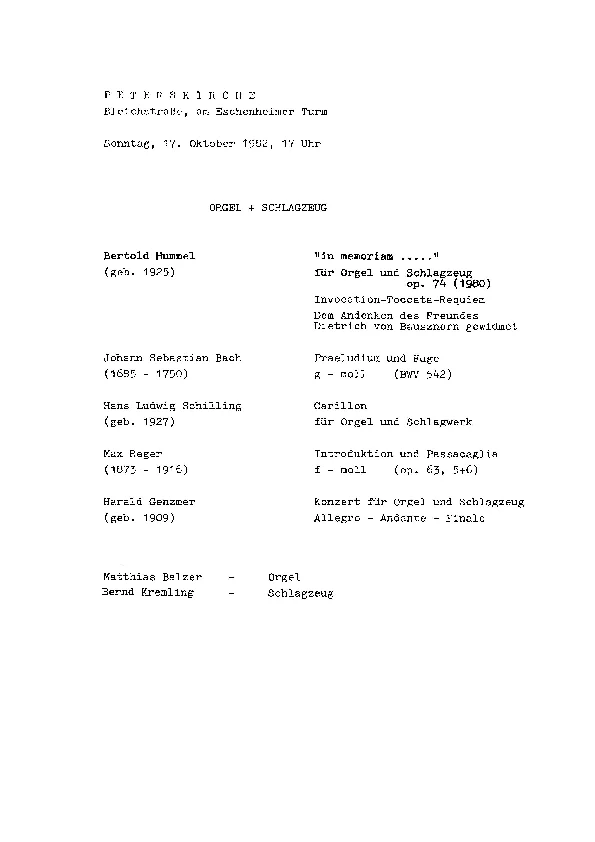
in memoriam ... for organ and percussion (op. 74, 1980)
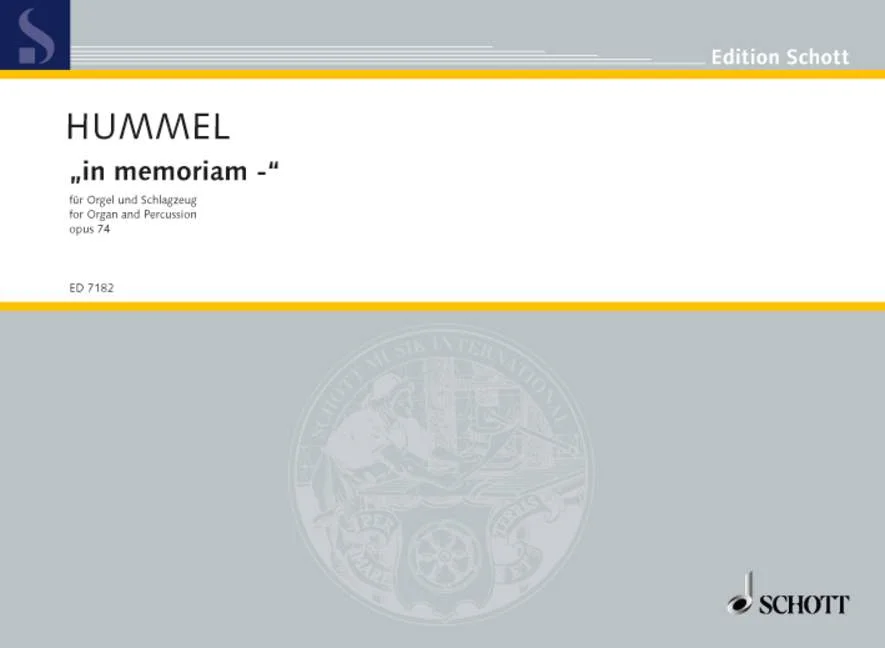
Dedicated to the memory of his friend Dietrich von Bausznern
I. Invocation, II. Toccata, III. Requiem
Organ, percussion (vibraphone, 2 bongo, 2 conga, snare drum, claves, temple block, wood block drum, tam-tam, gong, 4 cymbals, studded cymbals)
Duration: 14 minutes
Bernd Kremling | Matthias Balzer
Title: "in memoriam ..." for organ and percussion op. 74 (1980) - Length: 26 pages - Dated: I. 21.Aug.80 II. 27.Aug.80 III. Würzburg 27.Aug.80 - Location: Bavarian State Library Munich
Schott Music ED 7182 / ISMN: 979-0-001-07529-9
... a highly impressive composition that places a large percussion section on an equal footing with the organ. Sound effects of startling forcefulness created an image of deep sadness and emotional despair. With this work, Hummel succeeded in creating a wealth of magically fascinating sound visions in the Invocation, Toccata and Requiem movements. The chorale "Wenn wir in höchsten Nöten sein" ("When we are in dire straits") was heard as a solitary cantus firmus at the end, accompanied by a strangely pale bass "forlornly", with dabs of vibraphone providing light. Claus Hecker on the organ and Axel Fries on the percussion succeeded in creating a rendition that was able to shake the audience. The bold composition sounded convincing.
The unreal floating of the seventh and tritone sounds on the vibraphone, the long trills and shimmering runs of the organ, everything is of an exquisite, meditative colourfulness. This is dynamically enlivened, almost explodes in a motorised toccata, in pulsating rhythms on cymbals, woodblocks and tom-toms, and is finally pacified in a chorale that glides quietly into the vague, open.
Bertold Hummel is different: he likes to mislead the audience with his "In memoriam" (op. 74). Again and again, cascades of hard wood block and tom-tom sounds intersect the heavenly iridescence of the vibraphone; sometimes it miraculously merges with the organ to form a single, homogeneous body of sound and seems to be lost in thought and dreaming, until - completely unexpectedly - a cheeky, scratchy-loud percussion attack startles everyone out of their stupor. Truly not an everyday concert - but certainly one that many will be waiting to see again.
... a work that gets under your skin, even - or especially - if you don't realise that Hummel uses the musically usable letters of Bausznern's name as sound material and quotes a chorale in the third movement - Requiem. In an ever-increasing "Invocation", a fantastic "Toccata " (it was hard to believe that only a percussionist could produce these rapid changes of the most varied tone colours) and a meditative"Requiem", both performers also achieved the utmost precision in their interplay.
This led into the powerful final piece: the composition "In memoriam" by Bertold Hummel for organ and percussion. In the first movement Invocation, an invocation to God, melodies soar upwards and culminate in a relentless plea. The second movement, a toccata, expresses joie de vivre. Weissert and Volz performed with corresponding virtuosity in these movements, which moved between loud eruptions of sound on the organ and impressive percussion instruments and small, quiet islands of melody. The audience thus experienced a highly stimulating sound adventure away from the usual standard repertoire - with "open and curious ears", as the musicians, who received great applause, had hoped.
Hummel's "In memoriam -", dedicated to the memory of his friend Dietrich von Bauznern, also a professor of composition, placed the highest demands on the organist and percussionist. While the first movement, "Invocation", is characterised by a propulsive gesture, all forces are virtually unleashed in the following Toccata. Rapid dynamic and rhythmic changes, various trill figures, virtuoso runs on the organ and permanent manual changes, repeated exchanges of the various mallets in the percussion to serve the entire percussion palette, created a captivating drama that could only be followed breathlessly. In the following Requiem section, the entire compositional material is then brought together as a synthesis. After an acoustic climax, the work ends most impressively in pianissimo with the gentle introduction of the chorale "Wenn wir in höchsten Nöten sein".
Bertold Hummel's op. 74 "in memoriam" left a no less profound impression, its four sections on organ and marimba revealing a wealth of highly sensitive musical thoughts, with passages of almost mystical contemplation contrasting with emotional upswings to create haunting contrasts.
You don't notice that the work is full of intellectual artifice: the letters of a deceased friend's name are incorporated into it in many different ways. Rather, one feels fundamentally moved by this music.
Three economical movements without idle time, whose sometimes dramatic development animated the soloists to a rousing discharge of energy. The organ and percussion parts are closely intertwined in lushly proliferating sound gestures and filigree detail work.
The audience got involved with the music and were deeply impressed at the end. The brilliant opening with the Toccata, Requiem and final chorale "Wenn wir in höchsten Nöten sein" from "In Memoriam op. 74" by Bertold Hummel (1925-2002) in the unusual combination of organ (Josef Reichl) and percussion (Jan van Meerendonk) was a first highlight.
The duo ventured a special conclusion with "In memoriam" Dietrich von Bausznern. Encoded in this furious opus by Bertold Hummel, which can hardly be surpassed in terms of drama, was a curious sequence of notes. This goes back to the name of the deceased colleague Bausznern, to whom the composer dedicated the piece. It consists of the letters of the name, which were adopted as note names, as Volz explained. After this fire of vitality, an encore was demanded with long applause.
Hummel's "Concerto for Percussion and Organ" is a showpiece of modern church music in its complexity. The floating sounds of the vibraphone together with the shimmering runs of the organ create an almost meditative atmosphere. (...) Hummel created a wealth of magical sound visions in the three movements, which ends with the chorale melody "Wenn wir in höchsten Nöten sind". The pulsating rhythms on the cymbals, wood blocks and tom-toms that multi-percussionist Henning Kirsch, who had set up his percussion arsenal in the chancel, played to the organist in the gallery were masterly. Carsten Ehret responded just as excellently to a sometimes almost curious percussion sequence with short, precise notes on the organ.
Literature list of the German Music Council for the competition "Jugend musiziert":
Level of difficulty 4 and 5 / difficult - very difficult (intermediate level II - advanced level)
Literature tips:
Dietrich von Bausznern (1928-1980)
Concerto for organ and percussion (1976)
Performance time 20 minutes
Publisher Merseburger
Order number: EM879
Peter Michael Hamel (*1947)
Im Schweigen der Betrachtung for organ and percussion (2012)
in memoriam Bertold Hummel
Performance duration 10 minutes




Op. 74 was composed in 1980 at and is dedicated to the memory of the composer and friend Dietrich von Bausznern, who succumbed to an insidious illness in January of the same year.
In the three short movements Invocation - Toccata - Requiem, the musical letters D-E-C-H - B-A-Es-E of Dietrich von Bausznern's name are used in a variety of ways.
The Invocation - with its urgent gestures - is contrasted with a motoric Toccata, which gives the skin and metal instruments the opportunity to develop virtuosity.
The entire motivic material of the work is brought together arioso in the centre of the concluding Requiem. After an acoustic climax, a recapitulation leads to a quotation of the chorale melody "Wenn wir in höchsten Nöten sein". The work fades away in the extreme pp.
Bertold Hummel