Boris Goldstein
25 December 1922, Odessa – 8 November 1987, Hanover
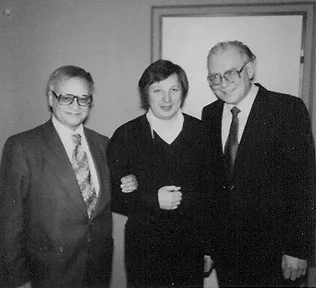
It was in 1975 that I first had the opportunity to meet Boris Goldstein. At a concert in Bad Kissingen, I was able to appreciate the magnificent qualities of this exceptional violinist. - In my capacity at the time as Vice-President of the University of Music in Würzburg, I managed to persuade Boris Goldstein to apply for a newly vacant professorship in violin. Following a brilliant artistic and pedagogical presentation, his appointment was merely a formality.
Soon after he took up his post, the first students began to apply for his masterclass, coming from both Germany and abroad. The international reputation of this prominent teacher spread rapidly, with the result that, within the space of a few years, the standard of violin playing at the university was raised considerably. His intensive – and at times relentless – teaching in the ‘Russian school’ style yielded exceptional results among the students. The Goldstein class recitals were always a special occasion. Special events – such as a grand Heifetz soirée to mark the 8th birthday of the revered old master – were universally well received.
The principal Würzburg pupils of Goldstein are (listed alphabetically): F. Barbari, Th. Berg, E. Bovensberg, M. Brokate, F. Brumat, L. Fischer, M. Fischer, J. Frucht, M. Guttmann, J. Haus, M. Herr, M. Kordowich, W. Krönner, O. Nodel, A. Nordmeyer, R. Novacek, T. Mehlin, A. Meshibowsky, E. Meyer-Berkhout, A. Pasternak, M. Perl, A.-M. Sirén, A. Skwortsow, K. Stojanow, J. Szentpali-Gavaller, M. Szykulski, F. Tempel, I. Varenberg, I.v. Weienberg, W. Zippelius. Most of them now hold important positions in the national and international music world. Thanks to his friendly and affable manner, Boris Goldstein was held in high regard and was much loved throughout the university – by colleagues, students and staff alike.
Personally, I owe him a great deal of gratitude for his valuable guidance as a composer. Working closely together, we produced the *Dialogues for Violin and Organ*, Op. 63, a demanding three-movement work which received its brilliant world premiere on 7 October 1977 in Hanover, performed by Boris Goldstein and the organist Manfred Brandstetter. This was followed by a recording with the organist and composer Claus Kühnl. This, too, received very positive reviews. Boris Goldstein offered friendly advice during the composition of my Suite for Solo Violin, Op. 78, which was written in 1982. As conductor of a chamber orchestra, I had the opportunity to perform J.S. Bach’s Violin Concerto in E major on several occasions with Boris Goldstein as soloist. As I had by then been elected President of the University of Music, I was able to establish some important contacts with radio broadcasters and record companies on Boris Goldstein’s behalf.
Over all those years of working together at the University of Music in Würzburg, a trusting friendship developed, underpinned by mutual respect and personal affection. Whilst on a trip to North America in the autumn of 1987, I received news of his sudden death, so that, to my great regret, I was unable to pay my last respects to him. This irreplaceable loss was, and continues to be, mourned by a large circle of his friends. Boris Goldstein has left a profound artistic and personal legacy! I shall always remember him with gratitude.
Bertold Hummel
Biography
Boris Goldstein, born in Odessa in 1922, was an outstanding violinist from a young age. At the age of ten, he performed Mendelssohn’s Violin Concerto on the radio with the Moscow Radio Orchestra, thus launching a sensational career. His teachers were P. Stoljarski, A. Jampolsky, L. Zeitlin and K. Mostras. The young violinist soon won prizes at prestigious competitions in Moscow, Warsaw and Brussels, followed by triumphant concerts in many European capitals. Famous musicians such as Kreisler, Prokofiev, Heifetz and Menuhin spoke admiringly of Goldstein’s playing. His rivals at international competitions included David Oistrakh, Ida Haendel and Arthur Grumiaux. Following a performance at the Wieniawski Competition in Warsaw, none other than Heinrich Neuhaus remarked of the young Goldstein: “One is astounded by his thoughtful and mature playing, his sense of style, and the depth and precision of his performances, which many masters would envy.” In the Soviet Union, Boris Goldstein recorded numerous records and tapes of violin and chamber music works, including pieces dedicated specifically to him. He performed regularly on the radio and made a great many recordings. Prokofiev’s Second Violin Concerto received its world premiere through him, conducted by the composer himself. In 1974, Boris Goldstein emigrated from the then USSR to Germany, where, from 1976, he led a masterclass as a professor at the University of Music in Würzburg. His performances as a violinist in Germany and Western Europe were unforgettable highlights of his career. Wherever he performed, he was celebrated by audiences and the press: ‘… a legendary violinist… a master of the great Slavic school of violin playing …” (Daily Telegraph, London, 1986). From 1981 onwards, Boris Goldstein undertook numerous tours at home and abroad with his daughter Julia, performing in Spain, Italy, France and Belgium to overwhelming acclaim. As a teacher, Goldstein was one of the most successful in his field. Many of his pupils went on to win prizes at a wide variety of international violin competitions. Boris Goldstein died in Hanover in 1987.