Dialogues for violin and organ (op. 63, 1977)
written for Boris Goldstein
I. Fantasia, II. Aria, III. Finale
Violin, organ
Duration: 17 minutes
Boris Goldstein | Manfred Brandstetter
A score /B violin part: Title: Dialoge für Violine und Orgel (1977) op. 63 / Dialogues for violin and organ op. 63 - Length: I. and III. movement 44 pages / 14 pages - Dating: I. 2.1.77 / II. - III. 16.1.77 Würzburg - Location:
Schott Music ED 20282 / ISMN: 979-0-001-14977-8
First edition: J. Schuberth & Co., Eisenach 1995
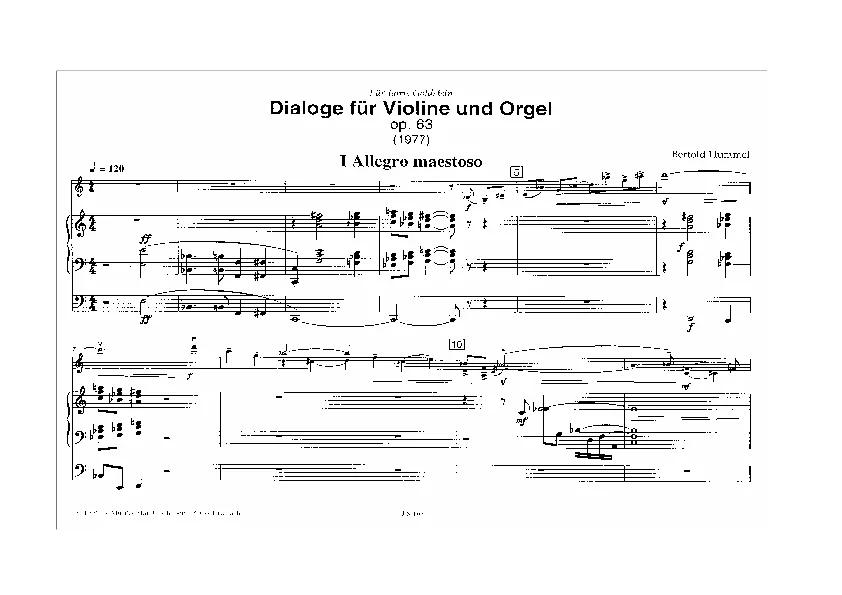
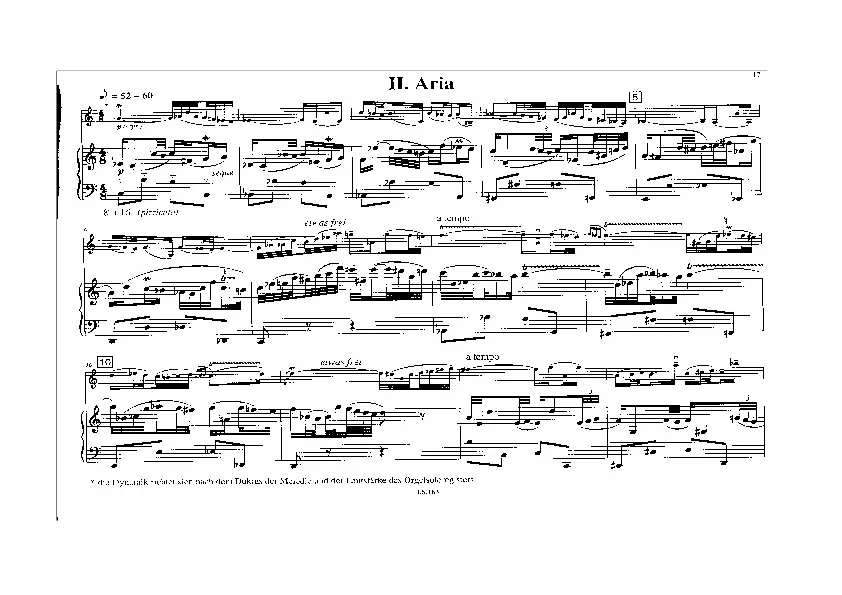
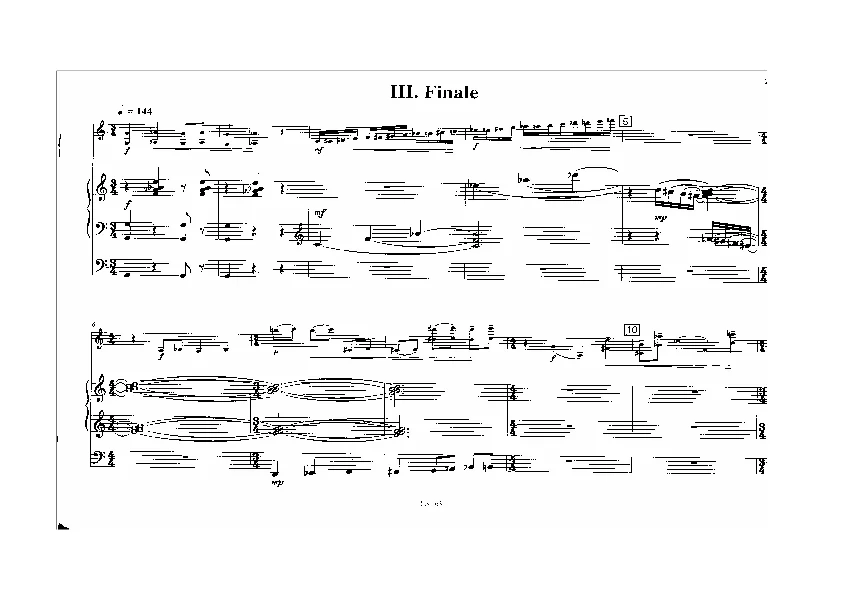
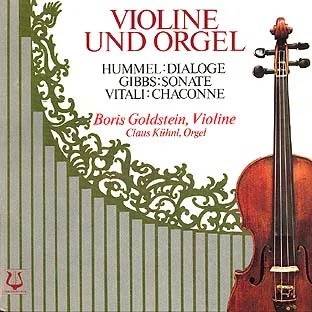
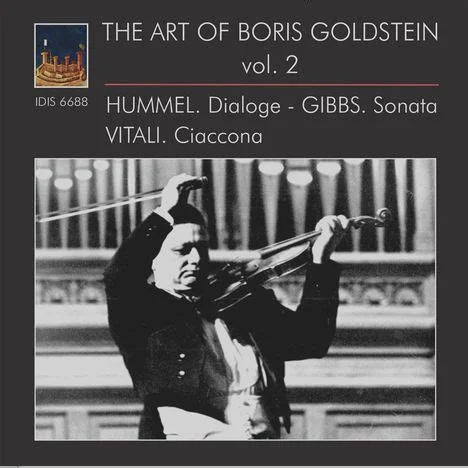
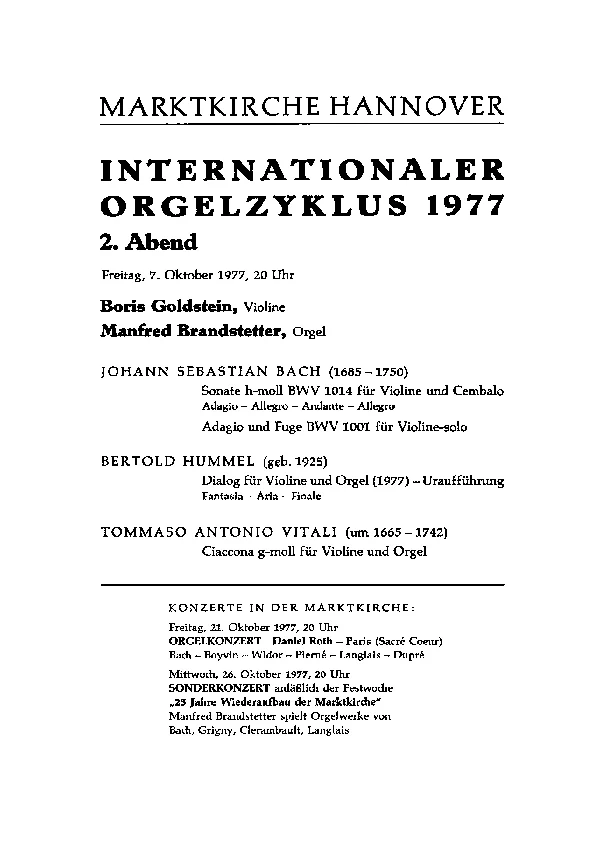
Here we heard genuine literature, not a solution written by chance for this instrument, nor a work that could be transferred to any other instrument. Hummel wrote this composition into the"heart of the violin". The form, unity and clarity of thought, imaginative and intellectually penetrating, unfold a strength of expression and a wealth of musical ideas that assure the young opus a firm place in the corresponding, sparsely considered literature.




In our time, we have become all too accustomed to measuring a composer by what he has invented that is "new". New effects are perceived as sensational, and yet they are meaningless as long as they are not based on an inner necessity. In this sense, Hummel can certainly not be counted among the avant-gardists. However, the opposite would be equally wrong, namely to categorise him among the traditionalists. Hummel mastered all the essential newer compositional techniques and used them sensibly in his works. This is why his works are particularly suitable for experiencing new music spontaneously. Hummel wrote his dialogues for the violinist Boris Goldstein. Goldstein wanted the second movement to be in the spirit of Bach. The composer therefore borrowed from Bach's patterns, but without denying his own language. As a result, this movement became an impressive example of how old forms can be filled with a new spirit. The finale is characterised by breathtaking virtuosity. Hummel applies new playing techniques, such as clusters, so logically and consistently that they fit into the stylistic structure without any constraints. The first movement lives from the interplay between violin and organ and probably contributed to the naming of the piece(Dialogues).
Claus Kühnl (Record cover Christophorus LP 73902)
The title "Dialogues" is very well chosen, as the compositional structure of the 3 movements shows:
While in the 1st movement both instruments are confronted with each other, i.e. are in constant interplay (in this respect comparable to the classical concerto in the sense of a competition between solo and orchestra), violin and organ unite in the "Aria" to form an artful 3-part movement modelled on J.S. Bach. The finale offers both instruments the opportunity to develop their virtuosity in delightful, dialoguing passages. The 1st and 3rd movements are directly linked by the common thematic material: minor third, tritone and a mode consisting of the sequence "minor - major second". While in the 1st movement the basic intervals (third, tritone) are used to develop three opposing thematic groups, constantly interspersed with development sections, in the final movement they are used exclusively to form chords. The events in the 3rd movement are no longer determined by themes in the usual sense, but by motifs based on the "minor-major second mode". Larger groups emerge, so to speak, composed of the smallest building blocks. The new mode is constantly present, sometimes as motoric interjections, sometimes as a movement in an almost inexhaustible imagination in ever new forms. In the 1st movement, this mode plays a role both as the bass foundation of the stylised chorale at the centre and as a motivic counterpoint to the interval constellation "minor third", "tritone". The "Aria", the 2nd movement, follows its own laws. On a chromatically rising and falling bass, the composer develops two lines - corresponding to each other in the polyphonic texture - which are intensified according to the principle of variation through increasing compression.
In terms of form, unity and expressiveness, this is a masterpiece in a genre of music literature where original works are scarce.
Claus Kühnl (Notes on the programme on 13 November 1977)