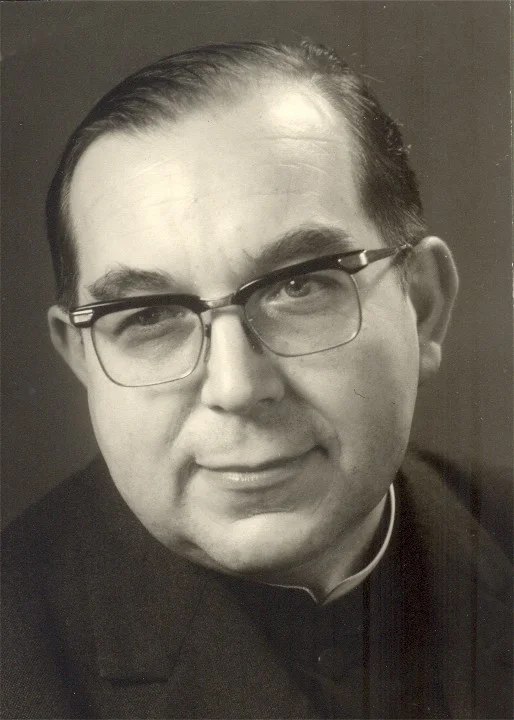
Franz Fleckenstein
8 June 1922, Würzburg – 5 January 1996, Würzburg
“During my time as a cantor in Freiburg and later in Würzburg, my works for the human voice focused on the composition of a large number of liturgical motets, chorales and hymns; in this regard, I must mention – not least – my personal contacts with the cathedral music directors Franz Stemmer (Freiburg im Breisgau), Franz Fleckenstein and Siegfried Koesler (Würzburg) – who repeatedly commissioned me to write music for their choirs and also to compose new chants for the liturgy.”
Bertold Hummel 1998
Works premiered by Franz Fleckenstein
- Würzburg Cathedral Mass for soloists, choir, congregation and large orchestra, Op. 31a
- Würzburg Cathedral Mass for soloists, choir, congregation, strings and organ, Op. 31b
- Proprium for the Feast of the Apostles of the Franks for soloists, choir, congregation and large orchestra, Op. 32
Bertold Hummel dedicated the motet *Veni, Creator spiritus*, based on the Gregorian hymn for two mixed choirs and organ, Op. 97d, to Franz Fleckenstein on his 70th birthday
Biography
Franz Fleckenstein. Born in Würzburg, he was a member of the boys’ choir and organist at the Carmelite Church (Reuererkirche) whilst still a schoolboy. He studied church music in Regensburg, served for some time as prefect of the Domspatzen, and passed his music matriculation examination there in 1941. This was followed by military service in various countries; after the war, he studied theology and was ordained a priest in 1950. Following several years as a curate in Miltenberg, he became music prefect of the Kilianeum in 1953, cathedral vicar in 1960 and, after Easter 1961, cathedral music director. He left Würzburg in 1970 to take over the directorship of the Regensburg School of Church Music, which later became a specialist academy. From 1974 to 1984, he served as regional president of the General Cecilian Association for Germany and was appointed to numerous committees and conferences. Upon his retirement in 1987, he returned to Würzburg, where he continued to undertake pastoral duties and took up a teaching post in church music at the Conservatoire. Among the honours he received were the title of Monsignor from the Vatican in 1973, the Albertus Magnus Medal from the City of Regensburg, and the Federal Cross of Merit from the Federal President. On 11 January 1996, his Requiem in the cathedral and his funeral at Würzburg City Cemetery were accompanied by music provided jointly by the Regensburg School of Church Music and the Würzburg Cathedral Music Department.
Fleckenstein’s tenure as cathedral music director coincided with the far-reaching reform of church music brought about by the Second Vatican Council in 1963, with its emphasis on congregational participation and the use of the vernacular. He embraced this reform, having initially adopted his predecessors’ liturgical arrangements featuring Latin choral Masses. In the years following 1964, Latin Masses with choir and congregation by Gelineau, Heino Schubert and Schroeder were first performed, followed by German-language Ordinarys such as those by Schieri, Heino Schubert, Rohr, Schroeder, Faulstich and Damjakob, and the large-scale German-language Würzburg Cathedral Mass by Hummel for the cathedral’s reopening in 1967. Towards the end of his tenure, Fleckenstein largely returned to the Latin choral Mass, albeit on the premise that there must always be a balance between choral and congregational singing (hymns, antiphons).
(from: Siegfried Koesler: Cathedral Music in Würzburg in the First Two-Thirds of the 20th Century (in: Dieter Kirsch / Ulrich Konrad (eds.): Church Music in the Diocese of Würzburg – Studies and Sources from the 16th to the 20th Century, Würzburg 2010)