Proprium (for the feast of the Apostles of the Franks) (op. 32, 1967)
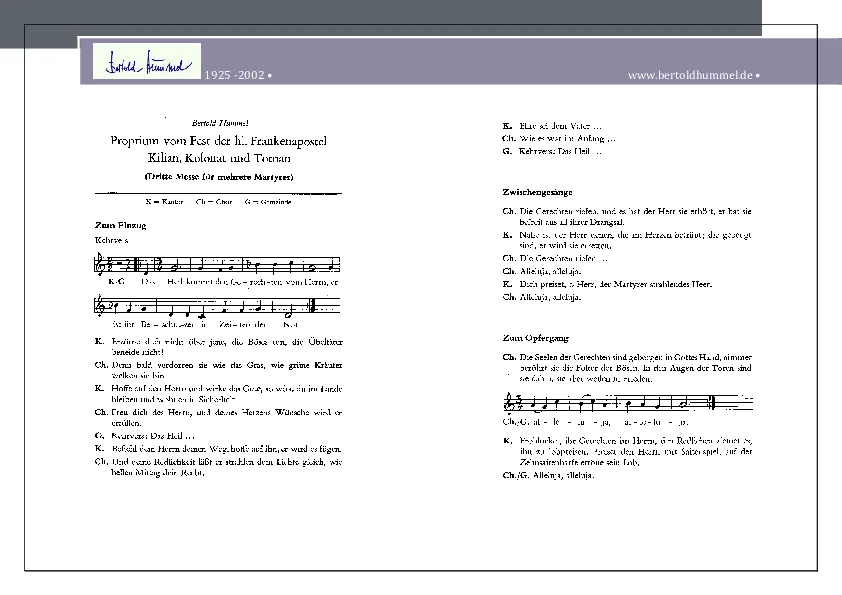
I. For the Entrance (Psalm 37), II. intermediate songs (Psalm 34), III. for the Offertory (Psalm 33), IV. for Communion (Psalm 126)
Baritone solo, mixed choir, congregation, large orchestra (2 flutes, 2 oboes, 2 clarinets in B-flat; 2 bassoons, 4 horns, 3 trumpets, 1 tuba, timpani, strings)
Duration: 25 minutes
Theo Nicolai | Würzburg Cathedral Choir | Würzburg Cathedral Boys' Choir | Würzburg Municipal Philharmonic Orchestra | Franz Fleckenstein
Title: Proprium for the feast of St Kilian / Proprium "Salvation comes to the righteous from the Lord" - Length: 56 pages - Date: - - Location: Bavarian State Library, Munich
Manuscript
The involvement of the audience, who in the first part could virtually join in with the work's motto "Salvation comes to the righteous from the Lord" and the"Alleluia" of the second part, brought an interesting and fully accepted note to the programme of this concert.




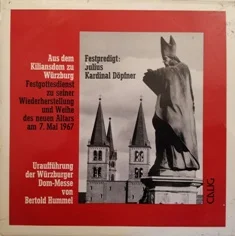
On the reconstruction of the cathedral (introductory text LP CALIG CAL 30330)
After 22 years of painstaking reconstruction, Würzburg's St Kilian's Cathedral was the last of the German cathedrals to be completed in May 1967. On the evening of 5 May, its doors were reopened to the faithful, on 6 May the new altars were consecrated and on Sunday, 7 May, Cardinal Döpfner held a festive thanksgiving service. This event was of secular significance for the city and diocese of Würzburg: after 22 years, both now have their episcopal church again and thus their religious centre.
Würzburg Cathedral has been resurrected in a new form. What had been preserved was restored, what had been destroyed was recreated in the spirit and according to the needs of our time, especially the centre of the cathedral: The bishop's altar and cathedra. This courageous combination of old and new gives the cathedral its unique charm and makes it not only an interesting and valuable architectural monument, but also a festive space in which the people of today can celebrate worship in the spirit of liturgical renewal.
What is visible in the new construction of the cathedral should be audible in the hymns of the thanksgiving service. Therefore, a Latin mass was not chosen from the existing treasury of church music. Instead, the Würzburg Cathedral Chapter commissioned a German mass from the composition teacher at the Bavarian State Conservatory of Music in Würzburg, Professor Bertold Hummel. At the service on this day, the faithful should not only listen with emotion, but also joyfully join in the "new song" in their mother tongue, which could be heard again in the cathedral after such a long time. The mass was to express the significance of the event, but at the same time fulfil the requirements of the Council, above all to enable the singing participation of the whole congregation. The task was not an easy one. Professor Hummel took it on and created a work in the "Würzburg Dommesse" that is not only musically very appealing, but also represents a serious contribution to the renewal of church music after the Council.
The Kilian Propers
The chants for the Entrance, Offertory and Communion are composed as antiphonal chants. The frame verse is sung either by the whole congregation (for the Entrance), by the choir (Offertory) or by the soloist (Communion). The verses of the respective psalm are sung by the soloist (offertory), the soloist alternating with the choir (entrance) or the choir alone (communion). The congregation always participates with a short and easy verse. The intermediate hymns (Gradual/Alleluia) are musically richer in accordance with their special status and are reserved for the choir and soloists. The Introit is introduced by a festive Intrada by the orchestra.
The Proprium was later given the title "Salvation comes to the righteous from the Lord" by Hummel. The Alleluia calls of the interludes correspond to the introductory 42 bars of the a cappella motet "Dem König der Herrlichkeit" op. 18a, composed in 1957.