Würzburg Dommesse (small ensemble) (op. 31b, 1969)
I. Lord, have mercy, II Glory to God, III Creed, IV Holy, holy, V Lamb of God
Soprano solo, baritone solo, choir, congregation, strings, organ
Duration: 25 minutes
Würzburg Cathedral Choir | Würzburg Cathedral Boys' Choir | Franz Fleckenstein
Title: - - Length: 46 pages - Date: reduced new version 30 June 69 - Location: Bayerische Staatsbibliothek Munich
Manuscript
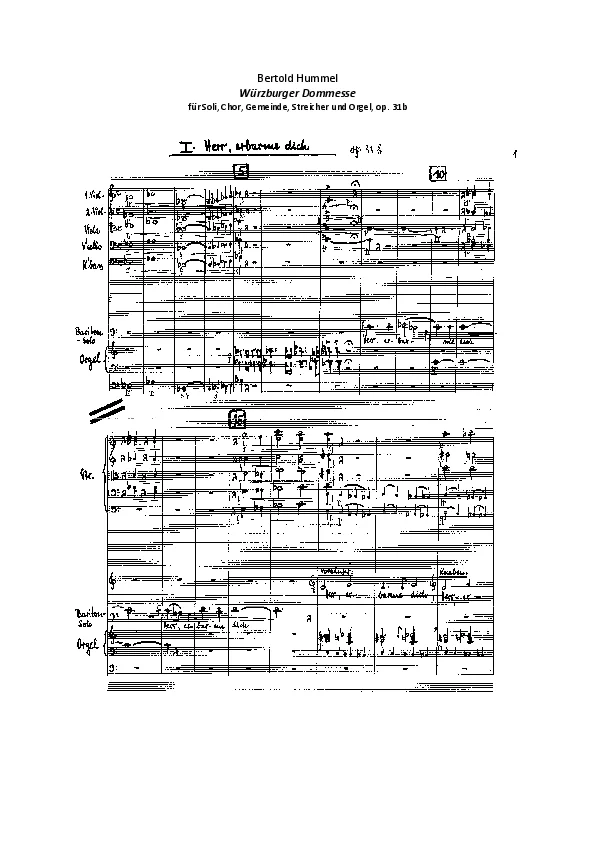
"Würzburg Dommesse"
Bertold Hummel's groundbreaking liturgical composition premiered
The extraordinary event of the consecration of the altar and the reopening of Würzburg's St Kilian's Cathedral also demanded a musical and artistic composition, especially if the music was to be regarded not merely as an ornamental decoration, but as a contribution to the church liturgy. It is no secret that the new liturgical order initially caused considerable uncertainty in the area of church music, especially due to some hasty and immature innovations - a walk through the Sunday and solemn services in the various churches, even in the same city, confirms this time and again. It is therefore a welcome step on the part of the Würzburg Cathedral Chapter to commission Bertold Hummel, professor at the Bavarian State Conservatory of Music in Würzburg, to compose a (German) "Würzburg Cathedral Mass", the first commission of its kind in Germany. The mass, written for soprano and baritone solo, choir, congregation and orchestra, was premiered at the Sunday service with the participation of Erika Rüggeberg (soprano) and Theo Nicolai (baritone), both from Munich, the cathedral choir, the cathedral choirboys and the Würzburg Municipal Philharmonic Orchestra, conducted by cathedral conductor Franz Fleckenstein.
The task was not an easy one: The composer had to transcend all liturgical constraints to find a "cathedral-like" tone that would correspond to the vast and lofty dimensions of the space and, despite the inclusion of the congregation in the circle of soloists, choir and orchestra, not to be content with being non-committal, but to span the entire work into a large - shall we say symphonic? - arc. Hummel achieves this by using the vocal parts and the orchestra alongside the strings with double woodwind, triple and quadruple brass and percussion to create broad musical areas in accordance with the size of the space. He creates broad musical surfaces to which he lends a generous but simple colourfulness. Hummel recognised in a superior way that such a surface outline can only be chromatic in the movements and interjections of the congregation, while diatonic elements predominate in the solo and choral parts; The way in which he knows how to combine and blend the two seamlessly reveals the master of his métier and confirms the true musician in the service of God, who does not aestheticise in an abstract intellectual manner and, for example, cheaply misuses and rapes the precious commodity of Gregorian chant for a German language that is not adequate to it, but who senses the special pious spirit of the word and the music with his heart. There are certainly references to Gregorian chant, but they remain recognisable as such and do not serve as a disguise for modernist speculation and unimaginativeness.
This is also evident in the other characteristic element that binds Hummel's mass composition together: Running through the entire work as a leitmotif, as it were, is the jubilant cry of the old Easter chorale "Christ is risen", a relationship of Easter resurrection joy to the resurrection of the Episcopal Church that also makes sense in terms of thought. This theme returns in various variations and changes in the calls of the congregation; in between, the solo and choral parts develop in free melodic arcs, growing out of it. The intermediate movements intended for the congregation are extremely catchy (the participation of the many hundreds who filled the cathedral to the last corner proved it), without the composer slipping into cheapness; he leads the popular voices themselves into a two-part canon.
It can be said that a new liturgical-musical form has been found here, which has been developed from the original source of the tradition and builds its contemporary language on it. Despite its modernity, it breathes baroque solemnity, devotion and joy, in keeping with the architectural character of the Würzburg Episcopal Church. The words of Archbishop Cardinal Dr Döpfner from his sermon, that faith must be founded on the secure foundation of tradition, have also found expression in the liturgical singing of the Cathedral Mass, as in the defining architecture of the Cathedral. A merit of the composer Bertold Hummel, who created a trend-setting work! A merit also of the Würzburg Cathedral Chapter, which commissioned this work!
Last but not least, the performance prepared with care, diligence and love by cathedral conductor Franz Fleckenstein. What Hummel demanded of the choir and orchestra was by no means an everyday occurrence - but the way in which the cathedral choir and cathedral choirboys accomplished their task, even in the unusual, and endowed the singing with all its beauty and devotion, and the way in which the philharmonic orchestra - supported by a wind section in the nave during the congregational singing - created a foundation and framework for the human voice, testified as much to Fleckenstein's understanding, securely cohesive guiding hand as to the lively inner involvement of all those taking part.
Dr A. Meyer




In 1969, Bertold Hummel reduced the instrumentation of his Würzburg Dommesse op. 31a in order to allow smaller congregations to perform it.
There is another outstanding composition for the liturgy, the Würzburg Cathedral Mass for the consecration of the rebuilt St Kilian's Cathedral in May 1967, which is a kind of "full mass", i.e. the Proprium and Ordinary are compositionally a unit. Although the Ordinary is labelled op. 31 as the "Cathedral Mass" and the Proprium as op. 32 with the title of the opening words of the Introit "Salvation comes to the righteous from the Lord", the movements play into each other in terms of their overall style and show that they belong together. Furthermore, although they are in German, the formal structure of the alternation between cantor, choir and congregation is very much in line with the traditional form of Gregorian chant. It is remarkable that such a large and important festive mass was composed in the vernacular so soon after the publication of the liturgical constitution ("Sacrosanctum Concilium" in 1963 and the church music instruction "Musicam Sacram" in 1967). On the one hand, it may reflect the composer's progressive liturgical thinking; on the other hand, it probably takes into account the fact that in the diocese of Würzburg, the vernacular language in chant in the so-called "German Mass" also had a very old and great tradition on high feasts.
"Zum Einzug" alternates blaring trumpets with a broad hymnal theme of woodwind, horns and strings in a festive Intrade until the antiphonal alternation of the congregation's frame verse with the soloist (baritone solo) and his psalm verses begins. The following"Kyrie", the"Herr, erbarme dich", begins again with a broad, wide-ranging theme alternating with striking trumpet bars, before the baritone intones the"Herr, erbarme dich" twice, followed by the same call, once from his lead singer, once from the boys' choir, one from the congregation and a final call from the choir. The"Christus, erbarme dich" is performed three times by the solo soprano, each time increasing in the extension of the call and melodic intensification, then performed in a similar manner by the precentor, congregation and choir as with the"Herr, erbarme dich". The solo soprano rises above a dense, chordal choral movement with triadic storms in a vocalise up to high C. This intensification of the entire call in the third"Herr, erbarme dich" is intensified in the exalted use of the two solo voices with the participation of all the others. One is almost inclined to see in this intensive structure the compositional realisation of the demand of the Second Vatican Council's liturgy constitution regarding the distribution of roles for all those actively involved in the liturgy.
The "Glory be to God" is a combination of baritone solo, choir and congregation. The choral structure of the following interludes, or rather response chants to the readings, is reminiscent of Gregorian chant, where huge melodic arcs are composed for the final syllables, for example, just as in the Latin gradual verses. This is also the case here in the choral movements set in sections. The"Alleluia" goes as far as double-choir-like eight-part harmony with repetitions, plus the solo baritone with a short psalm verse.
In the"Creed", again with baritone, choir and congregation, a sectional chordal conception prevails, from which a richer, canonically led arrangement stands out in"Er hat Fleisch angenommen".
The precentors, boys' choir, choir and congregation sing"Heilig" with"Hochgelobt" in unison, sometimes canonically as a genuine acclamation of the congregation with a few highlights from the soprano and baritone solo. As usual, the"Lamb of God" is divided into three parts for soloists, choir and congregation.
Franz A. Stein (in "Die Kirchenmusik Bertold Hummels", Tutzing 1998)
On the reconstruction of the cathedral (introductory text LP CALIG CAL 30330)
After 22 years of painstaking reconstruction, Würzburg's St Kilian's Cathedral was the last of the German cathedrals to be completed in May 1967. On the evening of 5 May, its doors were reopened to the faithful, on 6 May the new altars were consecrated and on Sunday, 7 May, Cardinal Döpfner held a festive thanksgiving service. This event was of secular significance for the city and diocese of Würzburg: after 22 years, both now have their episcopal church again and thus their religious centre.
Würzburg Cathedral has been resurrected in a new form. What had been preserved was restored, what had been destroyed was recreated in the spirit and according to the needs of our time, especially the centre of the cathedral: The bishop's altar and cathedra. This courageous combination of old and new gives the cathedral its unique charm and makes it not only an interesting and valuable architectural monument, but also a festive space in which the people of today can celebrate worship in the spirit of liturgical renewal.
What is visible in the new construction of the cathedral should be audible in the hymns of the thanksgiving service. Therefore, a Latin mass was not chosen from the existing treasury of church music. Instead, the Würzburg Cathedral Chapter commissioned a German mass from the composition teacher at the Bavarian State Conservatory of Music in Würzburg, Professor Bertold Hummel. At the service on this day, the faithful should not only listen with emotion, but also joyfully join in with the "new song" in their mother tongue, which could be heard again in the cathedral after such a long time. The mass was to express the significance of the event, but at the same time fulfil the requirements of the Council, above all to enable the singing participation of the whole congregation. The task was not an easy one. Professor Hummel took it on and created a work in the "Würzburg Cathedral Mass" that is not only musically very appealing, but also represents a serious contribution to the renewal of church music after the Council.
The Würzburg Cathedral Mass
The Kyrie, although long, clearly has the character of a call. The composition of the festive Gloria hymn departs from the previous formal scheme and seeks a new path in its structure. Here, too, the congregation participates with short calls. The Credo is not musically interpreted, apart from the middle section "He has taken flesh ...". The individual movements follow one another in a simple but incredibly powerful way. The entire Credo is, so to speak, composed over an organ point, on the note a.
The Sanctus is sung by the congregation and unanimous choir in canon. The soprano and baritone solo lend it a radiant splendour with their interjections. The Agnus Dei follows the division generally used today: soloist, choir, congregation. The festive service in Würzburg Cathedral showed that, despite all the difficulties that had to be overcome, the attempt was successful overall. The thousands who filled the vast space of the cathedral were not just spectators and listeners, they united their voices with the singing of the choir to form a powerful praise of God.