The crow and the fox (1974)
Cantata for four-part male choir, percussion, piano based on the fable "Le corbeau et le renard" by Jean de La Fontaine in the German translation by Walther Küchler (1877-1953)
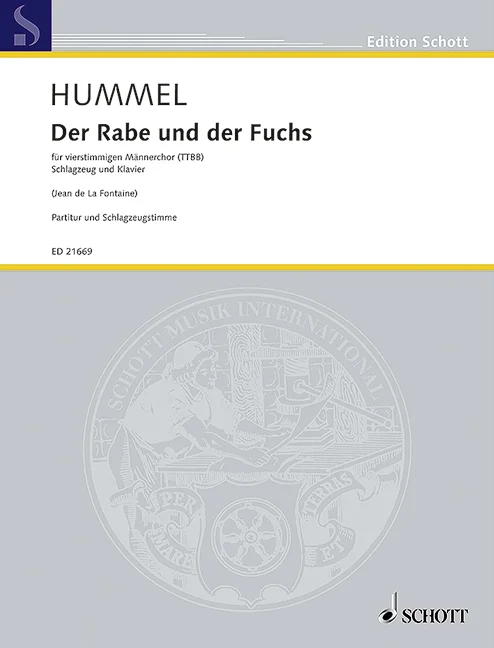
Four-part male choir, percussion, piano
Percussion (1 player): Xylophone, triangle, 2 rivet cymbals. (h./t.), 4 hanging cymbals, tam-tam, guiro
Duration: 5 minutes
Kugelfischer-Werkchor Schweinfurt | Jochen Sponsel | Irmtraut Schäfer-Pfannschmidt | Karl Haus
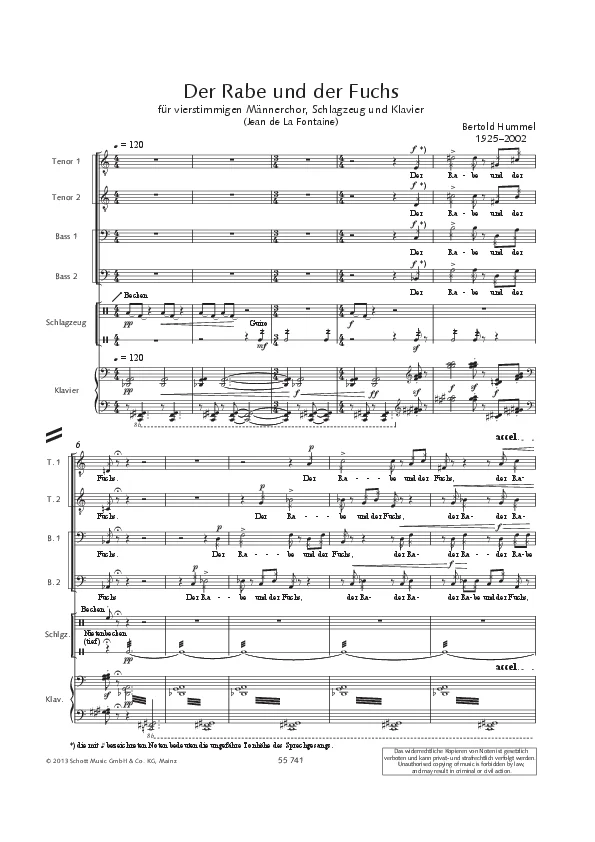
Title: La Fontaine: Der Rabe und der Fuchs (le corbeau et le renard) German transcription: Walther Küchler Music: Bertold Hummel (1974) for 4-part male choir percussion and piano - Length: 18 pages - Date: 23.III.74 - Location: Bayerische Staatsbibliothek, Munich
Schott Music
Score and percussion part: ED 21669 / ISMN: 979-0-001-19422-8
Choir score: ED 21669-11 / ISMN: 979-0-001-19423-5
Meister Rabe, auf einem Baum gespreizt,
Hielt einen Käse in seinem Schnabel.
Meister Fuchs, von dem Dufte gereizt,
Hielt etwa ihm dieses Geschwabel :
Ei, Herr von Rabe, guten Tag!
Wie hübsch ihr doch seid, wie man so schön nur sein mag!
Ich lüge nicht, wenn Eure Lieder
Gleich kommen Eurem Gefieder,
Seid Ihr der Phönix der Gäste der Wälder hier.
Der Rabe hört's, ist aus dem Häuschen vor Pläsier
Und sperrt, daß schön sein Sang mög schallen,
Einen weiten Schnabel auf, läßt seine Beute fallen.
Mein guter Herr, der Fuchs spricht, wie er sie erschnappt,
Der Schmeichler lebt, gelernt ihr's habt,
Auf Kosten dessen, der sein Ohr ihm kehrt;
Die Lehre, zweifellos, ist einen Käse wert.
Der Rabe, schamvoll und verwirrt,
Schwor, etwas spät, daß man ihn nicht mehr foppen wird.
Jean de La Fontaine 1668 / German translation Walther Küchler 1948
(from: JEAN DE LA FONTAINE: FABELS - Bilingual Edition - Winkler-Verlag Munich 1948)
Translation:
Master Crow perched on a tree,
Was holding a cheese in his beak.
Master Fox attracted by the smell
Said something like this:
"Well, Hello Mister Crow!
How beautiful you are! how nice you seem to me!
Really, if your voice
Is like your plumage,
You are the phoenix of all the inhabitants of these woods."
At these words, the Crow is overjoyed.
And in order to show off his beautiful voice,
He opens his beak wide, lets his prey fall
The Fox grabs it, and says: "My good man,
Learn that every flatterer
Lives at the expense of the one who listens to him.
This lesson, without doubt, is well worth a cheese."
The Crow, ashamed and embarrassed,
Swore, but a little late, that he would not be taken again.
(Translator unknown)
Original:
Le Corbeau et le Renard
Maître corbeau, sur un arbre perché,
Tenoit en son bec un fromage.
Maître renard, par l'odeur alléché,
Lui tint à peu près ce langage :
Hé ! bonjour, monsieur du corbeau.
Que vous êtes joli ! que vous me semblez beau !
Sans mentir, si votre ramage
Se rapporte à votre plumage,
Vous êtes le phénix des hôtes de ces bois. "
A ces mots, le corbeau ne se sent pas de joie,
Et, pour montrer sa belle voix,
Il ouvre un large bec, laisse tomber sa proie.
Le renard s'en saisit, et dit : Mon bon Monsieur,
Apprenez que tout flatteur
Vit aux dépens de celui qui l'écoute :
Cette leçon vaut bien un fromage, sans doute.
Le corbeau, honteux et confus,
Jura, mais un peu tard, qu'on ne l'y prendroit plus.
Jean de La Fontaine
Hummel has assigned the text of La Fontaine's fable"The Raven and the Fox" to a male choir, which revels in the flattery of the fox in triads, but retreats back to dry chanting when it comes to the words of the bruised raven. Original percussion effects and compact piano sounds provide an ironic backdrop to the plot, the punchline of which is spoken to the audience by the choirmaster. The Kugelfischer-Werkchor from Schweinfurt under the direction of Karl Haus ensured that this witty novelty was a hearty success with the audience.