Lobgesang (text: Kurt Heynicke) for four-part mixed choir a cappella (1971)
Four-part mixed choir a cappella
Duration: 6 minutes
Tonos edition no. 3828 / M-2015-1447-5
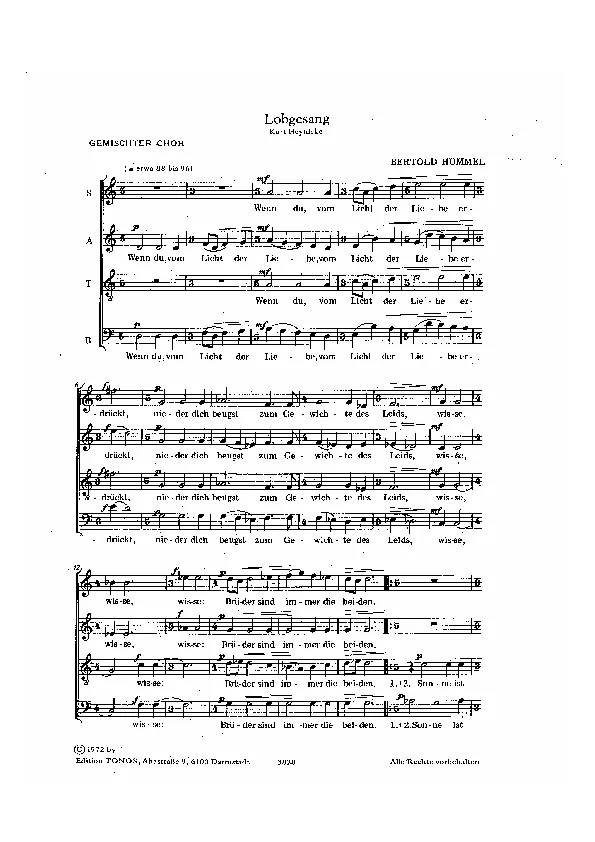
Wenn du vom Licht der Liebe erdrückt
nieder dich beugst zum Gewichte des Leids
wisse:
Brüder sind immer die beiden.
Sonne ist Welt nicht alleine.
Sonne an Sonne müsste vor Sonnen vergehen im Licht.
Liebe an Liebe sähe vor Liebe die Liebe nicht.
Eine Welt muss sein,
drein die Sonne scheine,
erst durch die Welt
ist Sonne in die Mitte gestellt.
Leid muss sein,
daß Liebe sich übe.
Ohne Leid ist Liebe nimmer Liebe.
Liebe muss geben, um sich ganz zu vollenden.
Leid muss nehmen, um sich endlich zu enden.
Bis auf erwanderten Gipfel der Not
die beiden zu singen beginnen vor Gott.
Kurt Heynicke
When you are crushed by the light of love
Bow down to the weight of suffering
know:
Brothers are always the two.
Sun is not world alone.
Sun upon sun should pass before suns in the light.
Love upon love would not see love before love.
There must be a world,
for the sun to shine in it,
only through the world
the sun is placed in the centre.
Sorrow must be,
that love may be practised.
Without suffering, love is never love.
Love must give in order to fulfil itself completely.
Suffering must take in order to finally end.
Until on the summit of hardship
the two begin to sing before God.
(from: Kurt Heynicke: "Das Leben sagt Ja - Gedichte" Deutsche Verlags-Anstalt, Stuttgart 1936)
The poet Kurt Heynicke (1891-1985), who was included by Kurt Pinthus in the poetry anthology Menschheitsdämmerung (Rowohlt ISBN 3499450550), which has become a classic, as one of the most important expressionist German poets, lived in Merzhausen. It was here that Bertold Hummel met him after the war, practically in the neighbourhood. They became friends, forged some opera plans and created occasional works together such as the good-humoured Badische Weinlied for a wine singer and piano. This choral work was composed in 1971 and was first published in the Breisgauer Sängerbund songbook for mixed choir (Edition Tonos Darmstadt 1972).