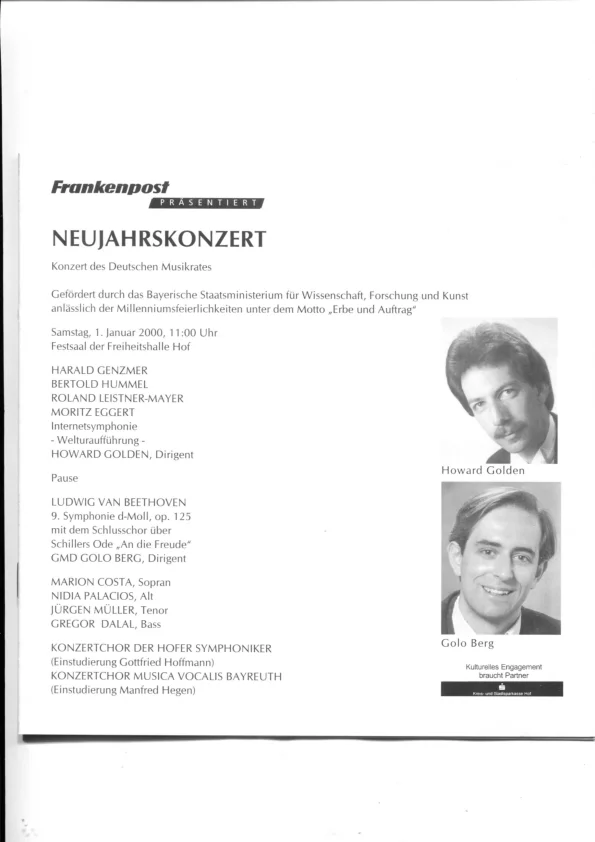
Internet Symphony for large orchestra based on themes by Harald Genzmer (1999)
Collaborative composition by Bertold Hummel, Roland Leistner-Mayer and Moritz Eggert
I. Andante con moto, II. Adagio, III. Finale
3 flutes (3rd + piccolo), 2 oboes, clarinet, bass clarinet, 2 bassoons, contrabassoon - 4 horns, 2 trumpets, 3 trombones - 1 timpani, 3 percussionists - strings (10.8.6.5.4)
Duration: 20 minutes
Hofer Symphony Orchestra | Howard Golden
Vogt & Fritz VF-1282-10 / ISMN: 979-0-005-07384-0
There was a lot of vital music.
The work is extremely effective and virtually jumps out at the listener with its percussion accents.
It is impossible to predict how the virtual audience will feel about it. In the concert hall, the work was an immediate success.
As if by a miracle, it did not remain a random selection of pieces. The listener at the premiere was presented with a puzzle in which the seams between the countless individual segments seemed to be smoothed and polished beyond recognition. The symphony surprised on Saturday - not least thanks to Howard Golden, who conducted the above-average orchestra with superiority and meticulousness - through the original variety of its richness of events as well as through the unity of its overall form. Although the motivic developments and realisations were not exactly easy to understand, there was always a subliminal coherence in the often disjointed, yet captivating moods. The musicians served this purpose by giving the detailed contours and colours of the sound the same importance as the theme (for example through the varied use of percussion).
Condensation and acceleration, tumult and harshness here - there a sudden, almost astonished standstill, a floating on a carpet of sound: For the performance never ran out of propulsive breath - not in the rather restrained first two movements - related like siblings, often eerily darkly coloured -; certainly not in the neoclassically illuminated and agitated finale; a burlesque with a bitter aftertaste.
In addition to the four contemporary composers, many of their predecessors and role models also played a part in all of this: the hidden allusion, the interlude, even the quotation is an important stylistic device in the work, which sometimes appears with the robustness of Hindemith or the sharpness of Shostakovich, then dresses itself in the dignity of Wagner or Bruckner or, in wonderfully suggestive moments, pays homage to Debussy, Messiaen, Toru Takemitsu - masters of music of the spheres.
An attentive audience demanded the symphony and found it in Hof. It did not serve him with pleasing music to welcome a "new era" after the 2000 threshold. On the contrary: it revealed quite serious, almost apocalyptic traits: as if it wanted to recapitulate the past, the progress and regression of the 20th century, destruction and hope.
Michael Thumser
They still work traditionally with pencil and paper, reports Moritz Eggert, who at 33 represents the young generation of composers. He is the only one of the four who works regularly with the Internet and also maintains his own homepage. Older colleagues such as Bertold Hummel are rather suspicious of the World Wide Web: he is at an age where people are surprised at how much time young people spend in front of the computer.




The Bavarian Music Advisory Council wanted to respond to the State Government's motto for the Millenium celebrations with a contribution reflecting musical life in Bavaria. The General Secretary, Jörg Riedlbauer, together with the four composers Harald Genzmer, Bertold Hummel, Roland Leistner-Mayer und Moritz Eggert,
representing all generations of Bavarian composers in the 20th century, wanted to organise a joint project. The internet was selected, as the central medium of the 21st century, to transmit art world-wide in a form never known before. Harald Genzmer developed three themes for a three-movement symphony. Bertold Hummel began work on the first movement, Moritz Eggert on the second and Roland Leistner-Mayer on the third. The three colleagues exchanged scores and each continued the ideas of his predecessor.
The first movement was started by Bertold Hummel. In a gently flowing motion (Andante con moto), the theme given by Harald Genzmer is developed initially with deliberate restraint over a bed of sound in the bass clarinet and lower strings. Gradually, middle and upper registers are brought in; the percussion sets striking accents until finally Genzmer's 12-tone row provides the framework for the brilliance of the full orchestra. With great craftsmanship, Hummel begins to play with the rich variety of ideas latent in the Genzmer theme, creating for the orchestra both tutti passages with a sure sense of the total effect and a number of concertante phases. Motifs go their own way, straying through the different orchestral groups with the lightness of a weasel, undergo a constant intensification process and finally slip into more tranquil waters - the point at which the transition to Moritz Eggert's middle section occurs. This central part has a deliberately scherzo-like feel, gaining a particular charm from the frequent rhythmical and metrical changes. Eggert also splinters off micro-cells of motif material; occasional references to Hummel's patterns of development contribute to inner unity. The capricious interchanges between the individual string groups intensify and, after a burlesque tutti, develop into a charming scene with horns, lower strings and bassoon group set against each other, until Roland Leistner-Mayer's contribution returns finally to Hummel's initial tempo and closes quietly with diverse refined rhythmical variations.
The middle movement, as the opening ideas show, was conceived by Moritz Eggert as a broad Adagio, subtly developing out of a closely-woven texture in the woodwind and then immediately coloured by horn and wood-block accents. But soon the multiply divided string section dominates developments, wind and percussion accents fan the flames energetically. Bertold Hummel carries this over into his middle section, intensifying the movement with a plethora of time-signature changes, leading the Adagio then into a more spirited middle section. This more lively part emerges into a peaceful sound landscape, growing again more lively through subtle rhythmic touches as Roland Leistner-Mayer takes us into the closing section, moving through a più mosso intensification before closing peacefully in an exchange between lower string registers, horn and trombone groups as well as the solo clarinet.
Leistner-Mayer opens the Finale, also choosing restrained dynamics, but with an unusually intensive and heavily-charged rhythmic element. It begins presto and transmits a feeling of great tension. Out of this rhythmic momentum, a continuous pulsation emerges, which Bertold Hummel continues into the middle section, creating an "oasis of tranquillity"; the momentum is carried over into the closing section by Moritz Eggert. The motion remains lively until the end, making use of a technique resembling "zapping" with TV remote control, picking out all kinds of elements from earlier in the work, removing them from their context, fragmenting them and rearranging them in new ways.
(From the programme notes for the première with the Hof Symphony Orchestra)
Of course, I was rather sceptical at first whether something like this would work, because every composer gives up part of his creative work in favour of the joint result, but this way of working was very interesting and I am now very confident: the work seems to have succeeded.
Bertold Hummel (Frankenpost 21.12.1999)
The predetermined themes of Harald Genzmer: