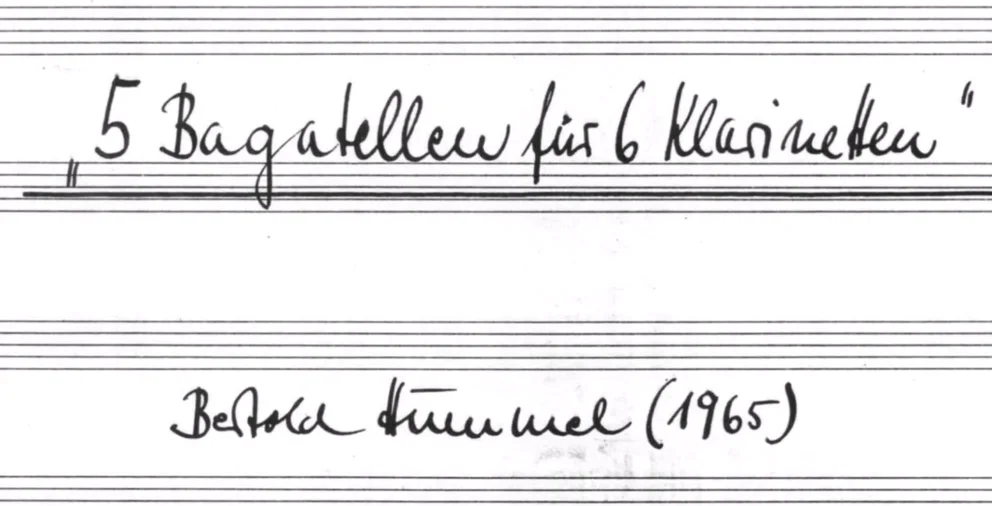
5 Bagatelles for 6 clarinets (op. 28, 1965)

Dedicated in honour to my teacher Harald Genzmer
I., II., III., IV., V.
Clarinet in E-flat, 2 clarinets in B-flat, 2 basset horns in F, bass clarinet in B-flat
Duration: 10 minutes
Manfred Dannewitz | Manfred Fehlisch | Hartmut Wellstein | Wolfgang Weth | Franz Barthold | Wolfgang Götz
Title: "5 Bagatelles for 6 Clarinets" - Length: 6 parts: 8,8,8,8,6,6 pages - Date: - - Location: Bavarian State Library, Munich
N. Simrock Hamburg-London (Boosey & Hawkes)
Score: ISMN M-2211-2068-7
Parts: ISMN M-2211-2069-4
The work and performance of Bertold Hummel's "Five Bagatelles" for six clarinets (1965) were a complete success for both the participants and the composer. He thoroughly understands his "craft". His ideas and ingenuity never cease to arouse admiration. He combines intellectual discipline, contrapuntal mastery, versatile tonal ideas and rhythmic differentiation in an ideal way. Hummel knows all about the technical and tonal peculiarities of a wide variety of instruments, and in this case neither overtaxes the musical understanding nor the technical ability of the musicians.




A little later, Bertold Hummel went in the opposite direction by combining six clarinets to create a block-like effect and producing almost magical effects due to the high fusion coefficient of clarinet instruments. His "5 Bagatelles" op. 28 reveal their origins: appointed professor of composition at the Musikhochschule Würzburg - at the time of Hummel's appointment it was still called the Bavarian State Conservatory - he immediately wrote music for practical teaching use. In this respect, he was similar in nature to his role model Hindemith and always placed his compositional metier at the service of practice. But even in this piece, inspired by the melodious sound of the clarinets, the mood suddenly changes and a march is heard again! As if there were an obsessive attachment to the military march that could be paralysed in an ironic way, Bertold Hummel caricatures the style of marching soldiers who are cheered on and urged on by the rhythm of the drums. By distancing himself from the lowlands of trivial and commercial music in this way, the composer demonstrates a deeply pacifist attitude, which he also repeatedly expressed to his composition students in conversation. He obviously chose the title "Bagatelles" in order to free himself from all the formal constraints of large-scale compositions. Unconcerned by the dictates of thematic exposition and development, he was able to abandon himself entirely to the gesture of his music and create formal organisms that are perhaps best described as "momentary forms".
Klaus Hinrich Stahmer (in "Die Kammermusik als persönliches Bekenntnis" Tutzing, 1998)