Franz Stemmer
29 November 1898, Heudorf/Hegau – 14 March 1974, Liptingen
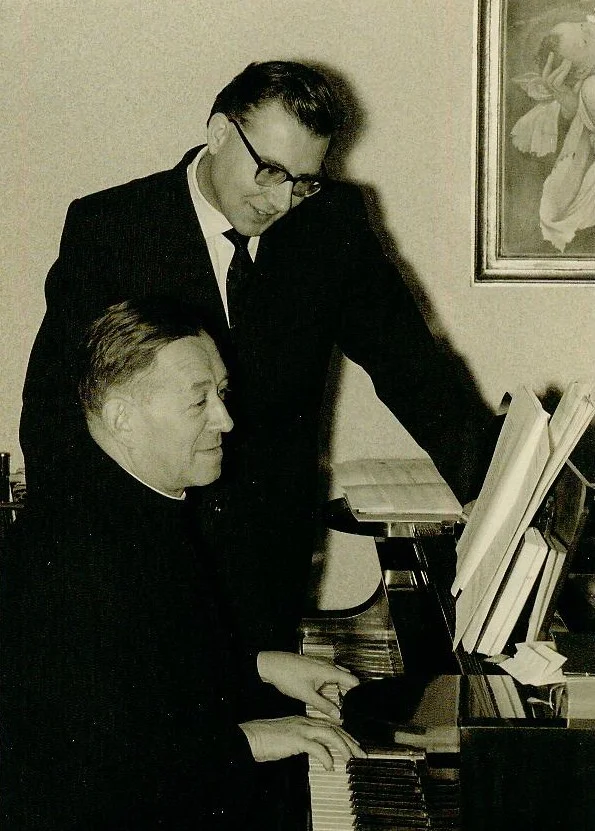
During my time as a cantor in Freiburg and later in Würzburg, my works for the human voice focused on the composition of a large number of liturgical motets, chorales and hymns; in this regard, particular mention must be made – not least – of my personal contacts with the cathedral music directors Franz Stemmer (Freiburg im Breisgau), Franz Fleckenstein and Siegfried Koesler (Würzburg) – who repeatedly commissioned me to write music for their choirs and to compose new chants for the liturgy.
Bertold Hummel 1998
From 1948, Franz Stemmer was a lecturer in Catholic church music at the newly founded University of Music in Freiburg. It was there that he would have met Bertold Hummel. He was a key patron of the young composer and arranged the world premiere of his *Missa brevis* Op. 5a at the Donaueschingen Music Festival on 12 October 1952. Two weeks later, on 27 October 1952, he organised a concert of sacred music at Freiburg Minster, featuring exclusively sacred works by the 27-year-old. Stemmer also secured him a financially lucrative commission to compose new organ arrangements for around 400 hymns for the new organ book *MAGNIFICAT* of the Diocese of Freiburg im Breisgau (1960). To ensure these arrangements were as practical as possible, Stemmer and Hummel spent some time attending church services together in the area around Freiburg to gain an insight into the abilities of the organists, most of whom were amateurs.
Works premiered by Franz Stemmer
- Missa brevis for choir and wind instruments, Op. 5a
- Offertorium for mixed choir and wind instruments, Op. 5b
- De profundis for alto and woodwinds, Op. 5c
- Revelation of New Life for solo alto, choir and chamber orchestra, Op. 8
Biography
Stemmer, Franz, Cathedral Music Director. Born 28 November 1898 in Heudorf (Hegau); ordained 5 April 1925; curate in Gaggenau and Karlsruhe; prefect in Freiburg; studied Catholic church music in Karlsruhe; in 1933, choral répétiteur at the Collegium Borromäum and assistant to the cathedral music director; in 1934, cathedral music director; retired in 1969. Died 14 March 1974, buried in Liptingen.
Monsignor Professor Franz Stemmer’s tenure as cathedral music director and choral teacher at the Collegium Borromäum spanned 35 years, from 1934 to 1949, a role which was further expanded by his appointment as Diocesan Chaplain to the Cäcilien-Vercins in 1943 and as a lecturer at the State University of Music in Freiburg in 1948. This extensive work in the service of sacred music was rooted in a devout faith which made his artistic and priestly ministry a life of fulfilment.
Born on 28 November 1898 in the quiet village of Heudorf in the Hegau region, the son of a teacher and choirmaster, he attended grammar school in Konstanz, where, whilst still a pupil at the Conradi-Haus, he drew attention to his exceptional musical talent through his work as a conductor and organist; he continued to exercise this talent even after his wartime service from 1917 to 1918, whilst studying theology in Freiburg, serving as conductor of the students’ choir and as organist. This remarkable musical talent then prompted the church authorities, following several years of pastoral work as a curate in Gaggenau and Karlsruhe and as prefect at the boys’ boarding school in Freiburg, to ask Chaplain Stemmer to undertake musical training at the newly established Institute for Catholic Church Music at the Karlsruhe Conservatoire, under the direction of the renowned Freiburg composer Professor Franz Philipp. After two years of study, he passed his church music examination in 1933 under Professor Philipp with great success; he remained connected to Philipp’s musical work throughout his life and premiered some of his church music compositions at Freiburg Minster. In the same year, the church authorities appointed him as choral répétiteur at the Collegium Borromäum and as assistant to the cathedral music director, Carl Schweitzer, at the Cathedral of Our Lady in Freiburg. Here, after rebuilding the cathedral choir, he succeeded – thanks to his musical temperament and his affable and warm-hearted openness – in developing this choir within a few years into one of the best in the archdiocese; its successes at the General Assembly of the German CäcilienAssociation in Freiburg in 1936.
The musical repertoire included works by Palestrina, the Viennese Classical composers, as well as modern composers such as Fr. Philipp, H. Schröder, Th. Rehmann, B. Hummel and others. His particular affection, however, lay with the works of Anton Bruckner, many of which were performed for the first time in the cathedral under his baton. This fruitful work was interrupted by the war years and the destruction of the city of Freiburg on 27 November 1944, in which the cathedral was also damaged, meaning that liturgical services could not be held in the cathedral for a considerable period. The performance of Franz Philipp’s oratorio ‘St. Elisabeth’ on 18 November 1945 proved to be an unforgettable experience, as wispy November mist drifted through the cathedral’s open windows, amidst the ruins of a city of Freiburg more than half destroyed.
His appointment as diocesan chaplain of the St Cecilia Society in 1943 gave Professor Stemmer the opportunity to apply his musical and educational talents to the development of church music within the archdiocese. Numerous courses designed to train teachers and laypeople as choir directors and organists, combined with the many church music services held in the individual deaneries, laid the foundations for a rich musical and liturgical life within the Archdiocese of Freiburg. His appointment as Papal Chamberlain, as well as the conferral of the title of professor by the Baden government, were expressions of recognition from both the Church and the State for his successful work in the service of sacred music and cultural development in the public life of the city of Freiburg.
As bell inspector and advisor on organ building in the diocese, his particular concern was to safeguard traditional organ building against the encroachment of electronic organs. The magnificent peal of the 15 bells at Freiburg Minster is thanks to his initiative. Owing to his successes, the General President of the St Cecilia Society for the German-speaking world appointed him to the Music Council, of which he was also a member as part of the ‘Consociatio internationalis musicae sacrae’ (CJMS), based in Rome, until he fell ill.
The strain of this excessive workload, both musical and organisational, had weakened his health at an early stage. An eye condition, which required two operations, compounded by a heart condition, forced Professor Stemmer in 1969 to ask the authorities to relieve him of his duties as cathedral music director.
The final years leading up to his death were a great trial for him, into which God led him after a stroke had robbed him of his last opportunities for public work as a bell and organ inspector. However, what made his final years as a musician particularly difficult was the realisation that a large part of his work had collapsed, triggered by the liturgical and musical reforms brought about by the Second Vatican Council, which he was no longer able to keep up with. The German liturgy, implemented in a one-sided manner in pastoral practice, increasingly displaced choral singing in the parishes, and the abolition of Latin services led to the dissolution of numerous church choirs, which he had built up with great effort as president of the Cäcilienverein.
Alongside his physical ailments, these events were a source of deep personal anguish for him as a musician through and through, from which death delivered him on 14 March 1974.
In Liptingen, following a choral requiem specified in his will and celebrated by the Most Reverend Auxiliary Bishop Gnädinger, Professor Stemmer found his final resting place beside his mother’s grave.
Carl Winter (from: *Necrologium Friburgense 1971–1975*, List of priests of the Archdiocese of Freiburg who died between 1971 and 1975, special edition from the Freiburg Diocesan Archive, Volume 97, Third Series – Twenty-ninth Volume, 1977)