Revelation of new life (op. 8, 1953)
Advent cantata for alto solo, mixed choir and chamber orchestra
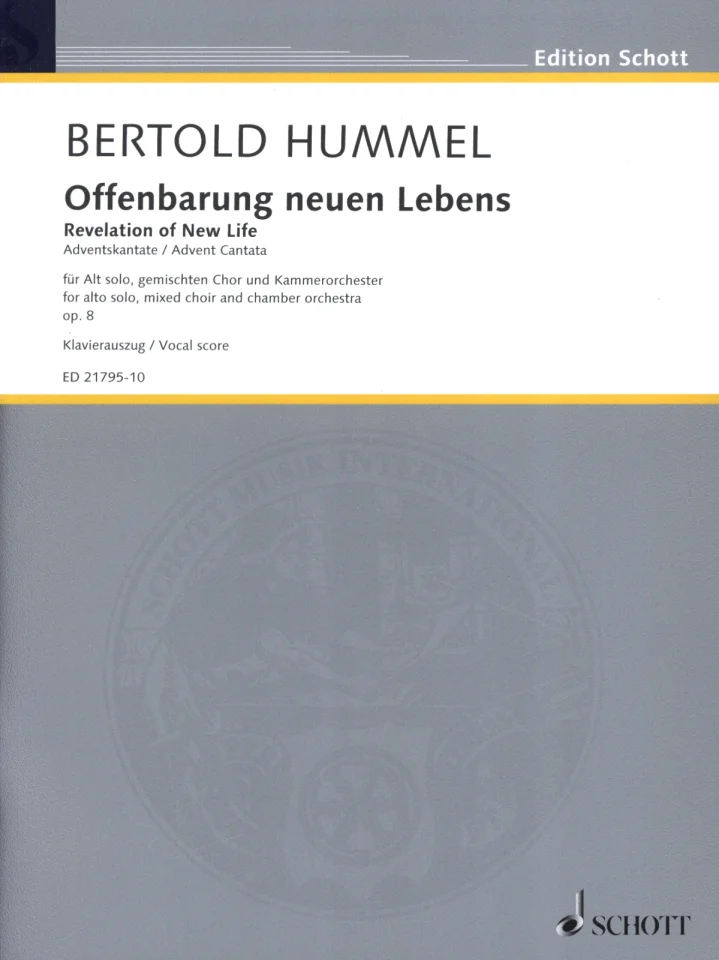
Antiphon I, Choral I, Psalmodie, Choral II, Antiphon II, Choral III
Alto solo, mixed choir and chamber orchestra (2 oboes (1 also english horn), 2 bassoons, 1 trumpet in C, 2 violas, 2 celli, 1 double bass)
Duration: 18 minutes
Helmtrude Kraft | Chamber Choir of the Freiburg State Academy of Music | Members of the Freiburg Philharmonic Orchestra | Franz Stemmer
A/B: Title: "Offenbarung neuer Lebens" for mixed choir, alto solo + chamber orchestra / Antiphon I - Length: 52 pages / 58 pages - Date: comp. in Oct. 1953 / Psalmody 2.Oct.53 / Chorale II 3.10.53 - Location:
Schott Music
Score ED 21795 / ISMN: 979-0-001-19851-6
Piano score ED 21795-10 / ISMN: 979-0-001-19852-3
Parts ED 21795-71 / ISMN: 979-0-001-19853-0
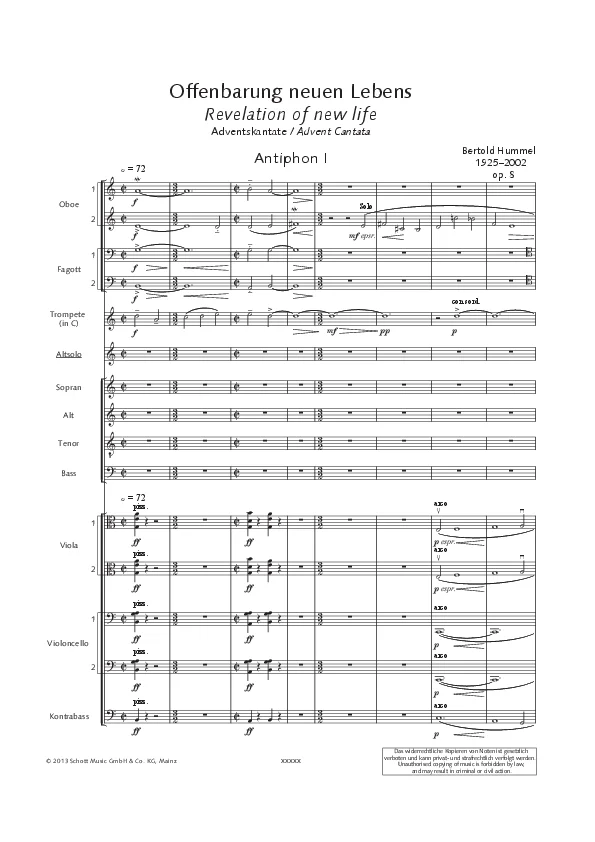
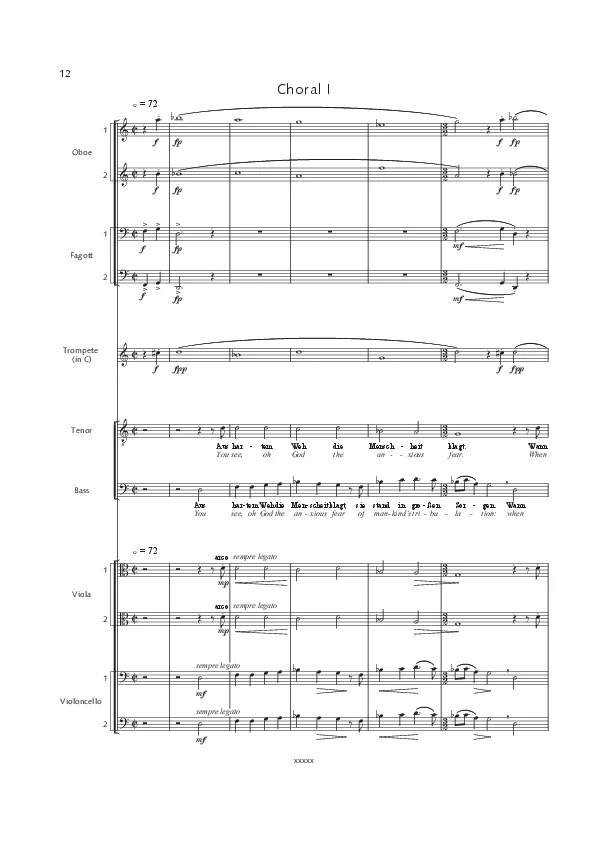

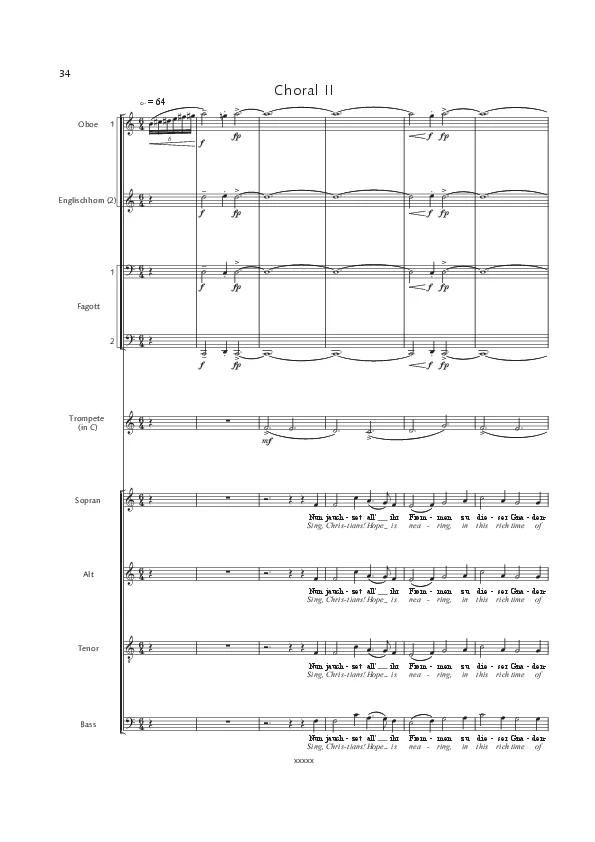
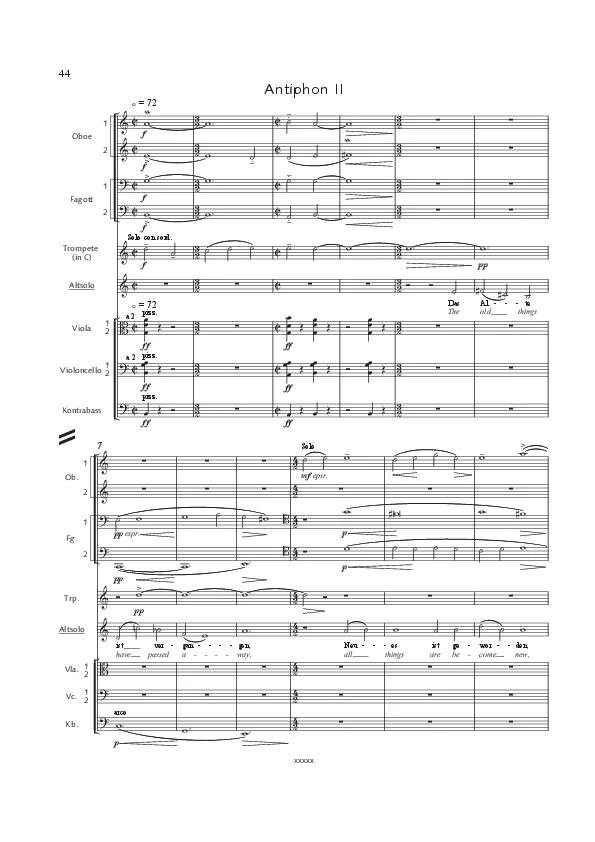

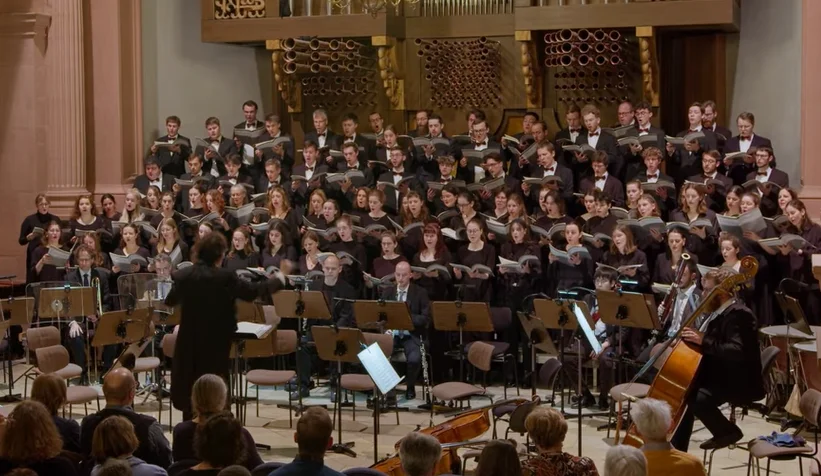
Südwestfunk had commissioned the young Freiburg composer Bertold Hummel to write the music for the Catholic morning service on the first Sunday of Advent. The work, entitled‘Offenbarung neuen Lebens’ (Revelation ofNew Life) and written for mixed choir, alto solo and chamber orchestra, was first broadcast on this occasion on Südwestfunk’s first channel. Its six movements, each of which introduces or follows on from the spoken word of the Scripture reading or homily, are based on texts fromthe ‘German Psalter’ in Romano Guardini’s translation. In the austere clarity of his musical language, the liturgical style adopted by Hummel since his Mass, which premiered in Donaueschingen the previous year, appears here to have been further refined into his own distinctive style. The melodic substance, largely drawing on ancient church “psalm tones”, is woven into a strict linear structure, with certain unmistakable influences from the late Stravinsky blending successfully with forms of polyphonic choral arrangement. ‘Antiphons’ for choir, alto solo and instruments alternate with pure accompanied choral movements and choral psalmody (‘Willst du uns nicht wieder Leben schenken’) over an orchestral passacaglia. With luminous clarity, the strictly imitative chorus ‘Wachet auf, ruft uns die Stimme’ concludes this work, which is imbued with a sacred atmosphere and, with its austere, sparse sonority, has also proved to be exceptionally well-suited to radio broadcast. The chamber orchestra, featuring soloists – with two oboes and two bassoons each, a trumpet used mostly in the manner of a cantus firmus, and five low solo strings (without violins) – contributes significantly to this. Helmtrude Kraft (alto), a chamber choir from the Freiburg State University of Music and members of the Freiburg Philharmonic Orchestra, conducted by Professor Franz Stemmer, rendered a clearly defined performance. Bn.
Even after more than fifty years, the depth of expression in this Advent cantata still captivates the listener. The lively rhythms and harmonic flourishes give the movement a dense texture, yet it remains transparent. Hummel pays close attention to the nuances of the text. Even his use of Baroque forms, such as the passacaglia, is hardly a distraction. He is not simply rehashing music history; on the contrary, such reminiscences arise almost inevitably from the work itself.
*The Revelation of New Life* is a compelling cantata, composed at a time of searching for new forms of expression in the middle of the last century, yet one which has lost none of its vitality and relevance to this day.
Markus Roschinski
Sources: Antiphon I + II, psalmody: Romano Guardini: Deutscher Psalter. After the Latin edition of Pope Pius XII, commissioned by the German bishops; Munich, Kösel-Verlag, 1950 / Chorale I: Text: c. 1525; melody after Michael Vehe's hymnal, Leipzig 1537 / Chorale II: Text: Michael Schirmer, 1640; melody: Johann Crüger, 1640 / Chorale III: Text and melody: Philipp Nicolai, 1599




Suggested programme for an Advent service featuring the cantata "Revelation of New Life":
Antiphon I
a) Reading: Genesis 1:26ff; 2:16ff; 3:1–7; 9; 11:6–19
Chorale I
b) Sermon, Part 1
Psalmody
c) Reading: Isaiah 35:1–10
Chorale II
d) Sermon, Part 2
Antiphon II
e) Reading: Revelation 21:1–8
Chorale III