Missa brevis for mixed choir and 8 wind instruments (op. 5a, 1951)
I. Kyrie, II. Gloria, III. Credo, IV. Sanctus, V. Agnus Dei
Mixed choir, 2 oboes (E.H.i.F), 2 bassoons, 2 trumpets i. C and 2 trombones (possibly tuba)
Duration: 18 minutes
Freiburg Cathedral Choir | Winds of the Freiburg Philharmonic Orchestra | Franz Stemmer
A/B:
Title: Missa brevis (1951) op 5 for mixed choir + 8 wind instruments / "Missa Brevis" op 5 for mixed choir and 8 wind instruments (copy 1986) - Length: 28 pages / 51 pages - Date: - - Location: Bayerische Staatsbibliothek Munich
Schott Music
Score: ED 21285 / ISMN: 979-0-001-18036-8
Choral score (with organ excerpt for rehearsal) ED 21285-1 / ISMN: 979-0-001-18037-5
Wind parts: ED 21285-11 / ISMN: 979-0-001-18038-2
First edition: Anton Böhm & Sohn, Augsburg 1981
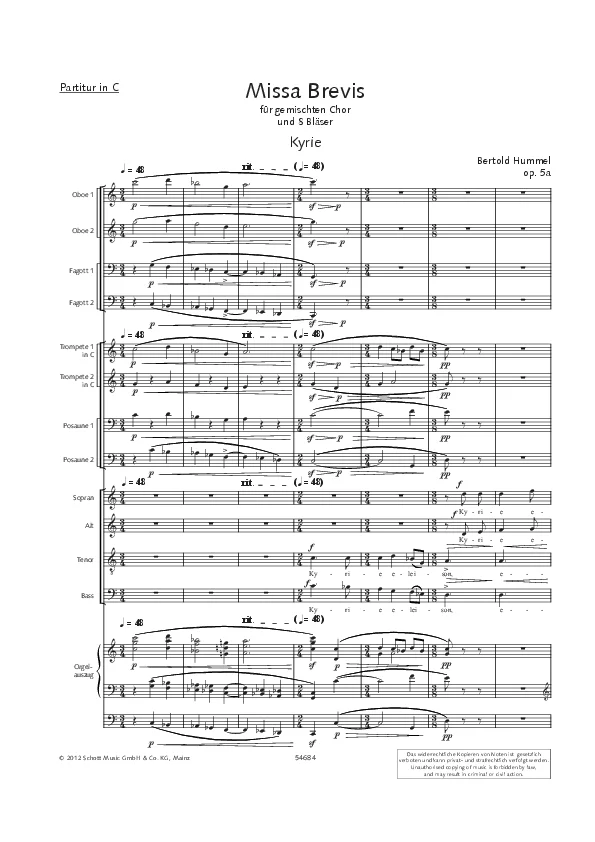
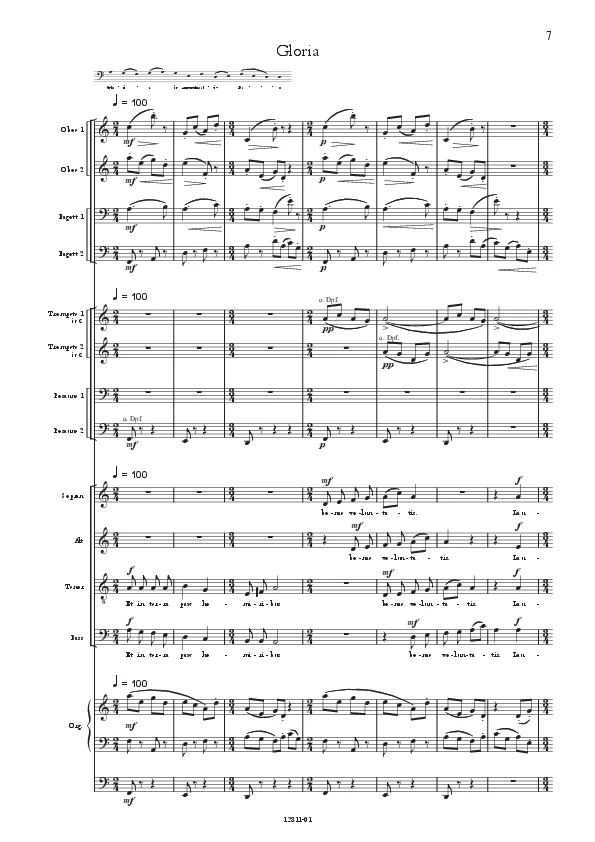
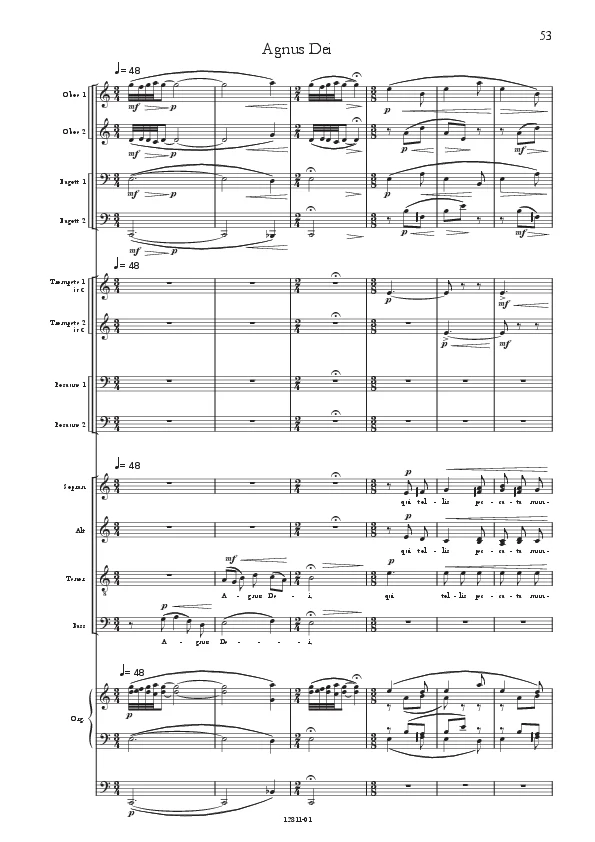
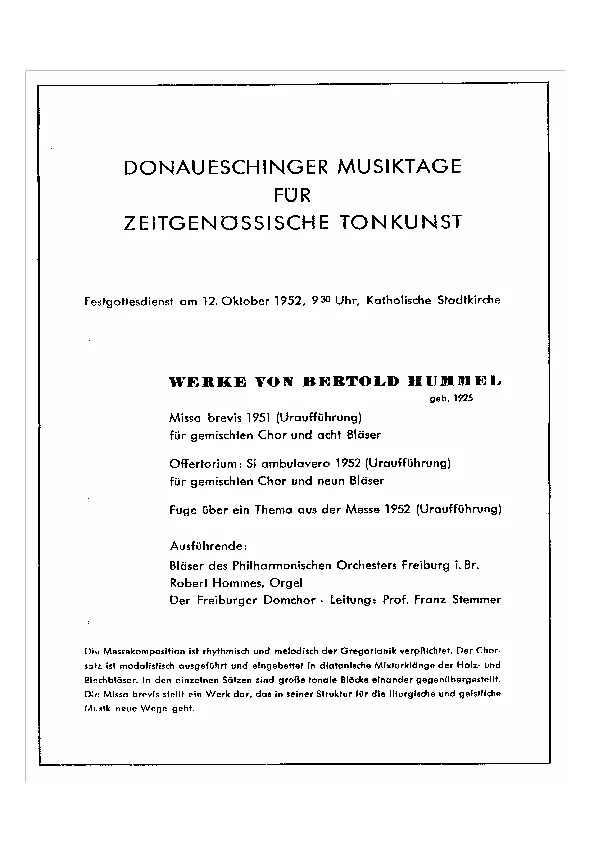
This work, dating from 1952 and lasting approximately 20 minutes, requires two oboes, two bassoons, two trumpets and two trombones. The organ part included in the superbly edited score is intended solely for rehearsal purposes and does not serve as an alternative to the wind instruments. The Mass is written in a moderately modern musical language, modally oriented and richly endowed with diatonic dissonances. The music’s close relationship to the text is particularly convincing, especially in the transparency of the wind section—which is always skilfully orchestrated—and its alignment with the rhythm of the language, which necessitates constant changes of metre. In terms of compositional technique, too, Hummel presents a skilful arrangement of both homophonic and polyphonic elements. In terms of line-leading and range, the work scarcely exceeds a moderate level of difficulty; the transitions to the choir’s entry notes, however, must be well rehearsed. Overall, Hummel’s *Missa brevis* (with *Credo!*) is a rewarding setting of the Ordinary that does justice to the liturgy.
With his concluding *Missa Brevis*, Op. 5, for choir and eight wind instruments, Hummel has composed an original and versatile work. Traditional elements, such as the setting of the Gloria and the Credo, are contrasted with a moderately modern musical language and an unconventionally dance-like Gloria movement.
For the first time in Donaueschingen, a work of modern liturgical music was put up for discussion, a Mass by the young Freiburg composer Bertold Hummel, performed during the service in the town’s Catholic church, which builds bold contrapuntal structures upon chorale motifs, modal choral parts and mixed wind sections, with a harsh timbre and a austere spiritual demeanour. The diligent and skilful performance by the Freiburg Cathedral Choir under Professor Franz Stemmer attested to its suitability for liturgical use.
For the first time this year, the Donaueschingen Music Festival for Contemporary Music has also given a voice to contemporary sacred music and included it in its official programme. Given the openness and the church music sector’s own initiatives in breaking new musical ground, as well as the position of church music within the wider musical landscape, this has long been a necessary step; let us hope that sacredmusic has thereby secured a permanent place at the Donaueschingen Music Festival. – It is no longer the case that the links between church music and modern music are as completely severed as they were years ago, and since church music is not bound to historical styles, it can glorify the liturgy in the language of its own time, just as every age has its own language – a point to which the popes have repeatedly drawn attention in their decrees on church music; Pope Pius XII, too, in his encyclical ‘Mediator Dei’ (1947), advocates a healthy modernism and thereby gives new significance to the psalm verse ‘Sing to the Lord a new song’.
The new work we are discussing here is Bertold Humrnel’s “Missa brevis”, written in 1951 for mixed choir and eight wind instruments. The young Freiburg composer (born 1925), a pupil of Genzmer, has demonstrated here – apart from his great technical skill – which also encompasses an unusual mastery of compositional technique, applied in an idiosyncratic yet never contrived manner – has demonstrated an astonishing maturity and independence in his creative power, and has created a work of lasting value in which the contemporary syntax of music finds liturgical expression. The musical language, both in its Gregorian-inspired melody and in its thematic material, is detached from any harmonic conventions of traditional musical forms and is far removed from functional harmony; on the contrary, the chordal structure – insofar as one can speak of it in the usual sense here – is ramified; the horizontal and vertical lines are conducted in a wholly idiosyncratic manner, prioritising coherence over the sonic experience. This ascetic rigour also applies to the treatment of the text, which, in its suspended declamation—likewise indebted to Gregorian chant —tolerates no musical interpretation whatsoever. In the musical setting and overall structure, homophonic and polyphonic elements stand in dogmatic opposition to one another. The wind parts (two oboes, two bassoons, two trumpets and two trombones each) likewise do not seek to blend with the vocal ensemble, as we are accustomed to in instrumental masses, but their ‘sounds’, employed in a mixture-like manner, and episodes sometimes even seem somewhat disconnected from the overall structure, so that one might not always find their role entirely justified. Yet, taken as a whole, this Mass is undoubtedly a masterstroke that forges its own path in liturgical music; a work in which, moreover, the great talent and—it seems to us—the vast potential for development of the young composer are clearly evident, as documented in his chamber music compositions. Cathedral Music Director Professor Franz Stemmer is known for his discerning yet determined and consistent approach to bringing valuable new works in sacred music to fruition; and so, with this new work too, together with his cathedral choir and the wind section of the Freiburg Philharmonic Orchestra, he has identified with the composer’s intentions with a conviction-driven dedication and, above all, has ensured that the world premiere in the Catholic town church of Donaueschingen was an exceptionally cohesive and powerfully effective in the Catholic town church of Donaueschingen. Immediately following the Donaueschingen premiere, Cathedral Music Director Professor Stemmer also paved the way for the work at Freiburg Minster, ensuring it received a favourable reception.
Dr M. Ganter
In terms of rhythm and melody, the young composer draws inspiration from Gregorian chant in this work, whilst tonally, certain elements appear to be influenced by Stravinsky. This fine example of practical modern church music meets the requirements of liturgical music based on the text in every respect.
A third example of modern church music was Bertold Hummel’s (Germany) *Missa Brevis* for choir and wind instruments. The melody of this work is inspired by Gregorian chant, but in terms of its expressive form and compositional technique, the mass is entirely modern and may be regarded as a fine example of contemporary church music.
In his *Missa brevis* for mixed choir and eight wind instruments, the young Freiburg composer Bertold Hummel employs a style of music that is austere and powerful, reminiscent of woodcut art. The masterfully crafted choral setting, which draws melodically and rhythmically on Gregorian chant, is largely based on the contrapuntal development of modal themes. This is complemented by diatonic mixed-tone sounds from the wind instruments. The sacred text is treated succinctly, with sparing use of melismas, and by eschewing all pompous sonority, Hummel’s Mass charts a course for German Catholic church music that turns away from all conventional, saccharine conventions.
Josef Häusler (from: ‘Europe’s Most Uncompromising Festival – On the Donaueschingen Music Festival’)




The Missa brevis for mixed choir and eight wind instruments op. 5 was composed in 1951 and premiered at the Donaueschingen Music Days for Contemporary Music in 1952. The Mass Ordinary(Kyrie-Gloria-Credo-Sanctus-Agnus Dei) is composed in a modal technique orientated towards Gregorian chant and church modes and is based on medieval models. The Latin mass text is arranged in a liturgy-friendly manner in a concise, woodcut-like manner. The harsh diatonic sound of the"Missa brevis" results from the modal treatment both vertically and horizontally. Ideally, the work should be played during a mass liturgy.
Bertold Hummel