Siegfried Fink
8 February 1928, Zerbst – 3 May 2006, Würzburg
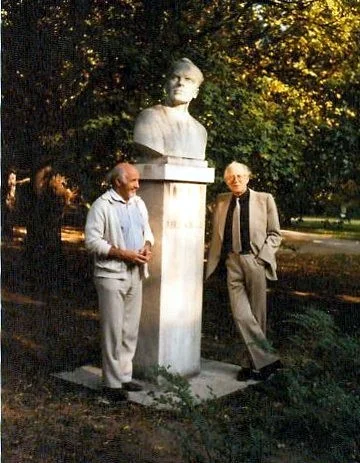
“My subsequent friendship with Siegfried Fink and his pupils naturally inspired many of my works. I immersed myself in the subject, had many pieces played for me, and was thus able to develop a sound style all of my own.”
Bertold Hummel, January 1998
“Dear Bertold,
the concert by our institute’s percussion class provides a welcome opportunity for me to write a few words to you. As your artistic and pedagogical work and your dedication have been honoured from so many quarters on the occasion of your milestone birthday, I would like to make a few comments from the perspective of ‘percussion instrumentalists’.
I have always emphasised to my students that curiosity and imagination are the defining criteria for our profession (our calling?). I have come to know and appreciate both of these qualities in you in such abundance. And I recall with great joy and pride the many hours we spent together working on and refining your numerous percussion compositions.Building on the teaching of compositional technique and expressive content in the 20th century, two aspects of musical composition have come to the fore: timbre and ‘timing’.... In my view, as a logical response to the question of how to combine the new sonic ideal with new rhythmic-metric formulas and sounds that had remained untapped, percussion instruments thus became the ideal instrumentarium for new compositions.
The composers of our generation have been unable to resist this fascination. Unfortunately, however, they have not always possessed the necessary knowledge of the performance and stylistic criteria of percussion.
You, dear Bertold, have, as in all your works, taken the only correct path and have engaged with the instruments through lengthy discussions with the performers of your compositions. And from this collaboration and your insights, compositions have emerged which, on the one hand, exploit the full potential of the instruments… but also always incorporate the ‘heart’ of the instruments – and which, despite the often very high technical demands, could and can always be performed faithfully to the score by the performers.
Thus, drawing on your profound knowledge of percussion instruments, you were able to realise the new and interesting soundscapes you devised – and in doing so, you have spared our instrument collection the use of garden hoses and watering cans.
I would like to express my special thanks here and now, certainly on behalf of many performers, for your wonderful percussion compositions.
Personally, however, I would also like to thank you for the 30 years we have spent together on our professional and personal journeys.”
Siegfried Fink (Speech given at a concert on 1 December 1995 to mark Bertold Hummel’s 70th birthday at the Würzburg University of Music)
The “Pope of Percussion” died on 3 May 2006 at the age of 78
Siegfried Fink was born in 1928 in Zerbst, Anhalt. His father was a violinist in the Königsberg Opera Orchestra, but was unable to continue practising his profession following an accident. After the end of the war, Fink began an apprenticeship as a bricklayer, which he completed with his journeyman’s examination. At the same time, in early 1948, he had secretly sat the entrance examination at the Franz Liszt University of Music in Weimar. There he studied timpani and percussion with Alfred Wagner and composition with Prof. Helmuth Riethmüller until 1951. This was followed by positions in orchestras in Weimar and Magdeburg, his first teaching post at the Telemann Conservatoire in Magdeburg, and, in 1958, his escape to the West – because of his commitment to jazz, Fink had been accused in the GDR of promoting decadent music with Western influences. Thus, the 30-year-old Fink first came to Lübeck and was engaged as principal timpanist on the very last day of the season, stepping in without a rehearsal to take over the performance of *The Flying Dutchman* under the baton of conductor Christoph von Dohnanyi. He was also appointed to the “Schleswig-Holstein Music Academy”, where, in addition to teaching percussion, he ran a jazz studio. In Lübeck, Fink devoted himself particularly to 20th-century music, soon making a name for himself as a soloist. This was followed by engagements at the “Days of New Music in Hanover”, the “Darmstadt Music Days” and as a lecturer at the “International Summer Courses at Weikersheim Castle”. After a brief spell at the University of Theatre and Music in Hanover, Fink finally arrived in Würzburg in 1965. As a lecturer in timpani and percussion and director of the ‘Studio for Percussion’, he turned Würzburg into a mecca for percussionists from all over the world. Here – at Germany’s first Chair of Percussion – he was able to realise his ideas for a new direction in percussion methodology and percussion music.
Siegfried Fink has received numerous awards for his artistic and music-educational achievements, including the Federal Cross of Merit, an honorary diploma from the Barcelona Conservatory of Music, an honorary doctorate from the State Music Academy in Sofia, and the City of Würzburg’s Culture Prize. Far more important to him, however, were his students, who were consistently among the prize-winners at national and international competitions and are now internationally renowned solo percussionists, such as Peter Sadlo, Mark Glentworth, Wessela Kostowa, Andrea Schneider, Bernd Kremling, Thomas Keemss and Mark Andreas Giesecke. This list could be extended to include many more names. Today, Fink’s students are active worldwide in orchestras or as teachers at music schools and conservatoires; some of them are already professors in their own right.
Incidentally, as a composer, he has written over 140 works for a wide variety of percussion instruments as well as for ensembles featuring other instruments, thereby setting new standards in the literature for percussion. These include, for example, a suite for solo snare drum (ZM 21710), which, as a concert piece lasting 9 minutes (!), was something quite extraordinary at the time of its composition. His Drumset Suite (ZM 21790) is one of the first fully notated works to have been written for this instrument. As the multitude of different notational conventions for percussion instruments often makes it unnecessarily difficult to grasp a part quickly, Siegfried Fink developed ‘Tabulatur 72’ (later updated as ‘Tabulatur 2000’); a system by which symbols and notation can be standardised.
Just in time for his 75th birthday on 8 February 2003, news arrived from America. Siegfried Fink became the first non-American to be awarded the ‘Lifetime Achievement in Education Award’ at a gala banquet during the most recent World Congress of the Percussive Arts Society (PAS). It was Siegfried Fink who brought percussion into the mainstream. He provided many important impetus to German percussion education. And anyone who is a leading figure in the German and European percussion scene today will almost certainly have the name Siegfried Fink featured in their CV.
(Source: www.percussion-creativ.de)
Siegfried Fink: “Sound and Timing” – Bertold Hummels’ works for percussion (in Composers in Bavaria: BERTOLD HUMMEL)