Herbsttag (Rainer Maria Rilke) for medium voice and piano (op. 71c, 1980)
Dedication
Wolfgang Osthoff on his 60th birthday
Instrumentation
Medium voice, piano
Duration: 3 minutes
Premiere
17 March 1987,
Würzburg, Toscanasaal of the Residence
Martin Hummel | Thomas Hitzlberger
Autograph
Title: Autumn Day (R. M. Rilke) - Length: 4 pages - Date: 25 Oct 80 - Location:
Publisher
Free sheet music download
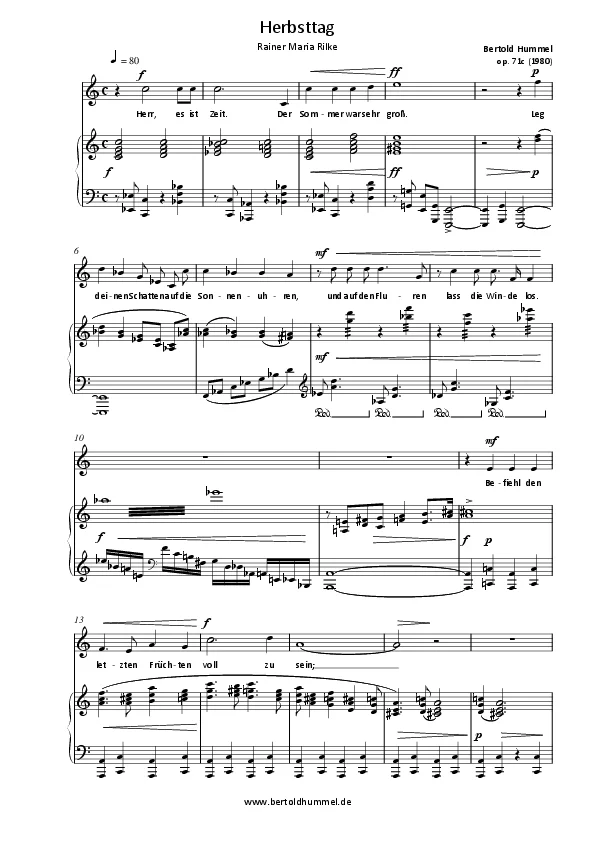
Op. 71c for medium voice (original)

Op. 71c for high voice
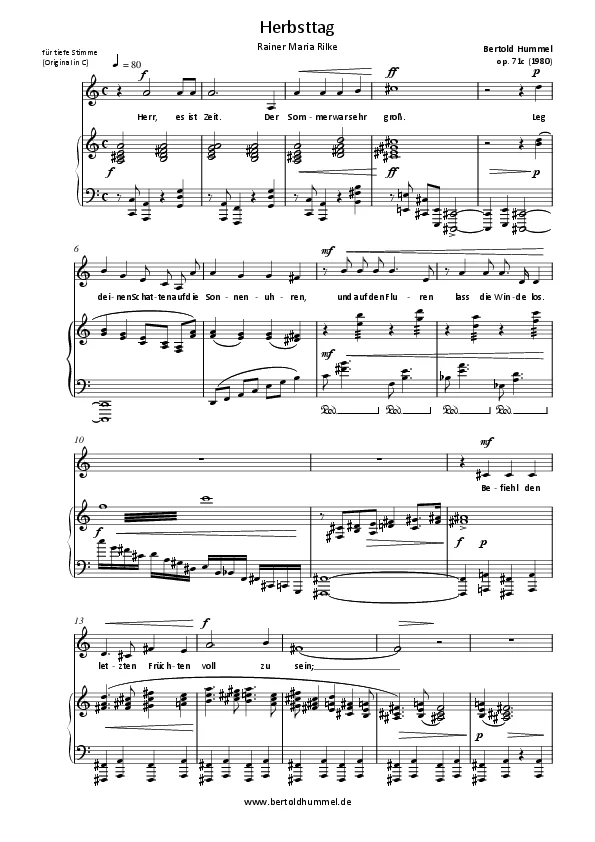
Op. 71c for a low voice
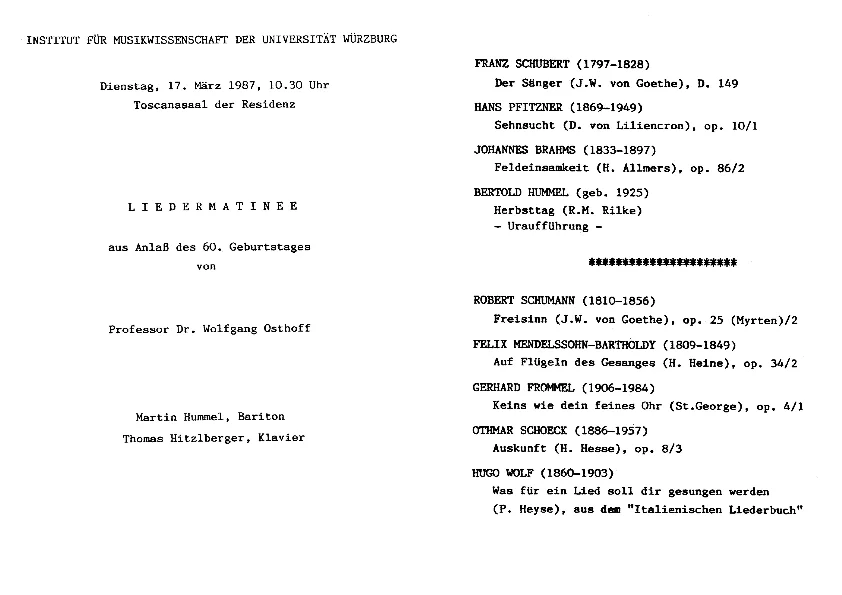
Programme for the world premiere of Op. 71c
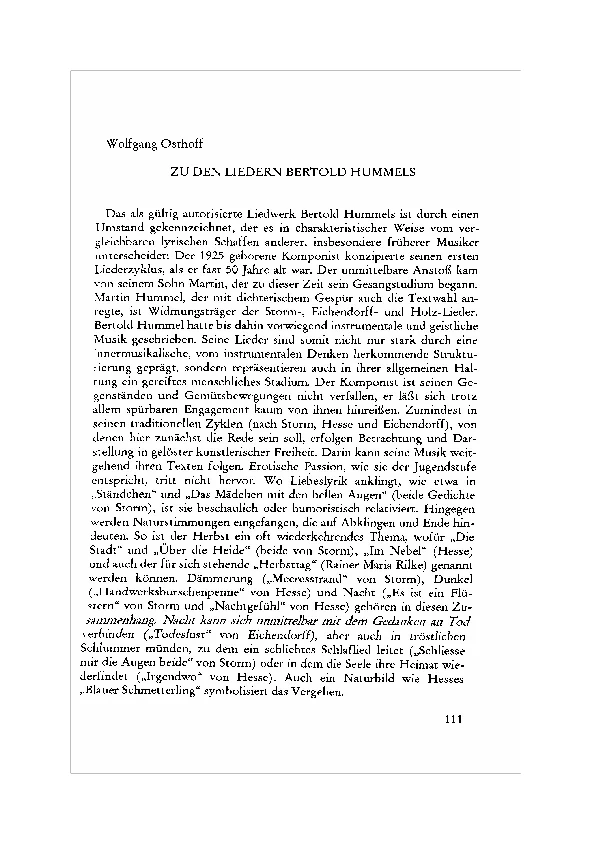
Wolfgang Osthoff (1988): On Bertold Hummel’s songs




Written in 1987 for the 60th birthday of a musicologist friend, Herbsttag (Autumn Day ) on a poem by Rainer Maria Rilke lends a further characteristic character to the theme that has been so central to Hummel since the Storm songs. Its ambivalence(Befiehl den letzten Früchten voll zu sein) is reflected musically in the transversal intervals and the associated oscillation between major and minor. This also brings into play the mild thirds and sixths that are rather rare in Hummel's music. The composer succeeds in summarising Rilke's growing verses (3, 4 and 5 verses) in their formal and thematic dynamics under a large musical arc. The inner climax is the end of the second verse, i.e. the only verse that Hummel repeats: Die letzte Süße in den schweren Wein. In its broadly sweeping sequencing (melodically derived from the phrase "südlichere Tage" heard shortly before), this is one of those passages where the melodic qualities of Hummel's songs manifest themselves particularly impressively.
Wolfgang Osthoff (in "Zu den Liedern Bertold Hummels" Tutzing, 1998)