Concertino for basset horn and string orchestra (op. 27a, 1964)
Movement titles
I. Prolog, II. Concerto, III. Epilog
Instrumentation
Basset horn, string orchestra
Duration: 15 minutes
Premiere
9 September 1966,
Ernst Flackus | Kurpfälzisches Kammerorchester | Wolfgang Hofmann
Autograph
Score / piano reduction: 2nd and 3rd movements (1st movement lost) / complete - Title: - / Concertino for basset horn (bassoon) and strings - Length: 22 pages / 19 pages - Dated: II. 16 March 64 / - - Location: - / Bayerische Staatsbibliothek Munich
Publisher
N. Simrock Hamburg-London (Boosey & Hawkes) Piano reduction and solo part: EE 5288 / ISMN 979-0-2211-2071-7
Original French folk songs




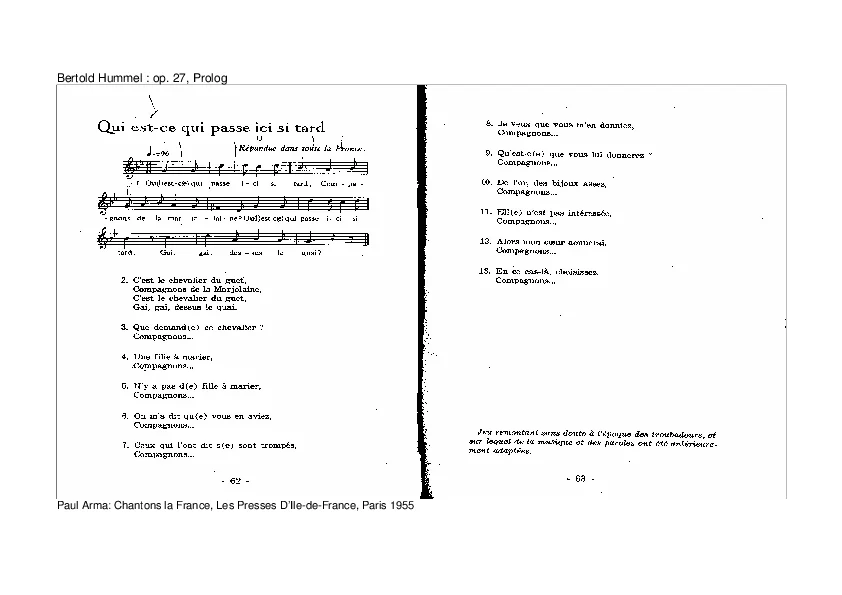
The 'CONCERTINO' op.27 was written in 1964 as 'Concertino for basset horn and string orchestra'. (In 1992 it was arranged for bassoon and string orchestra op. 27b). In this three-movement work, the solo part of which is extremely virtuosic, the organic inclusion of French folk melodies is particularly surprising and original. The melody and harmony are mainly based on sequences of fourths and fifths which, derived from a folk tune, provide the musical material for the prologue (1st movement) and the entire work. The 'Concerto' (2nd movement) is dominated by a striking bassoon motif (triplet upbeat, fourth and fifth leap). Like a rondo, this motif also appears in the orchestra in different variations. Furthermore, nervous scale movements, counterpointed by syncopations and odd rhythms, determine the musical progression. Suddenly a folk melody appears again - as a contrasting idea. After a virtuoso solo cadenza, this is continued as a 'cantus firmus' in the orchestra. The extremely fast-paced final bars of this movement are followed by a contemplative epilogue in the manner of an 'antiphonal chant' between the 1st violins (harmonically supported by the other string instruments) and the solo instrument.
Alfred Thomas Müller
Bertold Hummel composed the Concertino for basset horn in 1964. The piece is characterised by the use of French folk song melodies, which are incorporated into its own thematic material. In the first movement - Prologue - the solo instrument appears in recitative-like declamation. The Concerto, the second movement, is based on the meaning of the word "concertare" = "to compete", in that the soloist and string ensemble are brought together "competitively" to form an overarching unit. The short epilogue is a fading away in a strict alternation of basset horn and strings.
Hartwig Kuckuck
On 27 September 1958, Bertold Hummel composed the first movement of an unfinished sonatina for soprano recorder and harpsichord. This opening piece is partly identical to the 2nd movement of the Concertino op. 27.