String trio in E (op. 1b, 1948)
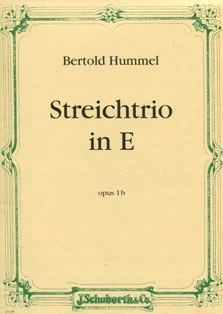
I. lively, moving, II. slow, flowing, III. finale, lively
Violine, Viola, Violoncello
Duration: 10 minutes
Marianne Schmidt | Edith Klein | Bertold Hummel
Title: String Trio in E (1948) - Length: 15 pages - Date: - - Location: -
Schott Music ED 20293 / ISMN: M-001-14998-3
First edition: J. Schuberth & Co., Eisenach 1995
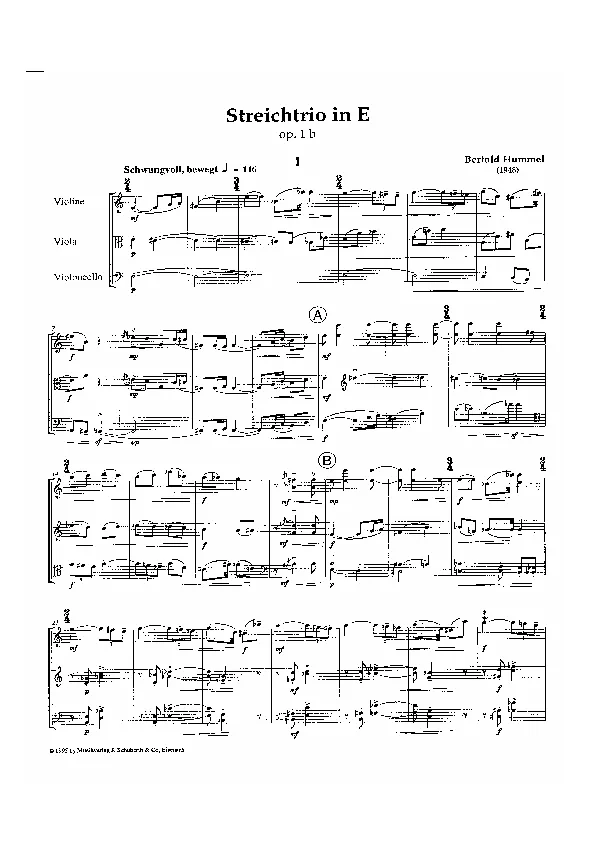
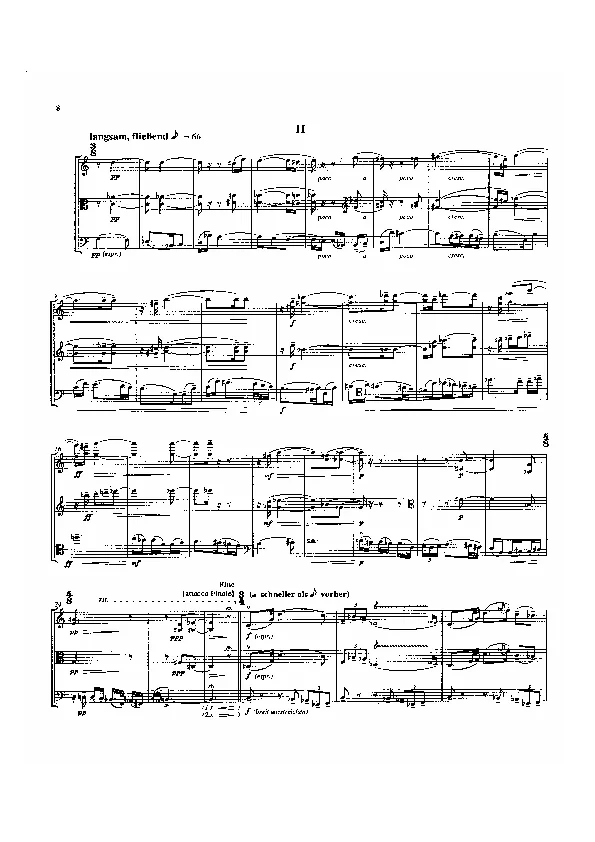
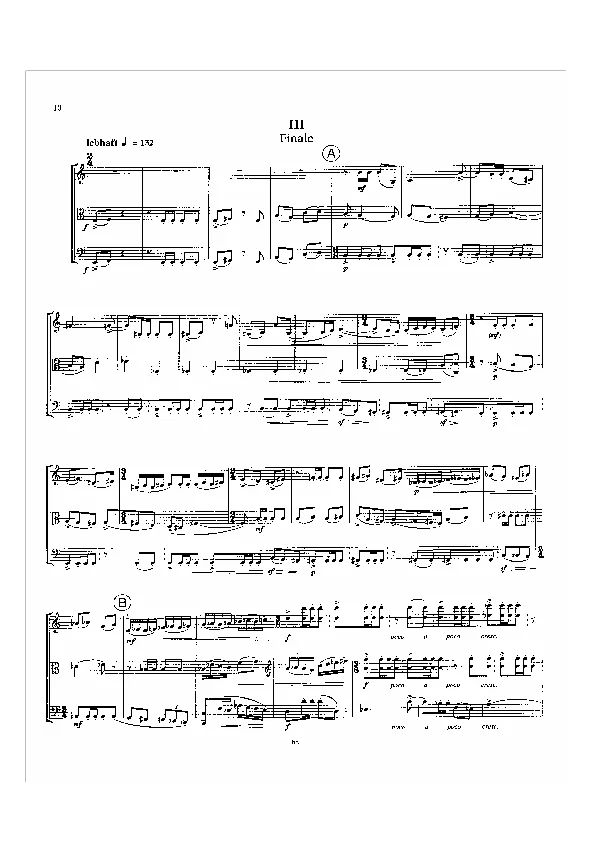
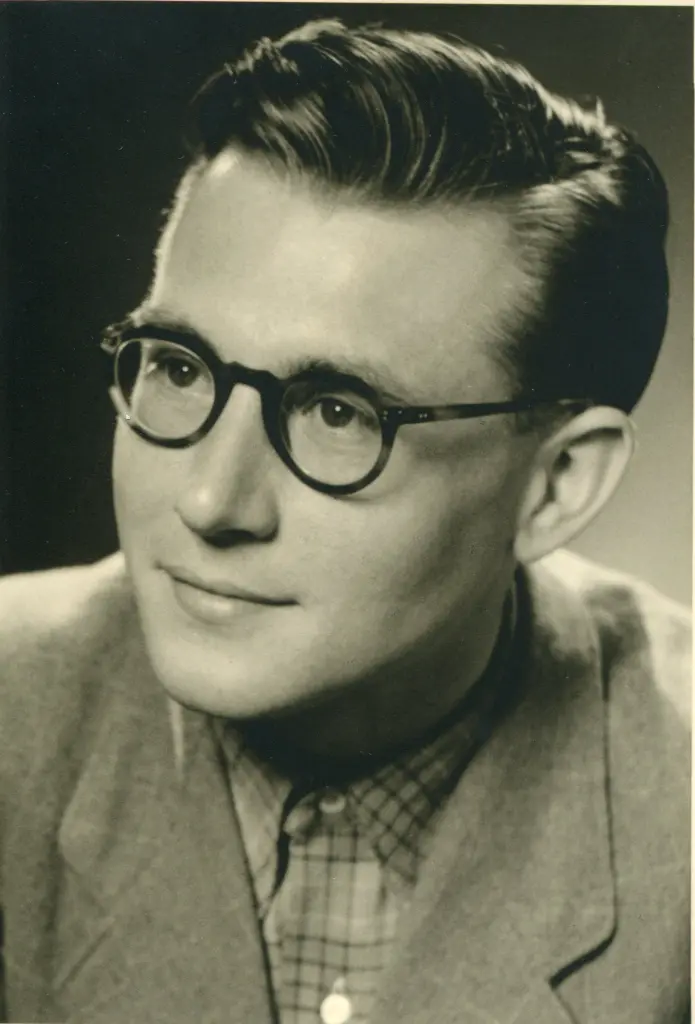
The young Bertold Hummel, whose three-movement String Trio in E, which had its public premiere that evening, was more than a sample of his talent. Even if Hindemith's influence cannot be denied in some of the details of this Genzmer pupil's work, he has already achieved something of his own from a genuine impulse, for example in the sharpened sound support for the great cello cantilena of the slow middle movement or in the concise rhythm of the final movement. The composer also achieved a decidedly heartfelt success in this splendidly musical and lively piece as the spirited leading interpreter on the cello stand together with Marianne Schmidt (violin) and Edith Klein (viola).
The String Trio in E by Bertold Hummel revealed a musician who knows how to conduct a musical conversation with the instruments that is fuelled by genuine intellectual fire, and a composition of solid craftsmanship and strong intensity of tension, at times somewhat brusque in its statement, in any case completely unconventional and free of any gimmickry.
Hanns Reich
Fritz Werner
"...a poem should give strength to live"
In memory of Rainer Maria Gerhardt
"gruppe der fragmente freiburger kreis 1st event poetry music painting Friday, 24 February 1950 20h. university lecture theatre 5". A striking poster, 60 x 25, with the brown lettering left out of the black applied to the wrapping paper. An unusual image of the lecture theatre with its 60 or so visitors, mostly young people. On the walls are powerful woodcuts by Erwin Steitz and Helmut Bischoff. Next to them, interesting monotypes by Waldemar Epple. The 22-minute-long "poem" by Claus Bremer was also unusual. Then they appeared, the poets, painter-poets, translations of these same poets, by Perse and Pound were read, the string trio in E by the highly talented Genzmer pupil Bertold Hummel was heard. And the head of this group, Rainer Maria Gerhardt, also read his own poetry. I don't know what he read. The programme includes The Great Wall. I only remember that his language was electrifying, that it was a completely new tone, an unspentness of words that was stirring. The first leap into the public eye had been made. After more than 40 years, it is difficult to bring this period back to life and what I have to say can only be a personal confession to a young poet who, for me, was the beginning of a new poetic consciousness.
Allmende 32/33, Elster Verlag Baden-Baden, 12th vol. 1992




If you rummage through the unpublished works of great composers, you will find many a "youthful sin" - provided that the composers did not carefully destroy everything that did not seem worthy of an opus number. Not so with Bertold Hummel, who in the 1990s released a manuscript for publication that he had written at the age of twenty-two and which bears witness to his early mastery. With the String Trio op. 1b from 1948, Hummel presents himself as an experienced chamber musician who knows how to come up with musical verve. A retrospective review of the music history of the post-war years reveals many works that are "worked" with remarkable seriousness and solidity. One involuntarily thinks of the reconstruction mentality of those years. Here, however, the youthful composer, who had returned home from a brief period as a prisoner of war, knows that he is free of this: the violin intones a theme in an a-periodic style, full of sweeping movement and punctuated by changes of metre, which serves as material for a sonata movement that bears the signature of a playfully inclined calculator. The toccata-like finale with polymetric structures is particularly close to Stravinsky and Blacher.
Klaus Hinrich Stahmer (in: "Chamber music as a personal confession", Tutzing 1998)