Fantasia bucolica for viola and chamber orchestra (op. 13f, 1956)
Viola and chamber orchestra (1.1.2.1-1.1.0.0-percussion, harp, strings)
Duration: 6 minutes
Hans Hasselmann | SWF Small Light Music Orchestra | Willi Stech
Title: Fantasia in D for viola + small orchestra - Length: 50 pages - Date: 20 Aug. 56 - Location: Bayerische Staatsbibliothek Munich
Schott Music score and parts: Rental material, piano reduction: VAB 92 / ISMN: 979-0-001-16435-1
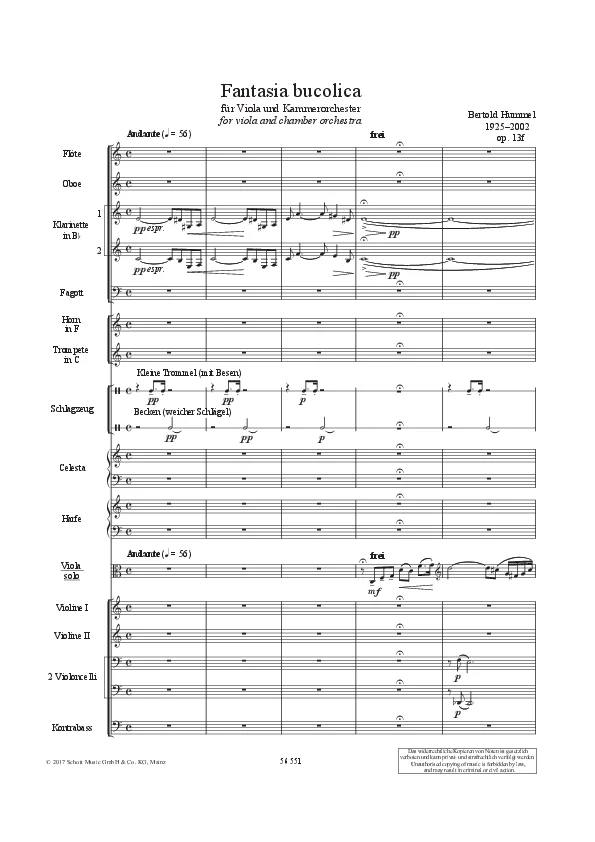
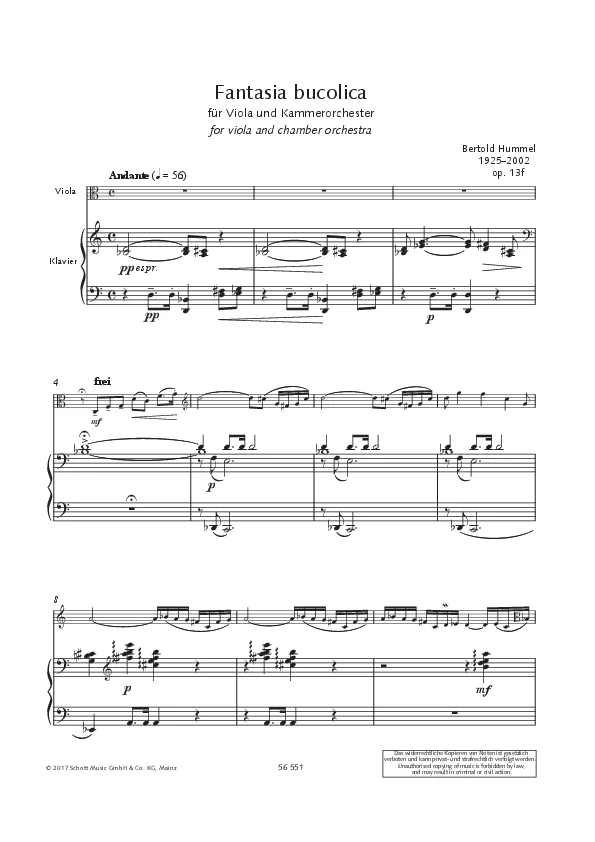

The *Fantasia*, lasting around six minutes, is a valuable addition to the concert repertoire for the viola. In the introductory *Andante*, the viola begins with a lyrical part to be played ‘freely’, accompanied by the orchestra’s arpeggios. Thereafter, the interplay between soloist and orchestra intensifies, building ever-greater tension and giving rise to a highly expressive sound enriched with dissonances. This is followed by a free, unaccompanied, elegiac melody on the viola, which leads via a ritardando into the Allegro. This Allegro is, in the Hindemith tradition, driven by a sense of momentum: a play of movements and rhythms, spirited, with surprising dialogues between the orchestra and the soloist, punctuated by expressive melodic motifs, by changes of rhythm marked by accents, and by dynamics that shift at short intervals. Towards the end, Hummel brings the music back to the Andante and to a free passage for the solo viola in a fully composed concert cadenza.
The Fantasia still appears tonal, centred on the note D. Yet its sonority expands and transcends the boundaries of tonal harmony, incorporating dissonances to intensify tension and energy. Emerging from Genzmer’s school, this work impresses with its solid technical foundation, which is also evident in the fact that it is composed with a deep understanding of the viola’s playing technique and sonic possibilities. The interaction with the orchestra is multifaceted, ranging from restrained accompaniment to polyphonic density.
The clearly laid-out edition published by Schott-Verlag of the solo part and piano reduction by Cornelius Hummel is ideally suited for study and concert performance. For advanced pupils and students, the Fantasia serves as an introduction to New Music that demands the highest level of musicality. In a concert performance, this piece allows the solo violist to draw on a wide range of techniques, resulting in an exciting and expressive interplay between soloist and orchestra. An important addition to the viola repertoire.
Franzpeter Messmer
Behr, Wolfgang Martin: Das kleine Unterhaltungsorchester des Südwestfunks unter der Leitung von Willi Stech. Untersuchungen zur Aufgabe und Bedeutung eines Rundfunkorchesters (1992). Printed: Baden-Baden 1994 (= Südwestfunk, Schriftenreihe Rundfunkgeschichte, Vol. 3).




The Fantasia bucolica for viola and chamber orchestra op. 13f was commissioned by the small entertainment orchestra Südwestfunk Baden-Baden in 1956. In the same year, it was also produced with this orchestra and soloist Hans Hasselmann under the direction of Willi Stech for SWF in Freiburg. This short concert piece begins with a dreamy introduction by the solo viola, leads into a virtuoso middle section and then ends again with the sounds of the beginning. The varied use of percussion in the orchestra's instrumentation is already striking here.