The Emperor's New Clothes - Chamber Opera (op. 10, 1955)
after Hans Christian Andersen in 5 pictures
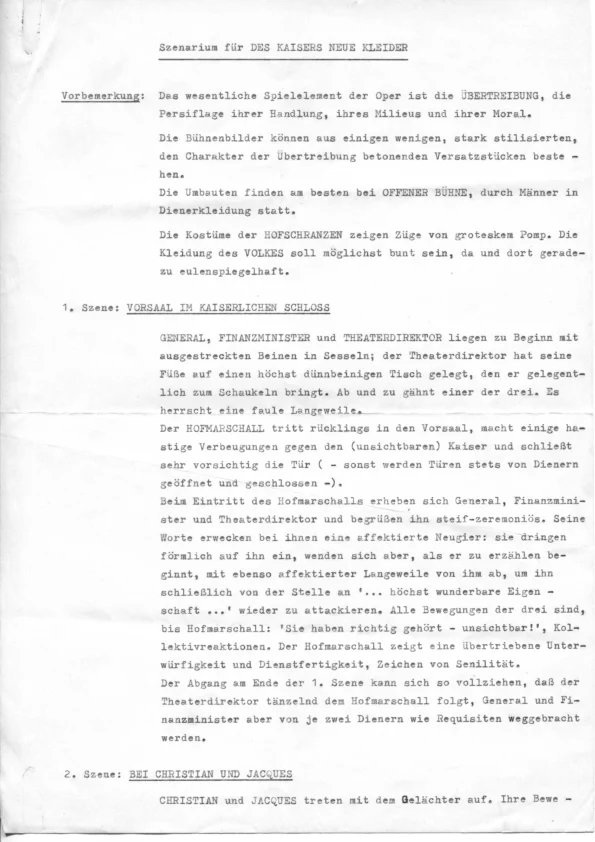
1st picture: The emperor's antechamber, 2nd picture: The court marshal's appearance at Christian and Jacques, 3rd picture: In front of the imperial palace, 4th picture: In the throne room, 5th picture: In the street
| The Emperor | Bass |
| The Court Marshal | Tenor |
| The General | Tenor |
| The Minister of Finance | Baritone |
| The Theatre Director | Bass |
| Christian, a swindler | Tenor |
| Jacques, a swindler | Baritone |
| A messenger | Speaking role |
| A child | Speaking role |
| Female voice | Soprano solo |
| Emperor's entourage | Male voices |
| People | Mixed choir |
Orchestra: 1.1.1.1 - 0.1.0.0 - percussion, piano (harpsichord), strings (without violins)
Duration: 55 minutes
Conductor: Günther Wich
Title: "Des Kaisers neue Kleider" (after H. Chr. Andersen) Chamber opera in 5 pictures; Length: 152 pages; Date: 1st picture: 21. VII. 54 / 2nd picture: - / 3rd picture: 18. June 55 Stellenbosch / 4th picture: Stellenbosch 11. July 55 / 5th picture: Las Palmas 13. August 55; Location: Bayerische Staatsbibliothek Munich
Manuscript
Complete recording of the world premiere


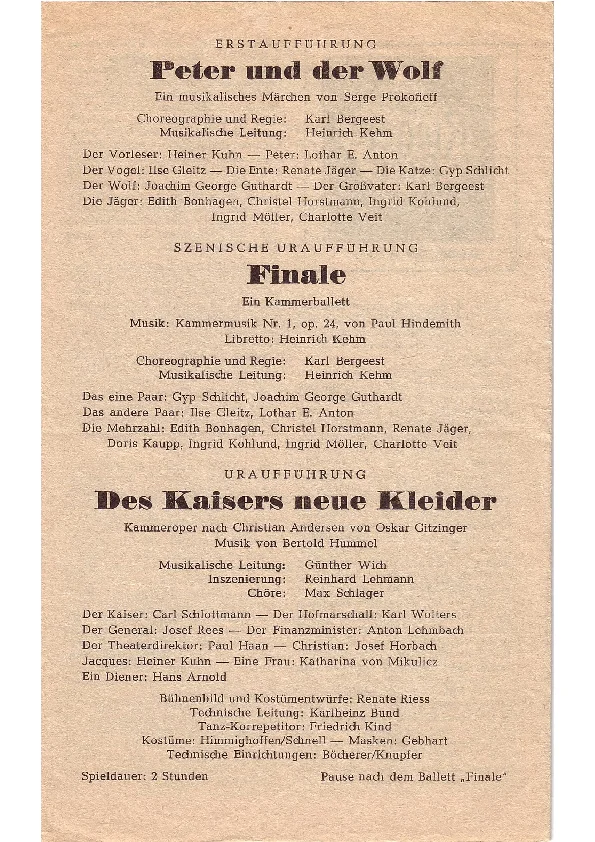
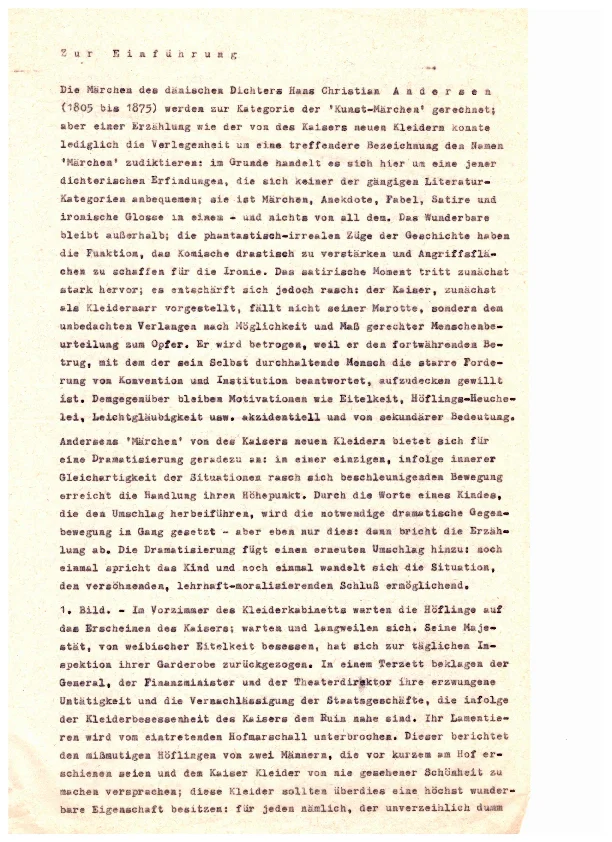
"The repertoire of the German opera stage, which is chronically lacking in light-hearted works, has now been given a new lease of life in Freiburg following Werner Egk’s *The Inspector*: 'The Emperor’s New Clothes’, a chamber opera by the 31-year-old Genzmer pupil Bertold Hummel, has had its world premiere at the Großes Haus. Oskar Gitzinger’s libretto summarises, in a rapid succession of scenes, Hans Christian Andersen’s satirical fairy tale about the emperor whose vanity clouds his judgement until, cheered on by a blindly faithful populace, he struts in in his underpants, the victim of two charlatans. Only the innocence of a child is able to reveal the rather stark truth. Emperor and people admit to self-deception and jointly plead guilty.
Bertold Hummel has ventured from church music into the milieu of these cheerfully moralising yarn-spinners and bag-makers. He has condensed the individual scenes into rigorous musical forms and accompanied the burlesque proceedings with a chamber orchestra comprising four woodwinds, a trumpet, three violas, two cellos, a double bass, piano and a rich percussion section, in a manner that is partly illustrative, partly contrapuntal. Despite the demands placed on the soloists and choir, his music is pleasing, though the instrumentation is at times a little patchy.
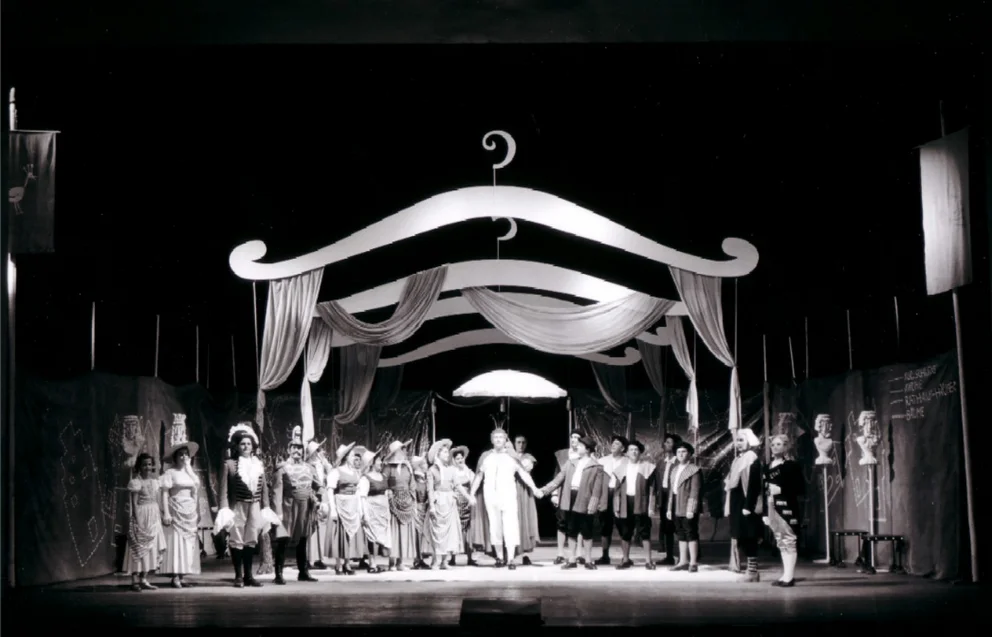
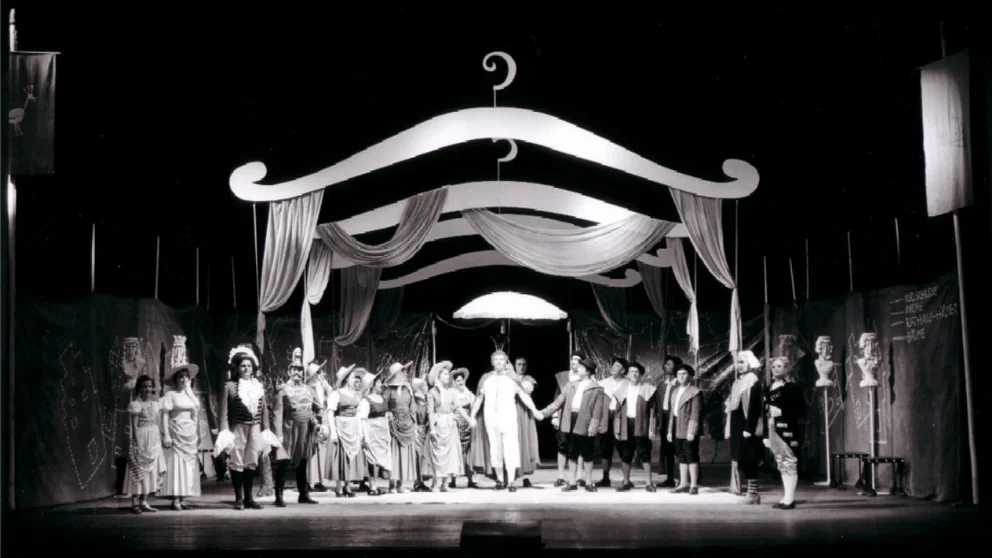
The Freiburg premiere, conducted by Günther Wichs, was staged by Reinhard Lehmann in Renate Riß’s particularly charming set design, crowned by elegantly curved coat hangers. Carl Schlottmann sang the role of the Emperor. The entertaining little work was warmly received by the audience."
Bertold Hummel has turned Andersen’s fairy tale into an ironic musical farce. He has given each of the five scenes a self-contained musical form. In the second scene, as the two tailors Jacques and Christian try to pass off the new clothes to the court marshal, a parody of modern dance rhythms is particularly effective.... His chamber opera, now receiving its world premiere, reveals a master craftsman and formal innovator who holds nothing back, neither for himself nor for the audience.