Prelude in d for organ (op. 85b, 1979)
Instrumentation
Organ
Duration: 3 minutes
Autograph
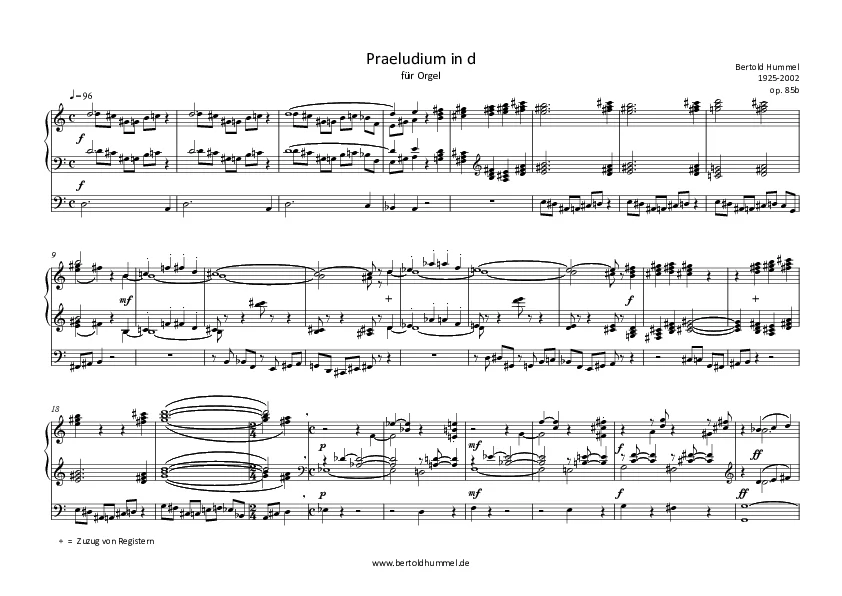
Title: Praeludium in d for organ - Length: 3 pages - Date: 25.11.79
Publisher
Free sheet music download
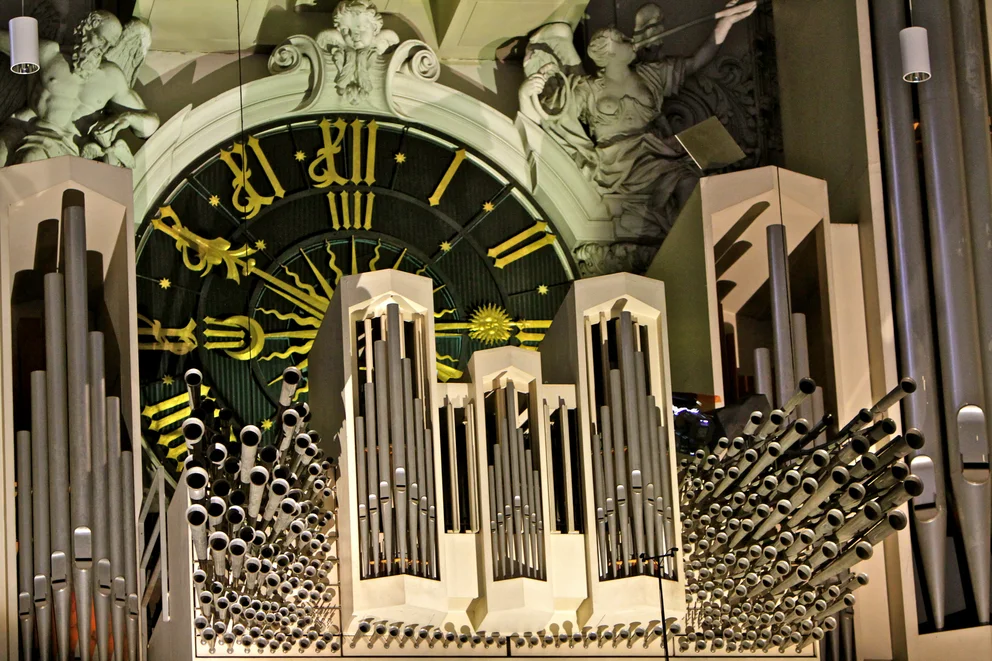
Neue Presse, Coburg, 7 May 2005
His "Prelude in D minor", Op. 85b, the improvisation: "Come, Creator Spirit", Op. 85c, and the postlude: “Let Us Rejoice Heartily”, Op. 85d, ranged from touching stillness and nature-inspired grandeur to dissonant, doubting passages and powerful, even majestic professions of faith. A fresh and new experience of organ music, which the composer had been eagerly anticipating as a project by Marius Popp, but which he was sadly no longer able to witness.




"The Prelude in D minor can also be played by the whole orchestra!"
Bertold Hummel
If, following the Council, Gregorian chant is considered the Catholic Church’s most authentic form of music, then Hummel’s organ music is particularly shaped by this idea — here, one of his answers quoted above applies once again: Gregorian chant is indispensable as a source of inspiration for all genuine church music. After Gregorian chant, the hymn is the next source of inspiration. When he is not using direct passages or fragments from Gregorian chant or hymns, Hummel invents modes as building blocks, which are sequences of notes modified from memory or from models and with which one can work contrapuntally and harmonically.
This working method can be seen and heard particularly clearly in the short pieces he wrote for the ‘Augsburger Orgelbuch für den gottesdienstlichen Gebrauch’ (Four volumes published by Böhm & Sohn, Augsburg). These are: a Prelude in D minor (Book 2), an improvisation: ‘Komm, Schöpfer Geist’ (GL No. 245) (Book 3) and a postlude: ‘Laßt uns erfreuen herzlich sehr’ (GL No. 585) (Book 4).
In the prelude, a six-note sequence in all possible variations runs through the entire piece. Although one cannot speak of a half-twelve-tone row, it is nevertheless interesting in this context that Hummel rarely employs strict twelve-tone compositional technique, because he wishes to determine his own parameters for composition.
(from Franz A. Stein, “Die Kirchenmusik Bertold Hummels”, Tutzing, 1998)
The opening of the Prelude in D minor is identical to the opening of the Proprium “For the Feast of the Transfiguration of Christ” ( 1961)