Concertante music for guitar and string quartet (op. 89a, 1989)
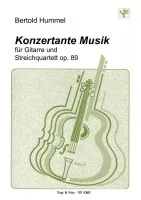
Dedicated to Michael Tröster
I. Andante, II. Burlesque, III. Arioso, IV. Finale
Guitar, string quartet
Duration: 23 minutes
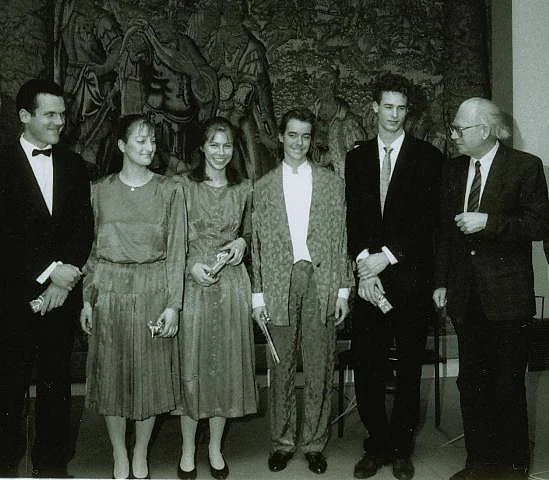
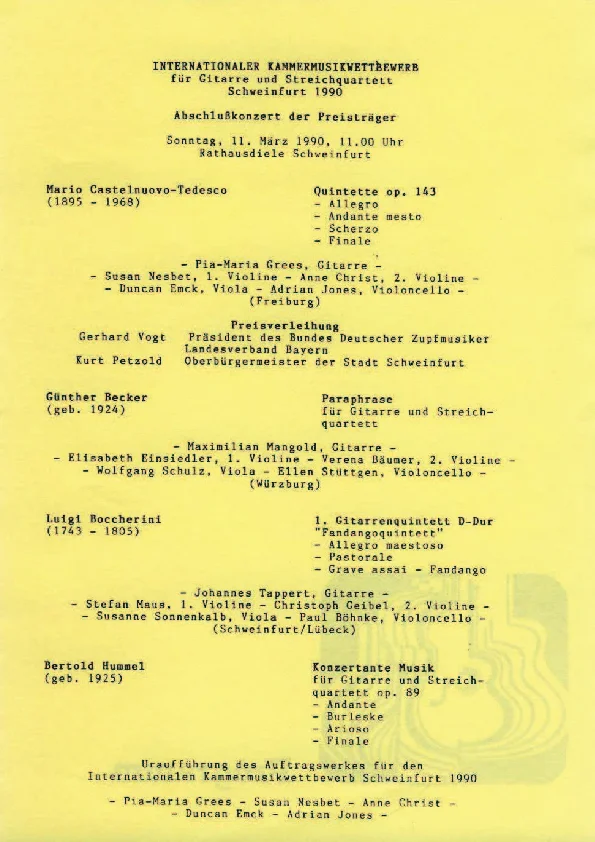
Pia-Maria Grees | Susan Nesbet | Anne Christ | Duncan Emck | Adrian Jones
Title: Konzertante Musik für Gitarre und Streichquartett op. 89 - Length: 49 pages - Date: I. - / II. 19.8.89 / III. 22.Aug. 89 / IV. 29.Aug. 89 - Location: Bayerische Staatsbibliothek Munich
Vogt & Fritz VF 1060 / ISMN M 2026-1283-5
Errata: score and parts: III. arioso, bar 32: last crotchet rest omitted. IV. Finale: bar 16: guitar and violin parts must be exchanged.
Overall impression: brisk, lively, formal, tendentially conservative, in the burlesque a witty-grotesque swan song to the "Dear Augustine", in the finale a virtuoso, beautifully extended solo cadenza.
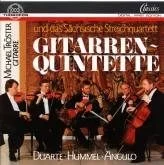
Despite all the desire for new impulses, it remains to be said that the quintets by Eduardo Angulo and Bertold Hummel, which have almost become "classics", will remain among the unrivalled masterpieces of the 20th century for a long time to come.




In the 1st movement Andante, a 12-note theme is presented above the organ point g, initially by the viola and cello. The guitar continues this episode in a quasi-recitative manner. The mirroring begins above the organ point E (bar 11); now the theme is played by the two violins. The guitar recitative also proceeds in inversion. In bar 21, the first 4 notes of the theme begin to be strettoed; the 12-note theme in the guitar follows via the organ point A, which leads to a chorale-like phrase (bar 31) that leads to F sharp major. The guitar enters again with the recitative. The repetition of the chorale episode ends in B major. This is followed by a narrowing of the first 4 notes of the 12-note theme. A triadic sequence (from bar 47), which takes the entire chromatic material into account, signals the approaching end of the movement. The 12-note row(from bar 54) appears one last time and is realised in a fully chromatic sound through sustained notes in the strings.
The Burleske (2nd movement) is characterised by the popular melody: "O du lieber Augustin". A turbulent semiquaver movement creates the necessary contrast to the song metamorphoses, tonal guitaristic commonplace formulas appear and are repeatedly wiped away or called into question. The movement ends with a grand final gesture.
In the 3rd movement, arioso sections with baroque phrases are introduced, structured, interrupted and concluded by static tonal and recitative-like episodes.
The finale is a concertante finale with a rondo character. A jazz-like theme over throbbing basses is contrasted with a somewhat grotesque march episode that leads into a guitar cadenza. This is followed by a kind of recapitulation with the realisation of various ideas from the 1st part. The calm coda comes to a surprising conclusion.
Bertold Hummel
The 1st movement (Andante) is structured by the 4-fold exposition of a 12-note melody. The intermediate sections are quasi realisations of melodic segments, which are processed in very contrasting ways.
The 2nd movement (Burleske) is characterised by metamorphoses on the folksong "O, du lieber Augustin ..." with many shades ranging from the grotesque to the lyrical.
Baroque models are developed in the 3rd movement (Arioso), framed and interrupted by recitative-like formulations.
The 4th movement (finale) is in the form of a round dance. It has a colourful alternation of throbbing and march-like passages - interrupted only by a solo cadenza and a few lyricisms - and is not entirely free of a certain cheerful irony.
The work is dedicated to Michael Tröster.
Bertold Hummel (15 November 1994)
Bertold Hummel's concertante music is influenced by the Second Viennese School. The first movement of his work is characterised by dodecaphonic structures. A row of twelfths is heard four times. Right at the beginning, it is first intoned in unison by the viola and cello. After an interlude by the guitar, which, like the following interludes, uses fragments of rows in a loose manner, the basic row is given over to the high strings: but now in a different mode, as an inversion. Another interlude can be heard, ending with a tremolo passage in the strings. Now the guitar comes up with the twelve-tone row, transposing it first from G to A, then in a new rhythmic guise to E. A final interlude characterised by strong dynamic contrasts passes by the listener, which is again concluded by a string tremolo before the row experiences its fourth exposition. This time, however, the individual notes of the twelve-tone melody are not entrusted to a single instrument, but wander through the voices of all the participants, a technique already used by Anton Wehern in the final movement of his first cantata.
The second movement forms a sharp contrast to the strict architecture of the introductory Andante, as it is characterised by playfulness and musical humour. The quotation of the song "O, du lieber Augustin" and its grotesque metamorphoses contribute significantly to the burlesque expression. Singing about the world of dear Augustin, Hummel once again reveals his affinity with the Viennese school. Schönberg also paid homage to the old Viennese folk tune and its hero by quoting it in his second string quartet.
The third movement of the concertante music, entitled Arioso, is once again a kind of journey into the past. With its continued spinning melody and hints of counterpoint, it takes the listener back to the Baroque era.
Finally, the finale takes the form of a rondo. Dance-like passages, whose pulsating rhythms seem to be inspired by the vigour of South American music, compete with march-like phrases in an exhilarating contest that is only occasionally punctuated by lyrical passages. However, the last word is reserved for the dance element: After a few glissandi that span the seventh, it is heard one last time - in sublimated form, so to speak - in the harmonics of the guitar.
Matthias Henke (in the CD booklet "Guitar Quintets" Thorofon CTH 2212)