Quattro Pezzi for percussion solo (op. 92, 1990)

for Peter Sadlo
I. Prolog, II. Allegro con brio, III. A la Sarabande, IV. Vivace
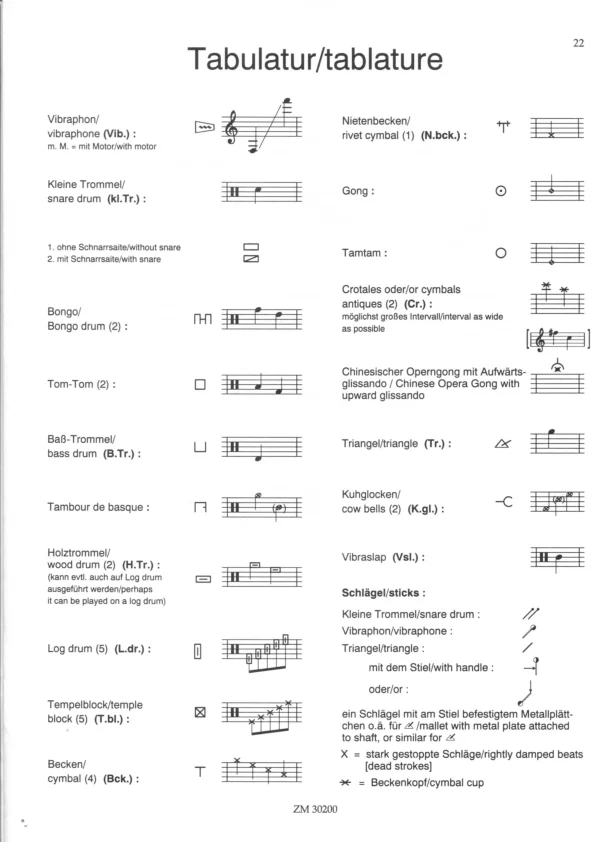
Vibraphone, snare drum, 2 bongos, 2 tom-toms, bass drum, tambour de basque, 2 wooden drums, 5 log drums, 5 temple blocks, 4 suspended cymbals, 1 studded cymbal, 1 gong, 1 tam-tam, 2 crotales, 1 Chinese opera gong with upward glissando, 1 triangle, 2 cowbells, 1 vibraslap
Duration: 18 minutes
Peter Sadlo
Zimmermann Musikverlag Frankfurt ZM 30200 / ISMN: M-010-30200-3
Bertold Hummel (born 1925), long-time president and composition teacher at the Würzburg University of Music, very soon discovered the unspent and almost inexhaustible sound potential of percussion for his compositions in his search for "the sound of our time". His catalogue of works includes such exemplary percussion compositions as Fresken 70 for percussion quartet, 5 Szenen for two percussionists, Aspekte for three percussionists, the Concerto for Percussion and Orchestra and Quattro Pezzi for solo percussion. The solo work is certainly a consistent challenge for Hummel, and so he composed for a wide variety of solo instruments such as organ, piano, flute, saxophone and tuba. Hummel created the necessary conditions for his compositional metier for percussion instruments by collaborating and corresponding with experienced and committed soloists in order to introduce the special differentiations and combinations of new playing techniques, new timbres and realisable virtuosity. As a result, he is able like almost no other composer to prescribe a combination of the various percussion instruments for the individual players in order to create new and interesting soundscapes by layering the different materials and sounds. In the solo work Quattro Pezzi, Hummel grouped a series of "exotics" such as Chinese opera gongs, cowbells, crotales and log drums around the "classical percussion instruments" such as vibraphone, snare drum, tom-toms and cymbals in 1995.
Despite their independent character, the four movements form a compositional unit, as the relationship of the movements to one another is reflected in the large-scale formal conception of the individual movements. In the 1st movement (Prologue), the different sound shapes of the multi-layered gestures are determined by the vibraphone and the metal idiophones cymbals, gong and crotales. In the 2nd movement (Allegro con brio), the sound of the skin instruments dominates, while metal and wood sounds, interrupted by two vibraphone passages, complete the toccata-like framework of the movement. In the 3rd movement (A la Sarabande), the soloist has the opportunity to explore the sound and playing possibilities of the vibraphone with a sweeping melody over a sarabande rhythm. At the centre of the 4th movement (Vivace) is a collage-like, Chaplinesque march episode, which - unusually enough - is given to the vibraphone, before short quotations from the previous movements bring the work to an effective close with a stretta.
What is impressive about this work is that, in addition to the temporal dimension and rhythmic accentuation, Hummel has placed the sound spectrum of the percussion at the centre. It is also praiseworthy that the composer has prefaced this solo, dedicated to Peter Sadlo, with a clear tablature which makes it much easier for the performer to study this very demanding work.
Siegfried Fink
Who can resist the finesse of Hummel's "Quattro pezzi"?
Here, Peter Sadlo had ample opportunity to display his extensive repertoire of playing and percussion techniques. Two movements were characterised above all by attractive tonal combinations and contrasts between the individual percussion instruments, while two movements focused on rhythm. The audience was enraptured.
In Hummel's "Quattro pezzi", 28 percussion instruments are utilised in a fascinating way.




The Quattro Pezzi were created in 1990 for Peter Sadlo.
A differentiated percussion instrumentation is grouped around the solo instrument vibraphone.
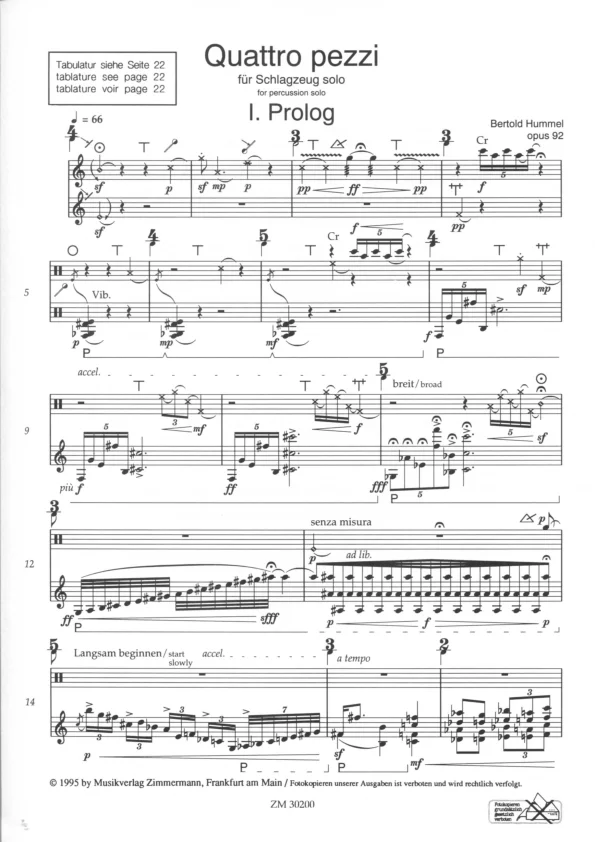
In the Prologue (I), vibraphone and metal sounds predominantly determine the various sound forms of invocative gestures.
The Allegro con brio (II) provides a toccata-like framework for skin, wood and metal sounds, in which two solo passages of the vibraphone are incorporated, with a melody reminiscent of jazz over a relentless ostinato figure particularly catching the ear.
A Ia Sarabande (III): A multi-part fantasy based on the sarabande rhythm gives the player the opportunity to fully explore the sound of the vibraphone.
Vivace (IV): At the centre of this virulent and virtuoso final movement is a march episode, which on the one hand is alienated to the point of grotesqueness and on the other is given a hymn-like interpretation. After the varied return of the beginning of the movement, a sequence of notes from the prologue is briefly quoted in the coda, whereupon a stretta effectively concludes the work.
Bertold Hummel
The possibilities of the instruments are explored in four very differently structured movements: Vibraphone, snare drum, 2 bongos, 2 tom-toms, bass drum, tambour de basque, 2 wooden drums, 5 log drums, 5 temple blocks, 4 suspended cymbals, 1 studded cymbal, 1 gong, 1 tam-tam, 2 crotales, 1 Chinese opera gong with upward glissando, 1 triangle, 2 cowbells, 1 vibraslap.
In the prologue (I.), metal sounds are used almost exclusively, grouped around the main instrument, the vibraphone. Only the triple use of 5 temple blocks offers wooden sounds. After several insistent invocative gestures, the movement's "golden section" begins with a certain calming, which leads back to the opening mood before a rhythmic canon between temple blocks and triangles brings the prologue to a close.
The Allegro con brio (II) opens with striking, pulsating movements on skin and woodwind instruments; cowbells, triangles and cymbals are sparingly added. Over a 2-note ostinato bass figure, which is heard 28 times, episodes reminiscent of jazz develop in the upper voice (both performed on the vibraphone). After reaching a climax, the beginning of the movement is taken up again in an extended metamorphosis. In a 4th section, the vibraphone comes to the fore again. Shortly before the end, another dynamic climax is reached, followed by a short, witty coda with the character of the beginning of the movement.
A la Sarabande (III.). The rhythm typical of the folk dance from Spain determines this quiet movement for long stretches, which is mainly dedicated to the vibraphone and its tonal and technical possibilities. One could speak of an arch form A-B-C-B-A, whereby the saraband rhythm is present in A and C, while a variable metre (3/4,5/8,7/8,2/4) comes to the fore in B. The'Sarabande' fades away with delicate cymbal sounds in the outermost pp.
A drum motif opens the final movement Vivace (IV.). Throbbing quavers and frequent metre changes are significant for this turbulent first section of the movement. The previously omitted vibraphone sketches a march episode for 11 bars, which is subsequently increasingly distorted up to double tempo; the march, which is resumed later, now takes on a pathetic character towards the maestoso. The initial drum motif introduces a development of the first section of the movement. The resumption of a vibraphone sequence from the prologue serves as a bridge to the coda. The turbulent, swirling conclusion is "vibraphone-free".
The work was written at the suggestion of percussion virtuoso Peter Sadlo and is also dedicated to him.
Bertold Hummel