5 scenes for 2 percussionists (op. 58, 1976)

Movement titles
I., II., III., IV., V.
Instrumentation
Player I: vibraphone, 3 bongos, quiro, 2 woodblocks, gong 50 cm, 2 cowbells, large ratchet
Player II: marimba, snare drum, 2 tom-toms, 5 temple blocks, 5 cymbals, 1 studded cymbal, tambourine de basque, triangle
Duration: 15 minutes
Premiere
9 August 1976,
Sveg (Sweden)
Andrea Schneider-Hagel | Wolfgang Schneider
Autograph
Title: 5 Szenen für 2 Schlagzeuger (1976) (Duo concertante) - Length: 23 pages - Date: I. 5.III.76 II. 6.III.76 III. 6.III.76 IV. 7.III.76 V. 9.III.76 Dorfgastein - Location: Bavarian State Library Munich
Publisher
Zimmermann Musikverlag Frankfurt ZM 19890 / ISMN M-010-19890-3
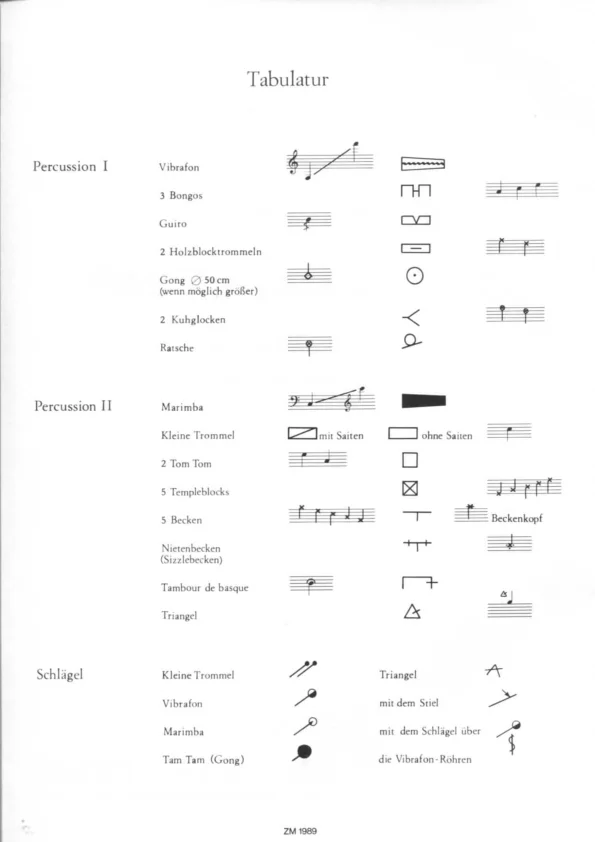
Percussion Tablature, Op. 58
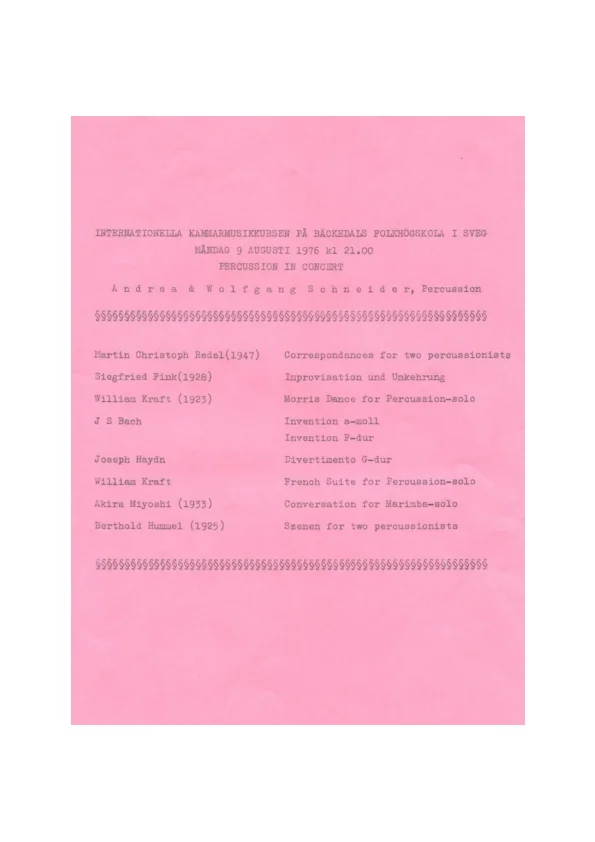
Programme for the world premiere, Op. 58
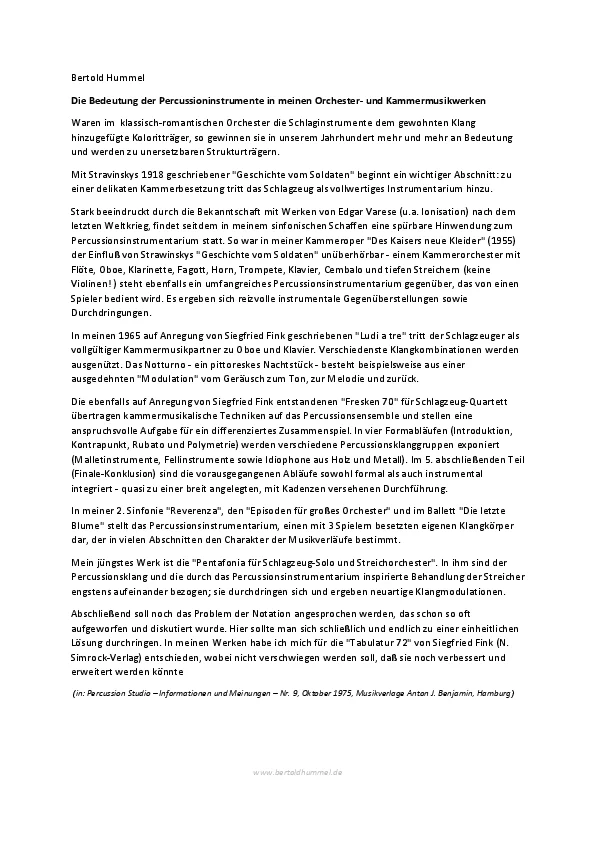
B. Hummel: The Importance of Percussion Instruments
Literature list of the German Music Council for the competition "Jugend musiziert": Difficulty level 4/ difficult (intermediate level II)




The 5 scenes for 2 percussionists op. 58 were composed in 1976. This "duo concertante" could also be interpreted as a dance piece by an imaginative choreographer.
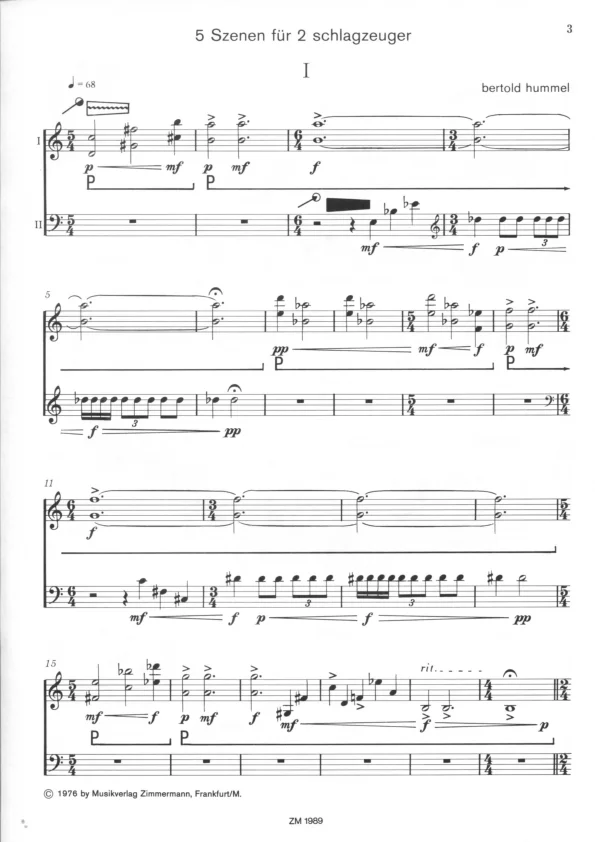
The introduction belongs to the two mallet instruments vibraphone and marimba. This is followed by a rhythmically turbulent passacaglia. The vibraphone is joined by skin, wood and metal sounds.
The 2nd scene is characterised by a gentle flow from one instrument to another. Despite its brevity, an arch-shaped development can be discerned.
Scene 3 is a "concerto piccolo" for skin, wood and metal sounds.
In the 4th scene, the sound of the vibraphone and marimba is the creative starting point.
The 5th scene with its various garish changes has something of a fairground hustle and bustle about it.
Bertold Hummel
The work, written in 1976, is introduced by a dialogue (crotchet=68) between vibraphone and marimba, followed by a concertante allegro (crotchet=144) . A passacaglia theme is assigned to metal, skin and wood sounds, which is also seconded by a varied vibraphone solo.
In the 2nd scene (quaver=88), low metal and marimba sounds predominate.
Scene 3: A polymetric fugato (wood and skin sounds), initially two bars apart, intensifies in the course of the movement, is shortened - also in the distance to half - and is intercepted by a short coda. The contrasting dynamics are of great importance for the constantly required sound modulation.
Scene 4 is characterised by tremolo sounds from the mallet instruments, with a few sparingly used metal sounds serving as sound bridges.
Scene 5: The different sound levels are played off against each other in turbulent alternation. Canon, waltz, march and chorale - developed from one and the same basic material - give the movement a certain theatrical character.
It is quite conceivable that the entire work could also be interpreted as a dance.
Bertold Hummel