5 aspects for 3 percussionists (op. 88d, 1988)

Movement titles
I. Prologue, II. Toccata, III. Notturno, IV. Mixtur, V. Epilogue
Instrumentation
Percussion (see tablature)
Duration: 11 minutes
Premiere
17 January 1990,
Saarbrücken, University of Music and Theatre
tri-percussions-ensemble; Günter Kamp | Thomas Keemss | Günther Peppel
First Performance
24 April 1992 (American premiere),
Miami, University of Miami, Maurice Gusman Concert Hall
Ney Rosauro | Troy Breaux | Scott Deal
Autograph
Title: 5 Aspekte für 3 Schlagzeuger - Length: 13 pages - Dated: I. - / II. 27.III.88 / III. - / IV. 12.IV.88 / V. - Location: Bavarian State Library Munich
Publisher
N. Simrock Hamburg-London (Boosey & Hawkes) EE 2875 / ISMN M-2211-0825-8
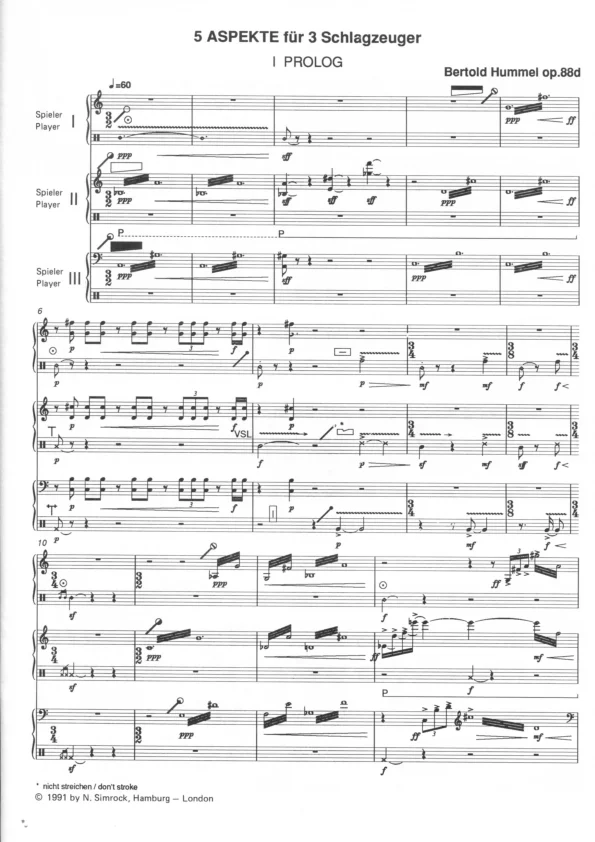
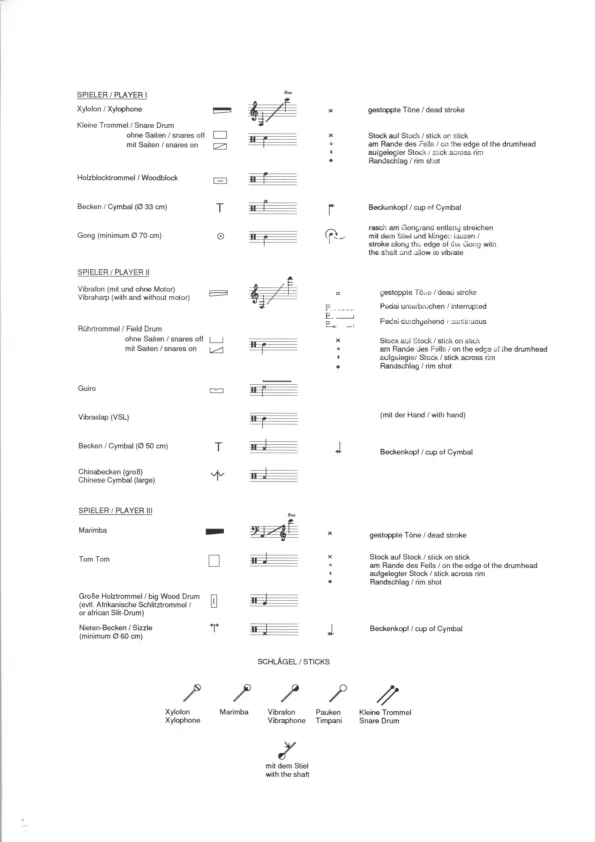
Op. 88d Percussion Tablature

B. Hummel and the tri-percussion ensemble, Stuttgart, 21 November 1990
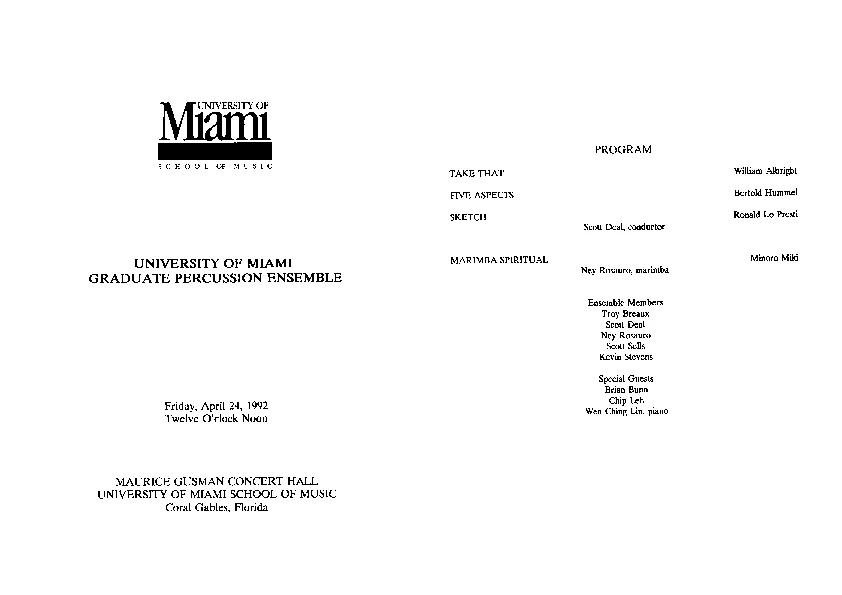
Programme for the EA (USA), Op. 88d
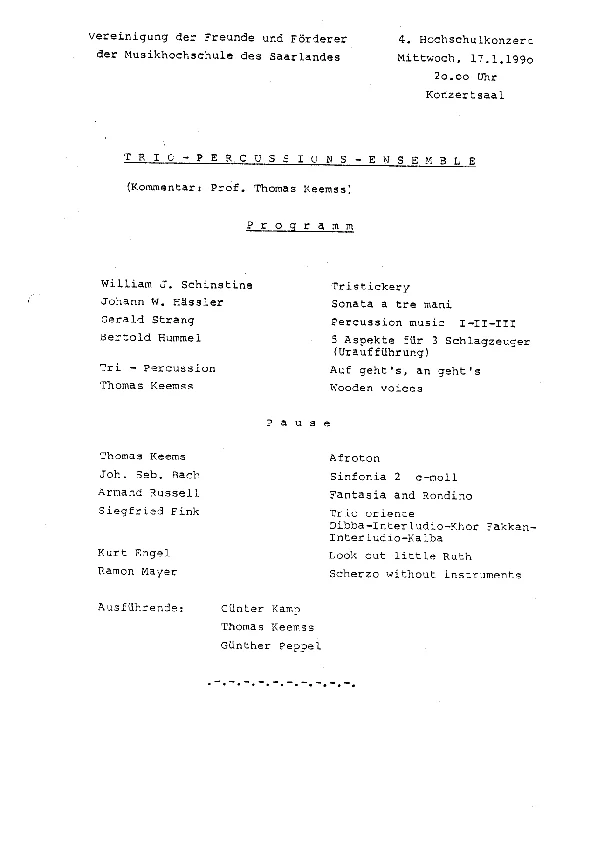
Programme for the world premiere of Op. 88d
Literature list of the German Music Council for the competition "Jugend musiziert":
Level of difficulty 4/difficult (intermediate level II)




The Five Aspects for percussionists op. 88d were written in view of an international competition for this instrumentation in Luxembourg (1991).
In the first movement , mallet instruments and metal idiophones dominate the sound. Sound surfaces are repeatedly replaced by broken structures. The comparison to contrasting colours comes to mind.
The 2nd movement is reserved solely for the fur instruments; short signals, sometimes offset in canon, dominate the extremely short movement.
In the 3rd movement - a "quasi nocturne" - the fur instruments are omitted, as in the 1st movement.
The 4th movement combines the mallet instruments xylophone, vibraphone and marimba in mixtures. The melodic intervals of minor third and tritone are characteristic of the again very short "aspect".
The somewhat broader 5th movement features chorale-like episodes alongside recitative-like sections. The work comes to a surprisingly turbulent conclusion with a stretta in the fur and metal instruments.
Bertold Hummel
The 5 aspects lead the 3 percussionists through very different and varied movements.
In the prologue (I), the material is first introduced (musically and instrumentally understood). In addition to the usual percussion instruments such as drums, cymbals and gongs, each player also has a mallet instrument to play: Xylophone, vibraphone and marimba are used side by side and ingeniously, gradually shifted in pitch and sequence. This creates a spatial effect that is further enhanced by the different timbres of the instruments
The Toccata (II) is reserved for the drums. Rapid sequences of semiquavers alternate, canon-like and in free entries, to culminate in a unison, fully composed ritardando.
The nocturne (III) makes use of three different cymbals in addition to the plate instruments, which gently envelop the glassy directness of the xylophone, vibraphone and marimba.
The Mixture (IV) combines xylophone, vibraphone and marimba into one instrument. Like an organ mixture register (consisting of a whole tone cluster of 3 notes, e.g. c-d-e. whose top note e appears in the lower octave), the 3 voices move exclusively in parallel. Only quavers, but a fast tempo and large dynamic differences create an astonishing effect.
In the epilogue (V), we again encounter all the instruments introduced at the beginning. The vibraphone emancipates itself as a solo instrument and is allowed to create 4 cadenza-like free sections. The 3 drums introduce the conclusion. The end is gentle (without staves) but not without sound in an fff beat from the 3 cymbals.
Certainly a very effective piece in the medium difficulty range.