In memoriam Anton Bruckner for organ (op. 91a, 1989)
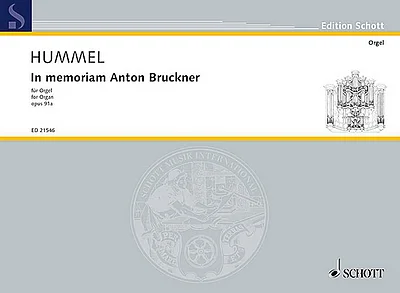
Dedicated to Erwin Horn
I. Fantasia, II. Adagio, III. Finale
Organ
Duration: 26 minutes
Erwin Horn
Title: "in memoriam Anton Bruckner" for organ op. 91 - Length: 51 pages - Date: I.
2.8.89 / II. 21.9.89 / III. 29.9.89 - Location:
(original version for Leipzig, overhauled by version of 8 Jan. 90)
Schott Music ED 21546 / ISMN: 979-0-001-19123-4
First edition: Anton Böhm & Sohn Augsburg, 1990
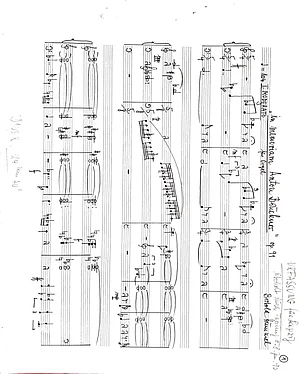
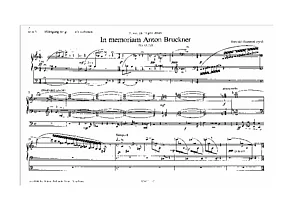

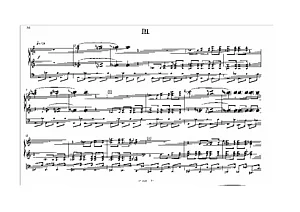



Many composers have approached the great organ improviser Anton Bruckner, who could never bring himself to write something for his instrument that was appropriate to its size and dimensions, from the organ. Of course, this can be done from many different angles. The most popular approach is to borrow material, form, pathos and even harmony from its symphonic nature in order to evoke his understanding of the organ. Bertold Hummel does this most impressively in a three-movement fantasia full of improvisatory verve and polyphonic technique, using the initials A and B as motivic elements and Brucknerian rhythmic gestures, primarily from the last two symphonies, as expressive elements to create a grandiose, wide-ranging example of genuinely German organ symphonic music. However, this requires not only a great organ, but also a virtuoso performer.
With his symphonic fantasy in three movements, Hummel has succeeded in creating a gripping work which, with a duration of around 25 minutes, never loses its attraction and is well worth practising.
The audience experienced a rare depiction of the emotional worlds of grief, resignation, hope and confidence in the musical realisation through ever new movements, trills and ornaments - and after unusual climaxes, finally a powerful inferno of sound. The organist understood perfectly how to characterise his contrast-rich playing with a superior, orderly expression and how to turn the gigantic sound sequences into a heaven-storming prayer.
The surprise of the evening, however, was the world premiere by Würzburg composer Bertold Hummel. Entitled "In memoriam Anton Bruckner" , this opus, with its enormous dimensions reminiscent of Bruckner's great symphonic breath, was more and more inspiring from bar to bar. Such daring, yet appealing mixtures, such multi-layered overlapping, yet audible layers of sound have rarely been heard on the Gewandhaus organ. It was nice that the composer himself was able to experience the success of his premiere. The open German-German border also creates a pleasant normality here!
So here we have a real piece of concert literature, based on an intimate and profound knowledge of Bruckner's oeuvre and an unconditional stylistic confidence in the form, and something for the real organ virtuosos.
Literature list of the German Music Council for the competition "Jugend musiziert":
Level of difficulty 5/ very difficult (upper level)




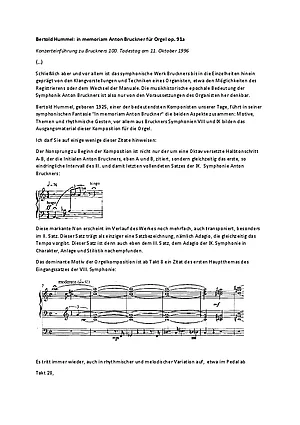
Anton Bruckner's initials (A, B), as well as tone sequences and rhythmic gestures, mainly taken from Symphonies 8 and 9, form the basic material of the work, which in the form of a symphonic fantasy in 3 movements is a homage to the genius of the great symphonist.
Bertold Hummel
Anton Bruckner's initials (A+B) open the first movement of this work as a gesture. The beginning of the main theme from Bruckner's Symphony No. 8 is briefly quoted and undergoes various metamorphoses in the course of the movement, developing towards a climax. Eight piano bars are the bridge to a coda in which the movement elements are taken up once again in a transformed form.
In the 2nd movement, the first four notes of the Adagio from Bruckner's 9th Symphony play a favoured role both linearly and harmonically. A four-bar chorale-like chord sequence, which I wrote down as an eight-year-old boy after hearing a Bruckner symphony for the first time, forms the contrast, first in ppp and finally at the climax of a 20-bar passacaglia, whose bass note sequence was derived from a 3rd theme. In the farewell over the semitone e', the tonal material of the movement is quoted once again before the Adagio fades away in the extreme ppp.
The toccata-like finale gets its urgent character from the dotted rhythm that dominates large parts of the movement. The movement is structured by insertions of various Bruckner tone sequences and motifs and finally reaches its majestic climax and conclusion over an organ point (A+B) with a broad sweep.
"In memoriam Anton Bruckner" was composed in 1989 and premiered by Erwin Horn at the Gewandhaus in Leipzig.
Bertold Hummel
A Leipzig chorale - misterioso
In those historically significant days of 1989, when the "German reunification" was in the offing and the opening of the "GDR" border was emerging as an all-German option and vision, a contact with Gewandhaus conductor Kurt Masur - a symbolic figure of the peaceful revolution - opened up the prospect for me of premièring an organ work by Bertold Hummel on the stately organ in the Gewandhaus in Leipzig. Following a suggestion, Master Hummel chose the title "in memoriam Anton Bruckner" for his three-part, almost half-hour opus 91 and incorporated symphonic motifs from his namesake - more or less audibly or in code. In the Adagio middle section, a three-bar chorale verse is heard "misterioso" and as if from afar, consisting of a sequence of five ("distant") major keys (E flat-A-F sharp-C-B) - seemingly in the "Bruckner manner": The question, "Where did he get that from?", could not be answered even on the most urgent reflection. It sounded so Brucknerian and yet was not a "Bruckner".
After a lengthy delay, garnished with a cryptic smile, the composer was ready to reveal the "misterioso": As a boy of eight, he heard a Bruckner symphony (the third) for the first time (on the radio) - a truly key experience for the boy Bertold, the composer "in nuce" ("in bud"). Bertold sat down at his piano without delay, invented a chord sequence in the spirit of the model he had just heard (specifically, it was probably the extended chorale in the finale of the Third), wrote it down on a sheet of music and kept his first composition for years. One day, the maturing and finally established composer thought, his first idea would serve him well as the actual building block of a work. After 54 years, the time had come:
The "Hüfinger Choral" (Hüfingen - Hummel's home town in South Baden) was set "in memoriam" - in memory of - "Anton Bruckner" and was to become a "Leipzig Choral"...
This chorale verse was to lead the "in memoriam" work from the darkest "ppp" depths to the tonal climax "fff" in the Adagio.
The work was then premiered - in the presence of the lively applauding composer - on 19 December 1989 in the Gewandhaus in Leipzig: exactly 24 hours after the last, largest peace demonstration in the 'GDR', which was coming to an end:
This impressive procession of silence and lights across Leipzig's Stadtring was led by Kurt Masur, who was followed by the married couple Hummel and Horn among hundreds of thousands.
Erwin Horn (in: Hochschulmitteilungen 2001-2002, Würzburg University of Music)
Bertold Hummel reaches truly Brucknerian dimensions with his op. 91b In memoriam Anton Bruckner. The title of the work can be understood as a tribute to the master of the organ and the symphony. Bruckner's spirit is present in the form, rhythm and movement structures with which Bertold Hummel combines his own ideas of sound. Concrete thematic references clearly emerge: the first movement is underpinned by the main theme of the Eighth Symphony, the second by the Adagio theme of Bruckner's Ninth Symphony.
A chorale idea in the Adagio movement deserves special attention. It sounds as if Bruckner had invented it - ppp misterioso - and yet it was penned by the eight-year-old boy Bertold, who went home under the impression of Bruckner's Third Symphony and decided to become a composer. The first thing he put down on paper was this bold choral idea, which now finds its fulfilment in his Bruckner fantasy. The homage to the Master of St Florian culminates with this chorale after a large-scale build-up in the full power of the organ.
The third movement is characterised by Bruckner's motoric and rhythmic style; motifs from the Third and Fourth Symphonies are also heard here. In addition, the entire work is permeated from the first to the last note by Bruckner's name motif: "A. B."
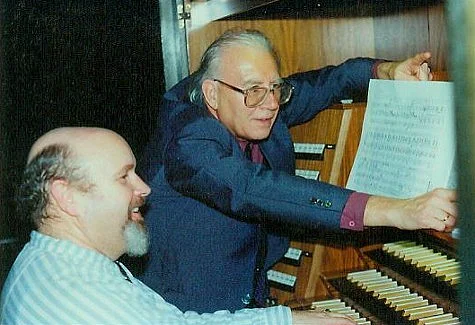
The suggestion to write an organ piece entitled In memoriam Anton Bruckner for a premiere at the Gewandhaus in Leipzig came from Erwin Horn. He played the work there for the first time on 19 December 1989 in the presence of the composer and his wife - in the midst of the "Wende".
The composer wrote a version for large orchestra of the middle movement of this organ work. This was premiered as an orchestral adagio on 8 September 1996 at the Brucknerhaus Linz for the opening of the International Bruckner Festival.
Erwin Horn