Visions (after the Apocalypse of St John) for large orchestra (op. 73, 1980)
I., II.
3.3.3.3 - 4.3.3.1 - timpani, percussion <3 - 4>, harp, strings
Duration: 22 minutes
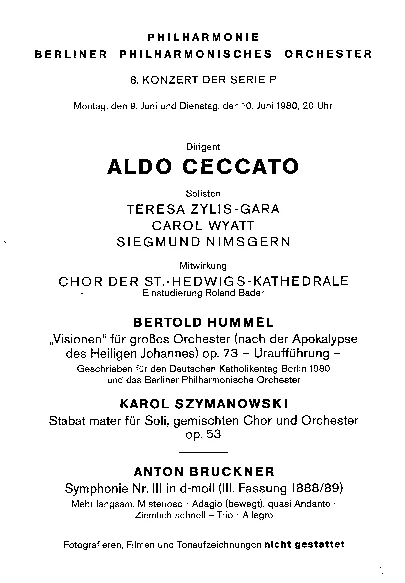
Berlin Philharmonic Orchestra | Aldo Ceccato
Commissioned by the 86th German Catholic Congress
Louisianna Philharmonic Orchestra | Klauspeter Seibel
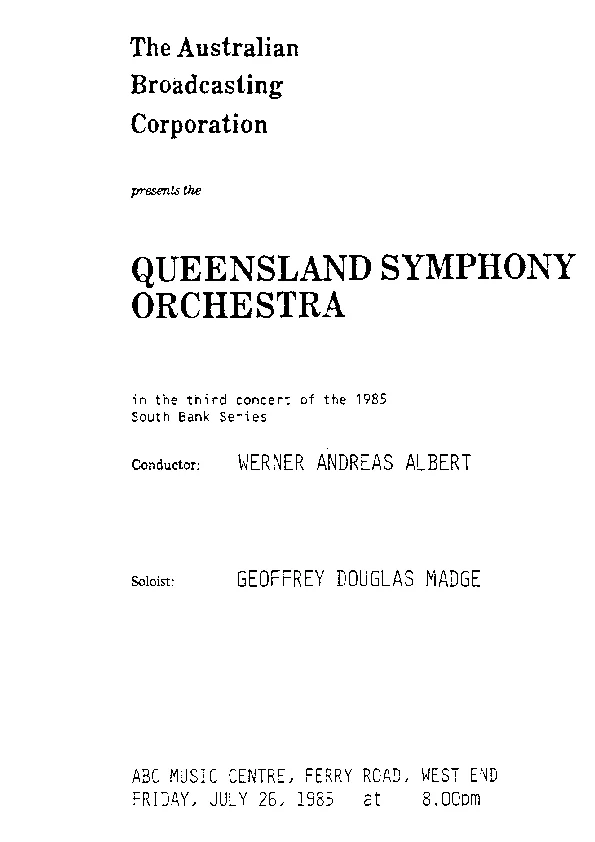
Queensland Symphony Orchestra | Werner Andreas Albert
Title: I. - Length: 67 pages - Date: I. - II. 1 April 80 - Storage location: unknown
Schott Music

It also recalled the consolation, promised joy and glory that Christianity opposes to the memento mori. Bertold Hummel captured precisely these two poles in sound in his "Visions". With fanfare-like winds, aggressive repetitions, hard percussion and a harsh, jagged line, John's apocalyptic visions emerge, interspersed with quiet moments, crowned by the splendour of the heavenly Jerusalem. Marcello Viotti and the radio orchestra intensely charged the expressive sound fantasies.
The two-movement "Visions for large orchestra" based on the Apocalypse of St John by Bertold Hummel, premiered here, is based entirely on an imaginative sensuality of sound. The twelve-tone organisation of the material, which is also conceived as motivic and thematic, gives the sound composition a structural foundation that reinforces the logic of the tonal language. The numerical mystical speculations that Hummel develops in the commentaries on his work are of secondary importance in comparison, although they are not insignificant for the ideological message of the work. However, the focus is often on static layers of chords, expansive twelve-tone cantilenas, contrasts of harshness and delicacy. With a predominantly beautiful sound. Hummel does not disdain echoes of the tonal musical language, for example in cadential chorale movements; just as little as illustrative procedures, such as brass fanfares, snare drum, timpani and tambourine as well as string tremolos to depict the apocalyptic horsemen. Lively applause and even a bravura cheer.
He articulates the apocalyptic side of the theme: a brutal cut after Lasso's angelic music. For Hummel transforms St John's Apocalypse into an anticipation of our current horrors. In two movements, actually two different states of excitement (Reinhard Schulz), the idioms of the orchestral treatment were captivating.
The symphony orchestra, which specialises in classical-romantic programmes, seems to have put an end to this: they took their subscribers right into the heart of stirring sound events with Bertold Hummel's "Visions" op. 73 based on the apocalypse of the evangelist Joitannes. In his apocalyptic vision, Hummel is not only interested in the dramatic stages of the Last Judgement, but also in the mysterious mysticism of numbers (the world of images with their sigils), which Messiaen uses in twelve tones as a "language cornmunicable" . Hummel's musical idiom is composed of tonal and atonal stretches, chordal towers, polyphony, a transparent melodic network - expressive spheres of lament, outcry and hope unite to form a suggestive sequence of expressionistic sound elements with a vehemently dramatic effect. Sounds of magical violence, insect-like whimsical, turbulently whirring, but not banal-pathetic like Joseph Martin Hauer's "Apocalyptic Fantasy" op. 5. Stages of more sensitive gestures also hint at something spherical in the style of Gustav Holst's "Planets". Hummel's message is always both coded and sensual, fantastically irregular, never hollowly booming. The meaningfulness and imagery of this language, the broad arc from the tentatively shimmering strings through increasingly dense to tumultuous events to the redemptive standstill in the extinguishing strings - the symphony orchestra under Klauspeter Seibel's prudent direction dealt with all these tricky tasks with great commitment and presence of mind. Hearty applause, the composer was invited to the podium three times.
For the Louisiana Philharmonic Orchestra's first Beethoven and Blue Jeans concert of the season, music director Klauspeter Seibel selected a late 20th century work to begin the program. Bertold Hummel's "Visions," based on the Apocalypse of the Book of St. John, is a work of great power that requires a full orchestra and a large percussion section.
Seibel and the orchestra revealed the variety of textures in the piece that make it so striking. The percussion section stood out in the performance, but the full range of the orchestra was explored by the composer -- and realized by Seibel.
Even without precise knowledge of these technical finesses, the tonally unbound music impresses with its refined sound mixtures, variety of forms and intensity of expression. The religious fervour of the first movement is based on a three-note motif (symbol of the Trinity), which takes on a hymn-like radiance over an iridescent carpet of sound from the strings and percussion batteries in the wind sections. In the second movement, the apocalyptic horrors are evoked and the "new Jerusalem as the hope of mankind" is apostrophised. Hummel quotes the Gregorian Tedeum as well as the B-A-C-H theme with which the movement ends. General Music Director Heinz Finger decoded the visionary mysticism of this dissonant music with a sense of contours, precise accents and subtle colour gradations. The intellectual vigour, formal coherence and expressive immediacy of the interpretation, as well as the concentrated music-making in all sections of the amplified orchestra, secured the work a respectable success, for which the composer, who was present, was able to express his personal thanks.
Hummel speaks more harshly, more relentlessly than in the friendly "Reverenza" of 1966 in the Visions, which were successfully premiered in the Berlin Philharmonie in 1980. He was inspired by the symbolic power of the biblical scenes from the Revelation of St John. And he succeeded in creating music that is full of substance, reflecting apocalyptic catastrophes as well as a longing for peace and faithful confidence.
A powerful percussion apparatus (seven consoles) sets powerful accents in the multi-layered structure. Massive clusters create a contrast to delicate passages. Hummel places his religious confession in the force field of chaos and order, of despair and redemption. Hummel's "book with seven seals" opened up spontaneously.
Hummel presents the dramatic stages of the Last Judgement, their symbolic content and their mysterious numerical mysticism with a musical language rich in sound and powerful imagery and in clear formal sequences that facilitate access to this intellectually and musically demanding work even for the unprepared listener, as does the skilful, differentiated instrumentation of a music that uses bitonality and twelve-tone themes to capture the unspeakable in sound.
The twelve-tone row may be seen as a symbol of the other world. They are visions that open up the listener's own fantasy world, that touch and at the same time seem timeless in their contemporary sound language.




The diverse images of the Apocalypse of St John the Evangelist inspired me to write this work. In two symphonic movements, I tried to capture something of the fascination of the revelations and their significance for our time. It was not only the dramatic scenes of this end-time vision that played a role, but also the mysterious numerical mysticism of John's visions that was important for finding the material and for the formal structure. In the composition, I attached particular importance to the comprehensibility of the musical ideas as well as to clear formal sequences.
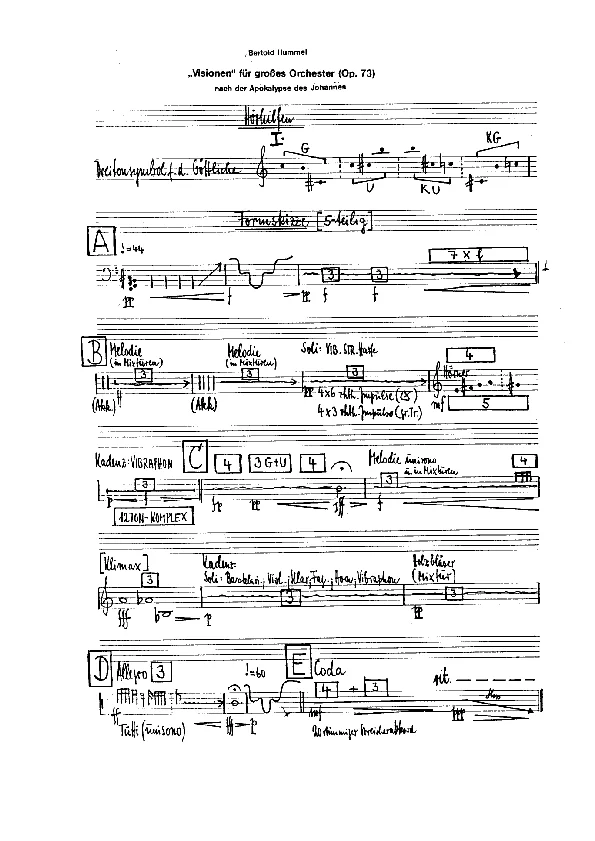
The work begins with a five-note sound and its modifications. A three-note motif (symbolising the divine) is added and becomes increasingly important as the movement progresses. The introduction ends with the sevenfold repetition of the note f.
Bitonal mixed tones determine the next, predominantly melodic section, which leads into a vibraphone cadenza.
A sequence of four notes is juxtaposed with the three-note motif. In the development section that now begins, all the elements of the movement are brought together. At the climax of the movement, which is quickly reduced, the three-note motif appears once again in unison in all clarity. A contemplative, tonal episode is followed by a short, violent outburst, which is replaced by a calm coda in which the original material is heard once again.
The 2nd movement is essentially a stormy allegro, signalling the apocalyptic horsemen. The first four notes of a twelve-tone row take on the function of a head motif. Contrasting rhythmic patterns give the movement, which is repeatedly interrupted by contrasting insertions, a musical flavour. After a large-scale build-up at a slow tempo, with the head motif as a basso ostinato, the movement fades away in the outermost pp. The four superimposed triads at the end of the work symbolise the four gates of the heavenly Jerusalem.
The work was composed at the suggestion of the Berliner Philharmoniker between November 1979 and April 1980.
Bertold Hummel
The symbolic power of the images presented to us in the revelations of St John has always stimulated creative forces.
Numerous works that have been created in recent decades show that the artists of our time have a special affinity with the images that appear in the Apocalypse. One reason for this may be that it makes sense to relate the great wars and human hardships of our century directly to the promises of St John.
The question of the critical man of our time is obvious: Are these visions of the evangelist the hallucinations of a schizophrenic, the tormented wishful dreams of a prisoner and a tormented man? John apparently heard voices, saw figures, heard singing, the sound of trumpets and thunderclaps, gave orders and carried them out. All signs of a psychiatric diagnosis of "mental derangement".
On the other hand, there is the value of what is said, the truth of the story. The battle and victory of light over darkness is expressed in a multitude of images. The Apocalypse depicts the drama of the world and humanity in an archetypal way and is therefore "timeless". Are not the fates of individuals and entire peoples sometimes dramatic anticipations of an end time towards which our world is irrevocably heading?
Long before I began composing my "Visions" in November 1979, I had been studying the fascinating "Book of the Seven Seals". I was deeply moved by numerous artistic interpretations of this end-time vision. I received particularly lasting impressions from Olivier Messiaen's "Quatuor pour la fin du temps", which the composer wrote in 1940 while a German prisoner of war and has been a key work in his oeuvre ever since.
It is not only the dramatic stages of the Last Judgement that inspired me as a musician, but above all the mysterious numerical symbolism of the Apocalypse, which lends itself particularly well to an abstract, textless interpretation. It would go too far to attempt a comprehensive in-depth psychological interpretation. Here are just a few numbers and their meaning that play a role in my composition.
The number 7 (7 stars, 7 candlesticks, 7 seals, etc.) is mythologically the number of transformation that leads to fulfilment. It points to a whole that is completed in individual effects and forms.
The number 6 indicates our attachment to matter. The number 4 and its multiplication, especially 12, 24 and 144, is the expression of a final perfection when it is related to a fifth (or a thirteenth).
Based on Hebrew numerical mysticism, WEINREB writes
"12 without the thirteenth is a state of struggle in which God fights with gods, as it says in the Bible, a state of perpetual, restless motion. From the thirteenth comes redemption."
It can be inferred from the above that my attempt at musical interpretation is not content with merely tracing individual dramatic scenes, but also includes the world of images with their sigils. For example, the reference to the heavenly Jerusalem - the eternal city of God - with its 4 x 3 gates at the end of the 2-movement work finds its musical realisation as follows:
Four triads are gradually layered on top of each other to form a sound that encompasses all 12 tones. The work, which was written at the suggestion of the Berlin Philharmonic Orchestra, was completed on 1 April 1980. I have certainly not escaped the danger of including confessional traits in my "visions".
Bertold Hummel
"Visions" for large orchestra op. 73 (after the "Apocalypse" of St John)
An attempt at an interpretation
Although the composer never commented on any of his works as extensively as he did on his "Visions", which he wrote for the Berlin Philharmonic on the occasion of the Katholikentag in 1980, those very comments and analytical schemes are more confusing than they contribute to a deeper understanding of this very thought-provoking tone painting. I say "painting" because the impressions after listening to the music remain just as vivid as when reading the"Apocalypse" of St John of Patmos, from which Hummel, like many artists before him, was inspired.
Initially, Hummel took a critical look at the biblical text. The following quotations are, without exception, taken from an introductory text by Hummel to his"Visions" op. 73, which the composer made available to the author.
Are these visions of the evangelist the hallucinations of a schizophrenic, the tormented wishful dreams of a prisoner and a tormented man? John apparently heard voices, saw figures, heard singing, the sound of trumpets and thunderclaps, gave orders and carried them out. All signs of a psychiatric diagnosis of "mental derangement".
Despite this, Hummel argues in favour of the truthfulness of the Gesichte and sees them as an archetypal depiction of the battle of good against evil: the battle and victory of light over darkness is expressed in a multitude of images. In an archetypal way, the "Apocalypse" depicts the drama of the world and humanity ... Are not the fates of individuals and entire peoples sometimes dramatic anticipations of an end time towards which our world is irrevocably heading?
Throughout his career as a composer, Hummel was repeatedly drawn to apocalyptic themes, especially the visions of St John:
'Long before I began composing my "Visions" in November 1979, I had been studying the fascinating "Book of the Seven Seals".
The author suspects that the reason for this "fascination" can be found in Hummel's own biography, who, like most of his generation, was forced into military service in 1943 when he was not even 20 years old. According to his own statements, this time left him deeply traumatised. He seems to have related the apocalyptic images to his own youthful experiences:
<It is obvious > to relate the great wars and human hardships of our century directly to the promises of St John.
Hummel also repeatedly depicted the horror of war and possible global annihilation in earlier works: in the first two symphonies, music is clearly heard as a mirror of fear. However, both works still have an optimistic finale. The ballet"The Last Flower" op. 55a, premiered in 1975 and based on a picture story by James Thurber, is different: whereas in Thurber's model, destruction and reconstruction of the world are strung together in an endless chain, with people forgetting each time why a war was actually waged (the flower symbolises the belief in the indestructible in man), Hummel finally lets the flower die after a war waged with nuclear weapons.
At the end of his"Visions", Hummel does refer to St John's vision of the heavenly Jerusalem, but only hints at it with a twelve-tone sound layered from four pure triads (the 4 x 3 gates of the city!), which in his other works ("Die letzte Blume","Poem") represents the sphere of dreams. Thus his conclusion remains at least ambiguous, for a dream can mean both premonition and illusion.
Claus Kühnl (from: "Die Sinfonischen Werke Bertold Hummels" in "Bertold Hummel", Komponisten in Bayern Vol. 31, Tutzing 1998)