Six songs after poems by Hermann Hesse (op. 71a, 1978)
for medium voice and piano
Dedication
for Herbert Roth
Movement titles
1. In the fog, 2. Journeyman's Lodging, 3. Blue butterfly, 4. Night feeling, 5. Somewhere, 6. Sometimes
Instrumentation
Medium voice, piano
Duration: 20 minutes
Premiere
22 October 1981,
Würzburg, garden pavilion of the Juliusspital
Herbert Roth | Arno Leicht
Autograph
Title: 6 Lieder after texts by Hermann Hesse set to music by Bertold Hummel op. 71 - Length: 22 pages - Date: November 1978 - Location:
Publisher
Schott Music ED 20287 / ISMN: M-001-14992-1
First edition: J. Schuberth Co., Hamburg 1983
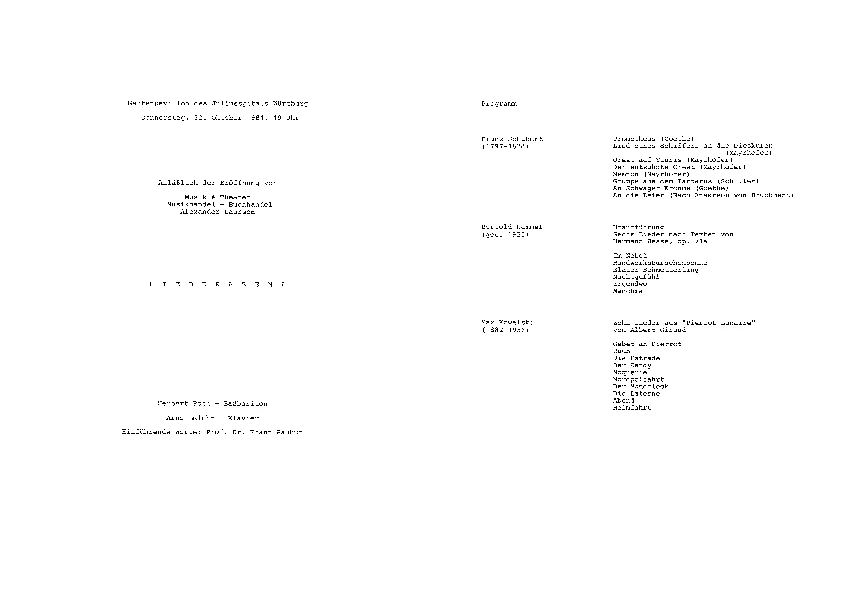
Programme for the world premiere of Op. 71a
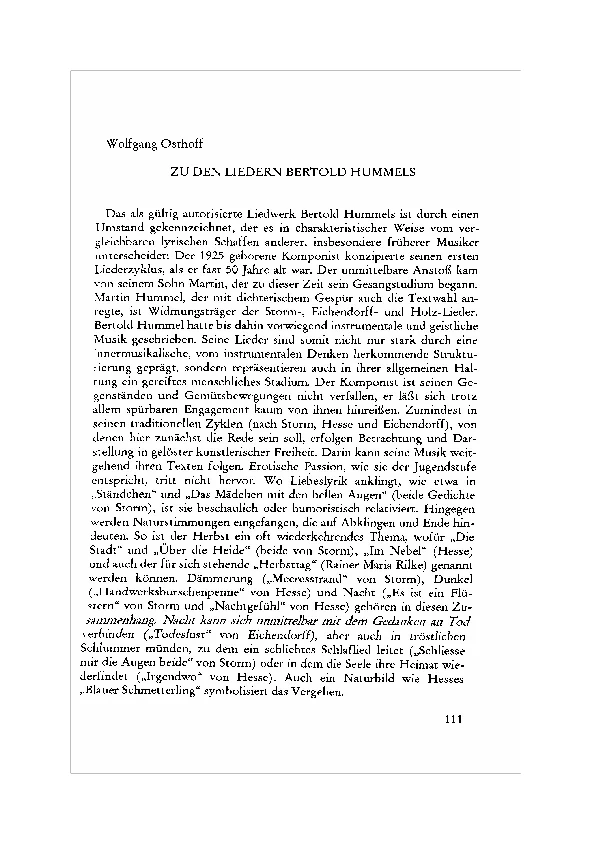
Wolfgang Osthoff (1988): On Bertold Hummel’s songs




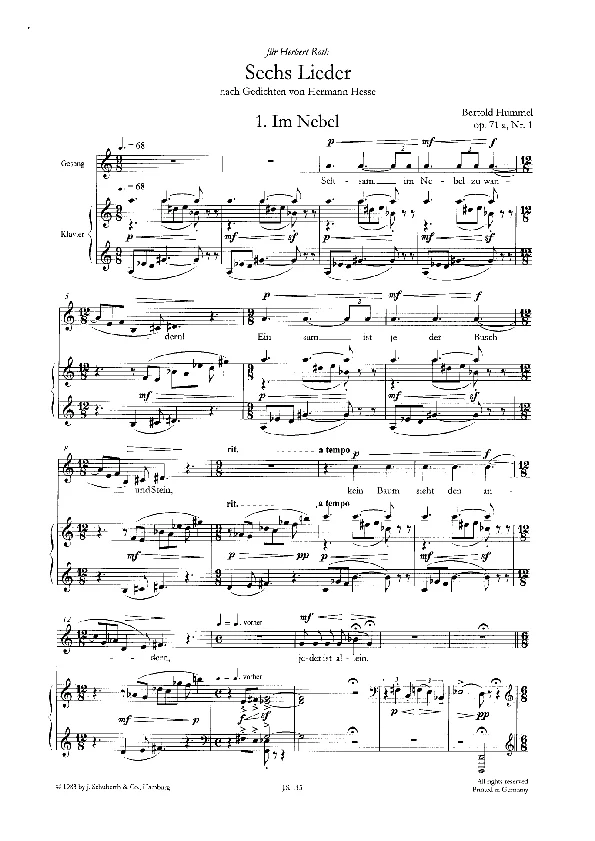
The basis of the first Lied Im Nebel (In the fog) is a short series of notes which has already been heard in the opening bars of the piano, moving simultaneously from a high note towards the bass and from a low note towards the treble, so that the resulting chords hover and swim like banks of mist.
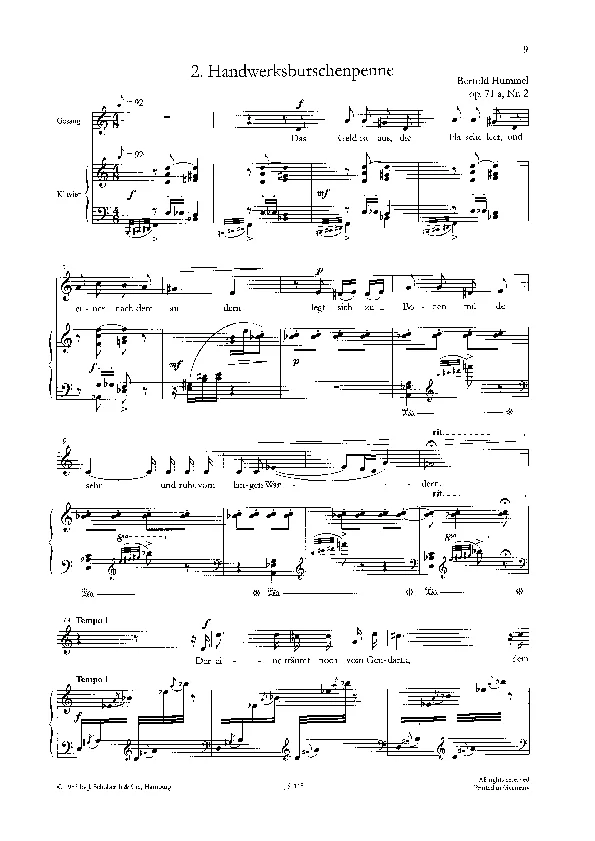
In the Handwerksburschenpenne (Journeyman's Lodging), one thinks one is hearing a marching song, but the music repeatedly breaks out of the stiff rhythm, the "secret pain" that tortures one of the three journeymen is present in almost every bar of the music.
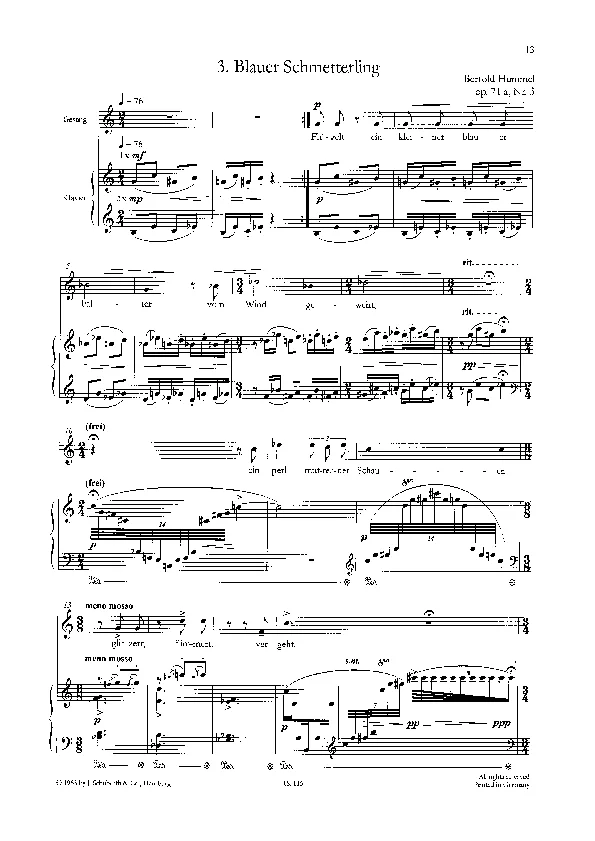
The third song, Blauer Schmetterling (Blue Butterfly) is as if painted with a few daubs of colour. The captivating harmonies of the piano resolve twice into a high note which is left to fade almost to silence. Above these, the voice glides and hovers, almost more reciting than singing.
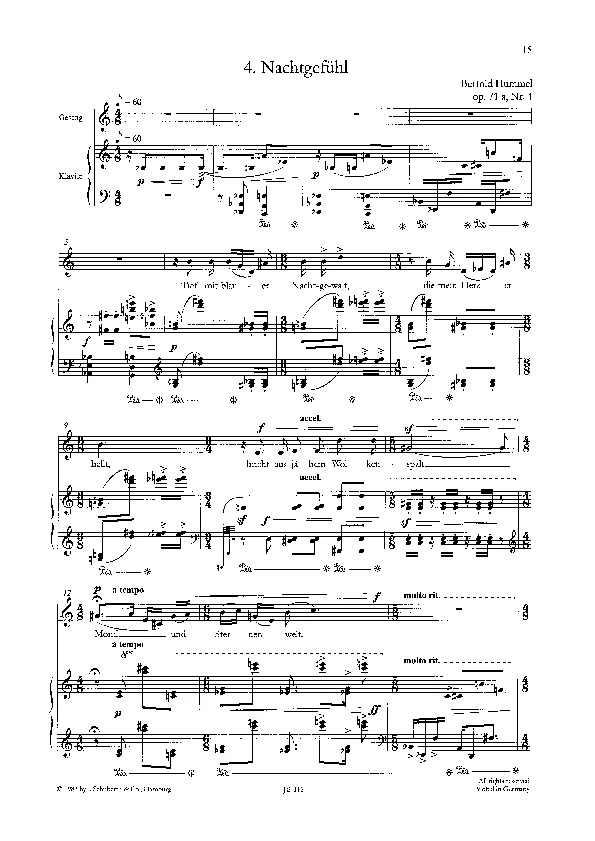
Nachtgefühl (Night feeling)is the central piece in the group of songs, not only in terms of the point in time, but also because here the voice and the piano accompaniment provide a climax in intensive expression and an orchestral, almost operatic concentration of sound.
The song Irgendwo (Somewhere) forms a single large musical arch going from powerful agitation to motionless quiet. In the final bars, at the words "Nacht und Sterne" ("Night and Stars"), a chord in the piano containing simultaneously all 12 notes of our musical system is heard. Thus are the perfection and completeness of the starry heavens symbolically represented.
The poem Manchmal (Sometimes), the basis of the last song, speaks of the experience that man can become one with nature if he immerses himself in it, and that he can thereby be changed. This is a thought that runs through the poetry of Hermann Hesse like a solemn fundamental harmony. Often, there are hints, as in this poem, of the mythology of the transmigration of souls. Through its music, the song makes the call of the birds as well as the blowing of the wind perceptible. With an unresolved chord, the work closes, like a question for which no answer has been found.
Arno Leicht
On the Hesse songs by Bertold Hummel
Siddhartha and Steppenwolf, Hermann Hesse's two uncompromising truth-seekers, determined the compass of my incipient adulthood. My father, always worried about the correctness of my forthcoming life decisions, seized the opportunity for a spiritual connection with his wayward son when I asked him to set poems by the poet I had discovered to music. The existential questions of loneliness, happiness, death and rebirth were also my questions about life. In the foggy month of November (1978), he composed the first song, which was followed by the other five at short intervals. We played them together again and again at home until they took their final form.
24 years later - my father had written three more cycles for me in the meantime (based on Joseph Eichendorff, Vincent van Gogh and Arno Holz) - I again presented him with a selection of poems by Hesse to set to music, which I thought of as a counterpart to the countless rather profound Hesse settings. Enthusiastic about the bizarre texts, he set to work with great motivation. As the composition process progressed, the increasingly clearer bad news of medical findings became more and more frequent. Nevertheless, he worked on the many details of the score with unusual perseverance and satisfaction, making final corrections on 21 July. He parodied the stylistic devices of dodecaphony, jazz and 19th century music with which he was well acquainted, as well as his own unmistakably personal tonal language in the spirit of the poetic model.
It was unforeseeable that these cheerful, almost comedic songs would come at the end of his extensive oeuvre, but this was in keeping with his serene wisdom in old age. As a rule, he always agreed with the order of the songs that I suggested, but this time it was important to him that the poem Belehrung (Instruction) be placed at the end: More or less, my dear boy, all human words are ultimately a hoax ...
My father died on 9 August 2002 - the 40th anniversary of the poet's death.
Martin Hummel (in: Programme booklet "Liedforum 15. & 16. 2025", Würzburg University of Music, 2025)