Introduction, Arioso and Fugue for organ (op. 4, 1952)
Movement titles
I. Introduction, II. Arioso, III. Fugue
Instrumentation
Orgel
Duration: 16 minutes
Premiere
16 August 1953 (Protestant Church Congress),
Hamburg-Altona, St John's Church
Dieter Weiss
Autograph
Title: - - Length: 20 pages - Date: - - Location: Bavarian State Library, Munich
Publisher
Simrock (Boosey & Hawkes) EE 5343 / ISMN 979-2211-5343-2
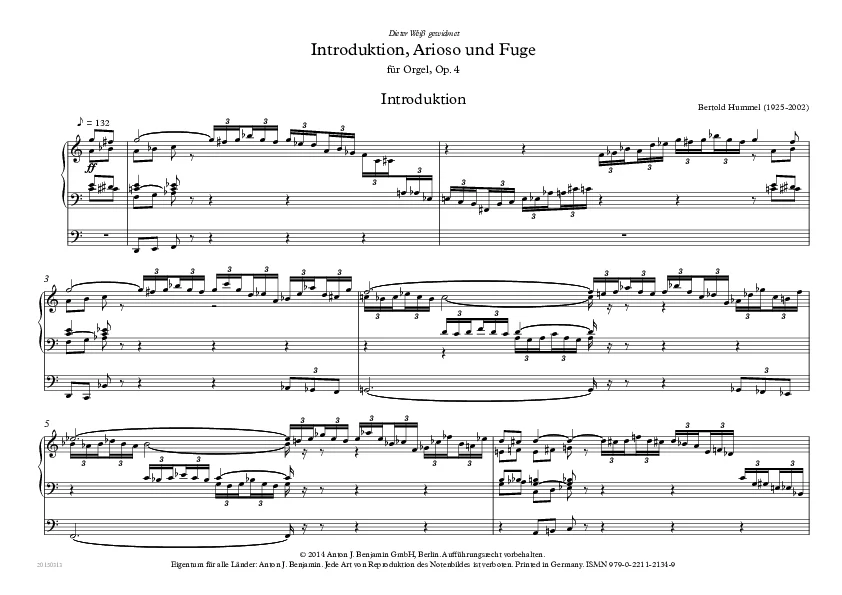
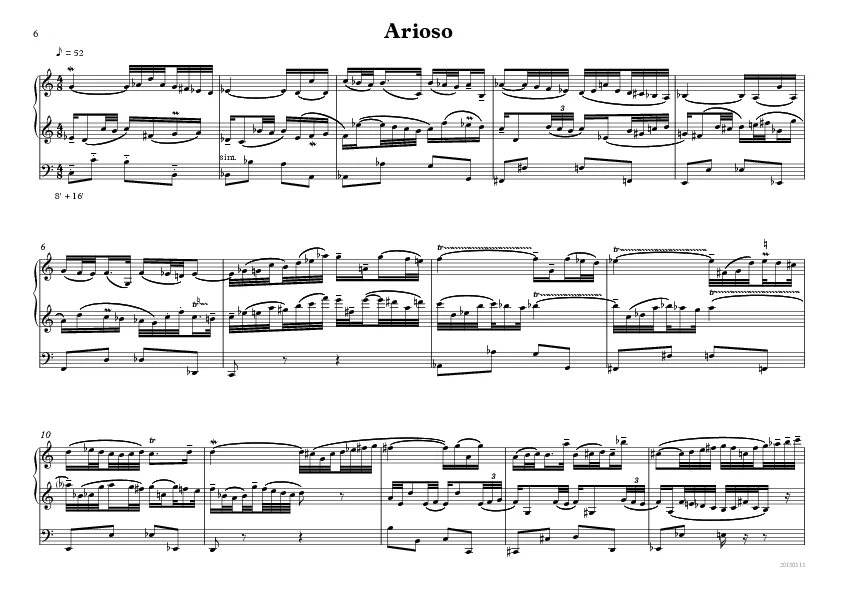
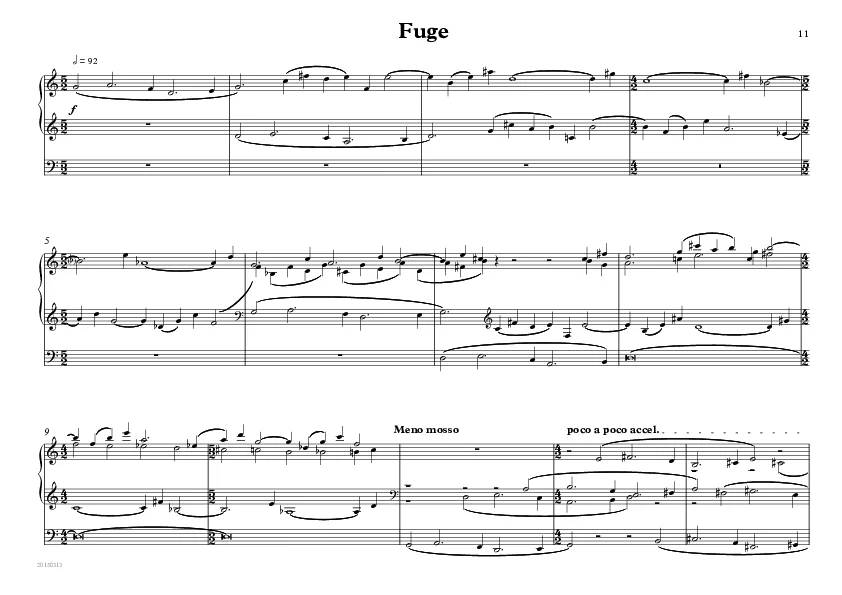
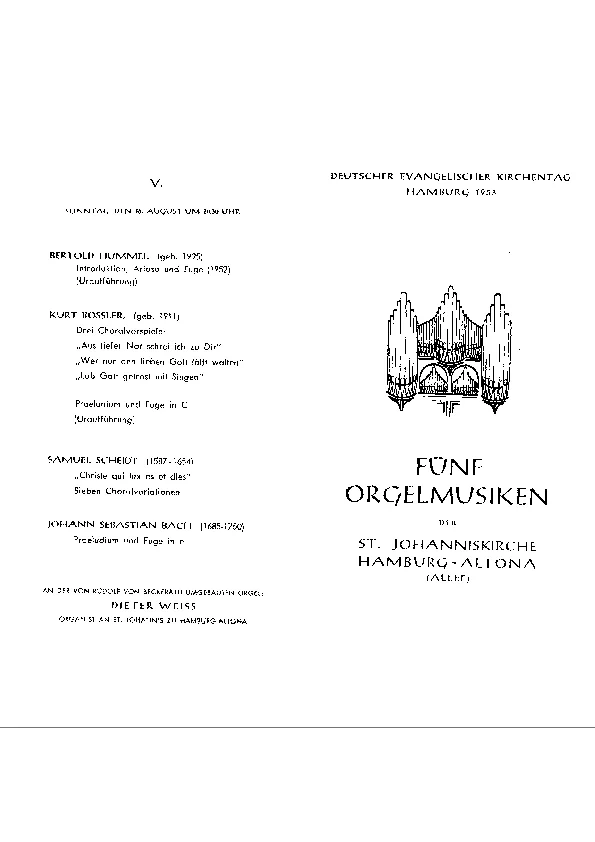
Programme for the world premiere, Op. 4
Larry, D. Crummer, The solo organ works of Bertold Hummel
Westdeutsche Zeitung Kempen, 7 December 1953
Dieter Weiß opened with the Introduction, Arioso and Fugue by Bertold Hummel, who was not yet 30 years old, which he himself premièred during the church congress in Hamburg. Monumentally powerful, atonal chord sequences in the introduction, a linear, lyrical arioso and an extraordinarily witty fugue, performed with consummate artistry, gave the listeners a convincing and impressive understanding of the musical work of a modern young composer, even on this small organ.




Preface (Simrock EE 5343)
Bertold Hummel's Opus 4 was composed in 1952 and premiered by Dieter Weiss on 16 August 1953 in the St. Johanniskirche in Hamburg-Altona on the occasion of the Protestant Church Congress.
The work pays homage to J. S. Bach, and its sequence of movements is reminiscent of Toccata, Adagio and Fugue in C major.
The festive introduction makes reference to Bach's G minor Fantasia in its gestures. A chordal alternating-note motif alternates with recitative-like triplet runs. Both basic motifs are further developed in a variety of ways, including in canonic technique.
The Arioso, later used as the middle movement of the Dialogues for violin and organ op. 63 (1977), also takes up Bach's idiom: Over a basso ostinato, which clearly alludes to the famous Air from the third orchestral suite, two richly ornamented, polyphonically conducted solo voices concertise.
Finally, the elaborate fugue makes use of a wide variety of contrapuntal techniques: strettos at various intervals, inversion and augmentation of the theme, and a second counter-subject is also introduced. The work concludes with the simultaneous sounding of the theme in its original form and inversion.
Christoph Weinhart, 2009
It must be played with virtuosity. 1st Introduction (loud and lively) 2nd Arioso 2 lines over chromatic bass (hopefully you will find out how it is done) slowly, and exactly in rhythm. 3rd Fugue (not too slow) please don't be academic!
Bertold Hummel (in a letter of 13 November 1952 to the organist of the premiere)