Asiago for percussion and violoncello (op. 107b, 2001)
Dedication
Dedicated to Roberto Brazzale
Instrumentation
Violoncello, percussion instruments: vibraphone, 2 tom-toms, 2 bongos, snare drum, temple blocks, 4 cymbals, studded cymbals, gong (diameter 50cm, larger if possible), tam-tam, triangle, chimes, cowbell, vibraslap
Duration: 16 minutes
Premiere
5 August 2001,
Asiago (Italien), Duomo di S. Matteo
Julius Berger | Peter Sadlo
Autograph
Title: ASIAGO for percussion and violoncello op. 107b - Length: 12 pages - Dated: 9.7.01
Publisher
Schott Music; score and 2 parts ED 9721 / ISMN M-001-13640-2
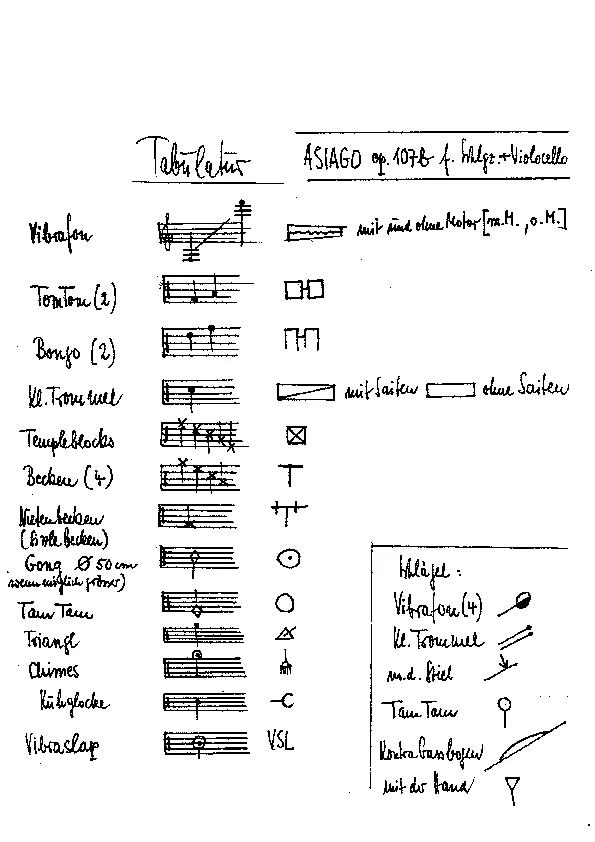
Op. 107b, Percussion tablature
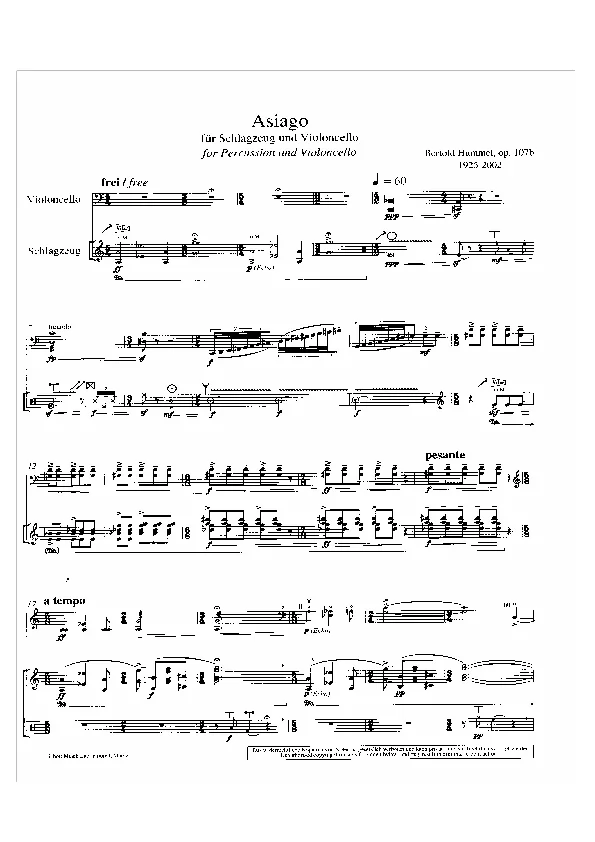
Op. 107b, beginning
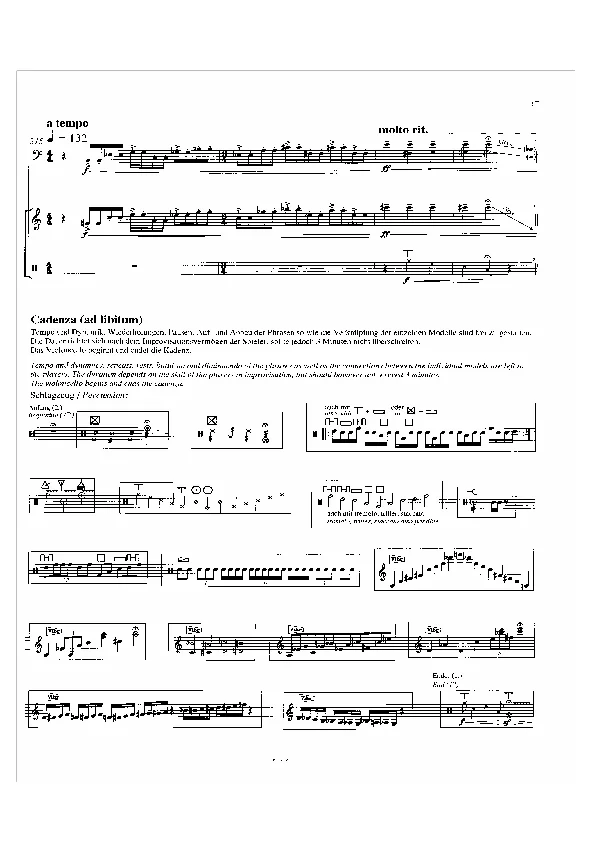
Op. 107b, Cadenza and Finale
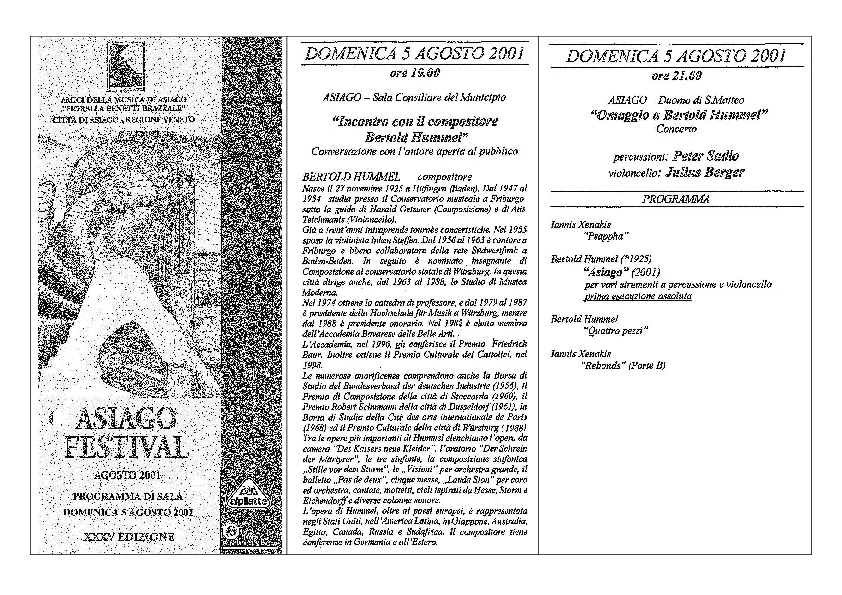
Programme for the world premiere of Op. 107b




Preface (Schott Music)
In the summer of 2001, Bertold Hummel composed the present work as a commission from the "Asiago Festival" and for the first time united his favourite instruments in this large-scale "Fantasia in one movement" - as he himself described it.
Asiago - the musical letters a-s-a-g open and close the work - is a successful exploration of the diverse sound combinations of percussion instruments and the mystical, sensual sounds of the violoncello, whereby the string instrument is at times treated percussively and the percussion like a string instrument. Hunting rhythms alternate with meditative moments. Choral fragments lead into a large cadenza in which the instrumentalists have the opportunity to improvise freely on the basis of given models.
The premiere of this approximately 15-minute work took place on 5 August 2001 in the Duomo di S.Matteo in Asiago in northern Italy and was in the hands of Peter Sadlo and Julius Berger, who are among the most committed interpreters of my father's works.
Martin Hummel
Speech by Bertold Hummel on 5 August before the premiere of ASIAGO in the Duomo di S. Matteo in Asiago
In a time of increasing secularisation, the creative and probably also the post-creative artist has the task of pointing his fellow human beings to the transcendent, to the inexplicable and also the unprovable. The language of music - perhaps the most universal - is of particular importance here. The depiction of suffering and horror alone cannot be the immanent component of a work of art. The reference to consolation and hope is indispensable. In addition, life, nature and, for the believer, the knowledge of God give sufficient cause for praise and thanksgiving.
There is no reason at all why these life-affirming qualities should be attributed exclusively to the masterpieces of the past, as we inevitably (undoubtedly) stand more or less on the shoulders of our ancestors, and yet human suffering has always been just as present as the longing to overcome it.
My musical language is emphatically characterized by my early exposure to Gregorian chant. As the son of a church musician and teacher, I came into close contact with organ and choral music in my youth, from Palestrina to Bach, Viennese classical music, Bruckner and contemporary music. Military service and being a prisoner of war (1943-47) were a major turning point for me! I began my studies (violoncello and composition) in 1947.
Hindemith, Bartok, Stravinsky, Schönberg, the Viennese School (Berg and Webern), Schotakowitsch, Messiaen, Petrassi, Dallapiccola, Nono, Britten, Darmstadt and Paris were very influential.
From the variety of stimuli I was able to develop my own style, the aim of which is to make musical ideas tangible - in my opinion - and to create a triangle between composer, performer and listener at the highest possible level. A l'art pour l'art point of view has always been suspect to me, just as I was very critical of Theodor W. Adorno's musical aesthetics at the time. I would like to contrast the intolerance of a certain avant-garde with humane respect for all seekers of truth.
The following can be said about the composition: "Asiago": The specification was the instrumentation violoncello - percussion performed by 2 players who have been familiar with my work for a long time. (The percussion tablature has 22 instruments).
The motto of this work consists of the letters ASiAGo, which can be set to music; most of the melodic and enharmonic structures are derived from these 4 tones. In addition to this four-note sequence, other four-note sequences came to mind that have repeatedly played a role in my works: B-A-C-H and Richard Wagner's Tristan motif.
Formally, the one-movement work is divided into 4 sections, which should be easy to recognize in terms of movement (slow-fast-slow-fast). Before a 5th final section (slow-fast-slow) of a coda, a cadenza is inserted by the two players in which they can link the given models in free improvisation.
One could speak of a fantasy that offers the instrumentalists many creative possibilities both in terms of rhythmic drama and melodic lyricism. From the so-called Bartok pizzicato of the violoncello to the vibraphone bowed with the double-bass bow.
I hope that this combination of instruments, which has rarely been performed to date, will pass its acid test and - like all of you - I am very much looking forward to the première.