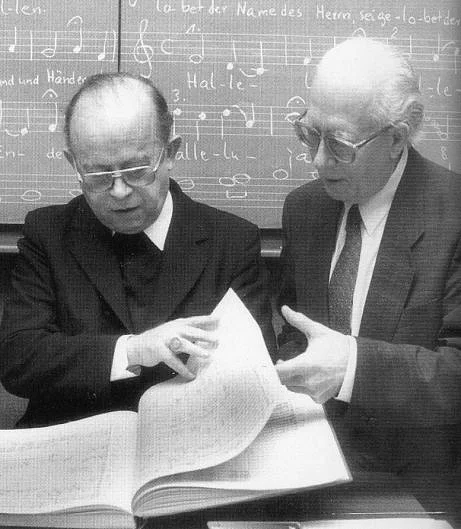
Paul-Werner Scheele
6. April 1928 Olpe - 10. May 2019 Würzburg
Music lessons at the piano
Bishop Paul Werner - a friend and connoisseur of music
When Professor Dr Paul-Werner Scheele was appointed Bishop of Würzburg in 1979, this was good news for musical Würzburg, as rumour had it that the new head pastor had considered studying music in his youth.
So the first meeting was eagerly awaited, and it soon became clear that his interlocutor was a profound connoisseur of music and its history. The dialogue ranged from Gregorian chant to Palestrina, Bach and Handel, Viennese Classicism, Romanticism and the music of our time. In my case, I was able to identify many parallels of inclination, particularly with regard to the works of Palestrina, Bach, Anton Bruckner and Olivier Messiaen. In the meantime, Bishop Paul-Werner has repeatedly spoken and written competently on musical issues (church music) and on the life's work of composers (Anton Bruckner), which has earned him a high level of respect in specialist circles. His private pianistic activities and inclinations are primarily focussed on the classical composers Bach, Haydn, Mozart and Beethoven, whose works he immerses himself in with dedication in the few leisure hours that his schedule allows him. Chamber music is also one of his specialities. Together with the Protestant Dean Martin Elze, who plays the violin, he has tried to harmonise possible theological dissonances by playing Mozart sonatas in an ecumenical spirit. As an attentive listener, Bishop Paul-Werner usually follows developments in contemporary music on recordings, but also - if time permits - in the concert hall. Here, it is particularly the works of Olivier Messiaen whose intellectual and theological depth touch and convince him.
In shaping the text for my oratorio The Shrine of the Martyrs, I was able to experience Bishop Paul-Werner as a sensitive translator of ancient Irish texts and as a knowledgeable co-creator of a large-scale formal genre. In an original reference to canon tables from old Irish manuscripts, a convincing structure was created, in which five soloists, a mixed choir, a boys' choir, a speaker as well as a large orchestra, a percussion ensemble and three organs - positioned in different places, utilising the acoustics of Würzburg Cathedral - are used. The collaboration naturally required several "sessions", which were usually opened by a chamber music "prelude" with the episcopal pianist. This was followed by a performance of the completed parts by the composer and their appraisal, as well as questions about the arrangement of the text. There was lively discussion about comments, cuts etc. A good Franconian wine was not to be missed at the "finale", and despite the seriousness of the oratorical theme, the bishop's sense of subtle humour came into its own time and again. The result was a collaborative work that was presented for the first time in the anniversary year of 1989 to a large audience and attracted regional attention.
Bertold Hummel (in "Friede und Freude - Zum 25. Jahrestag der Bischofsweihe von Paul-Werner Scheele" Sonderdruck des Würzburger Katholischen Sonntagsblattes)
Works by Bertold Hummel that are connected with Paul Werner Scheele
- The Shrine of the Martyrs op. 90
- Message of Peace of the Apocalypse op. 94
- Christus heri op. 103h
- A small reverence op. 95f,2
- Album sheet for piano
Biography
Paul Werner Scheele was born in 1928 as the son of a commercial clerk and a housewife in Sauerland. He had five siblings, two of whom died in childhood. Scheele attended primary school in Olpe and secondary schools in Olpe and Attendorn. During the Second World War, he was called up for military service in the air force. After the end of the war, Scheele passed his A-levels in Attendorn on 8 October 1946.
From 1947 to 1951, Scheele studied philosophy and theology at the universities of Paderborn and Munich. On 29 March 1952, he was ordained a priest by the then Archbishop of Paderborn, Lorenz Jaeger. After his ordination, Scheele was a parish priest and religion teacher in Paderborn for ten years until 1962. After further studies from 1962 to 1964, Paul-Werner Scheele was awarded his doctorate in theology in Würzburg on 4 February 1964 with the dissertation "Johann Adam Möhler's doctrine of the unity of the church and its significance for the foundation of faith". On 3 March 1966, Scheele accepted an appointment to the Chair of Fundamental Theology at the Ruhr University in Bochum. This was followed in 1970 by his appointment to the Chair of Dogmatics at the University of Würzburg. From 1971 to 1979, Scheele was provost of the cathedral in Paderborn and at the same time held a professorship for dogmatics at the Faculty of Theology in Paderborn.
On 31 January 1975, he was appointed titular bishop of Druas and auxiliary bishop in Paderborn. He was consecrated bishop on 9 March 1975 by the Archbishop of Paderborn, Johannes Joachim Degenhardt. The auxiliary bishops of Paderborn, Paul Heinrich Nordhues and Friedrich Maria Rintelen, were the co-consecrators. Pope John Paul II appointed Paul-Werner Scheele as Bishop of Würzburg on 31 August 1979. The inauguration took place on 21 October 1979 by the Archbishop of Bamberg, Elmar Maria Kredel. Under his aegis, St Kilian's Cathedral was extensively renovated. On 1 April 2002, he celebrated his golden jubilee as a priest.
On 14 July 2003, John Paul II accepted the resignation of Bishop Paul-Werner Scheele due to his age.
Until his retirement, Scheele was Chairman of the Ecumenical Commission of the German Bishops' Conference and a member of the Commission for Faith and Order of the World Council of Churches. Even after his retirement, he continues to be a member of the Vatican Council for Promoting Christian Unity. Scheele is involved in the Bartholomew Society and is a member of the board of trustees of Shalom Europa (Jewish community in Würzburg and Lower Franconia). Bishop Scheele was an honorary canon in Paderborn and Würzburg, recipient of the Golden City Plaque of the City of Würzburg, the Bavarian Order of Merit and the Federal Cross of Merit First Class as well as honorary professor and honorary senator at the University of Würzburg. On the occasion of his 85th birthday, the City of Würzburg awarded him the Ring of Honour in 2013. Paul Werner Scheele died on 10 May 2019 in Würzburg. Literature tip: Paul Werner Scheele: Lob der Musik und der Musiker Beiträge zu einer Theologie der Musik darin: In memoriam Bertold Hummel Echter Verlag, Würzburg 2005