Message of Peace of the Apocalypse for mixed choir and large orchestra (op. 94, 1991)
Dedication
Paul-Werner Scheele on his 63rd birthday
Instrumentation
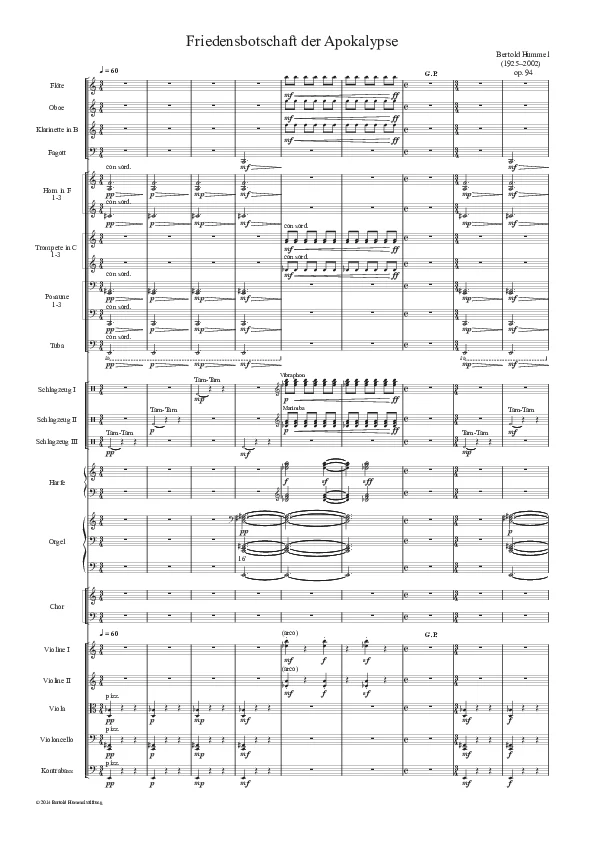
1.1.1.1.-3.3.3.1. - percussion (3), harp, organ, strings
Duration: 6 minutes
Premiere
7 February 2015,
Würzburg, Neubaukirche
MonteverdiChoir Würzburg | Vogtland Philharmonic Orchestra | Matthias Beckert
Autograph
Title: Die Wiederkunft des Herrn op. 94 - Length: 13 pages - Date: - - Location:
Publisher
Bertold Hummel Foundation
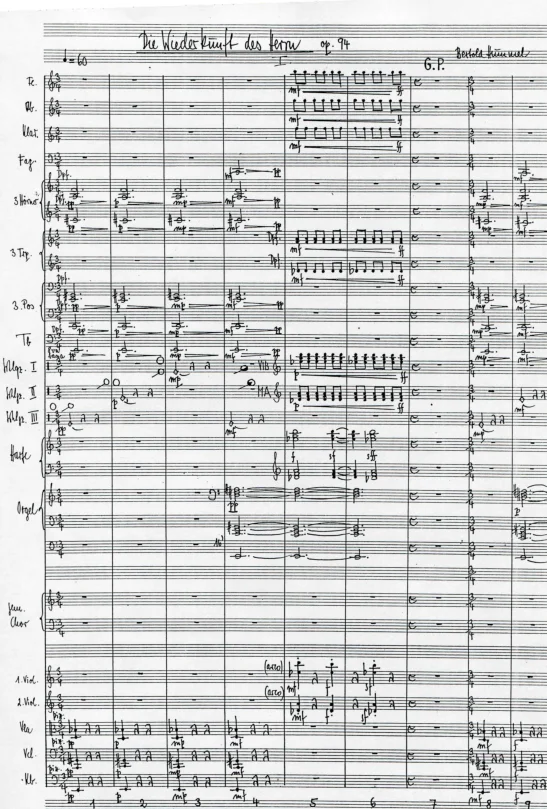
Op. 94, manuscript
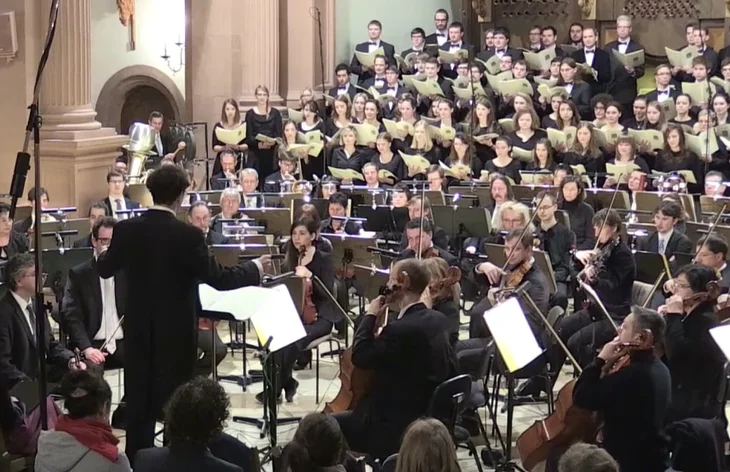
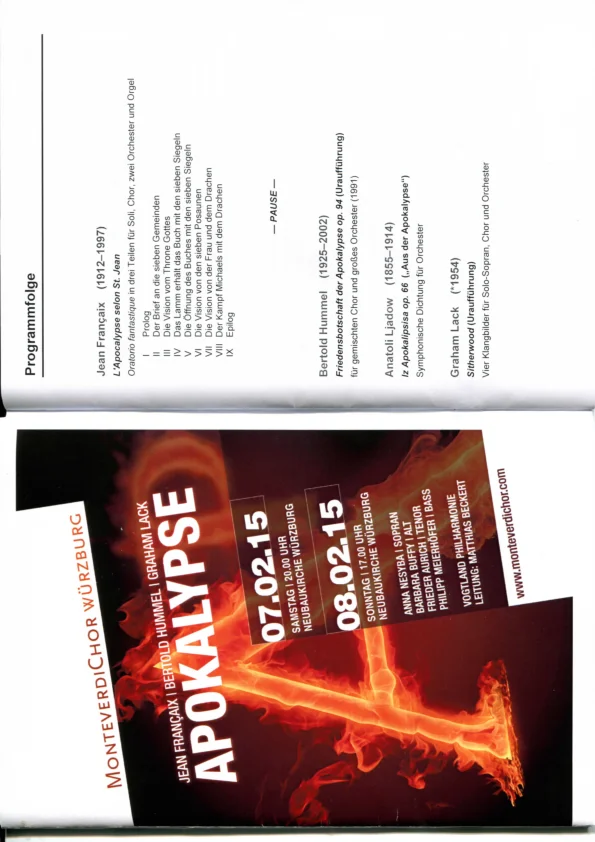
Programme for the world premiere of Op. 94




In 1990/91, Bertold Hummel conceived a cantata with texts from the Apocalypse in collaboration with the Würzburg Bishop Paul-Werner Scheele, which was to be premiered at the inauguration of the redesigned St Michael's Church of the Würzburg seminary. For various reasons, Hummel, who had already dealt intensively with the theme in 1980 in his perhaps most important orchestral work "Visions after the Revelation of St John" op. 73, hesitated to compose the work. He wrote out the Apocalypse's message of peace, which was to open the work, and gave the score to Paul-Werner Scheele as a present for his 63rd birthday.
The fragment "Von der Wiederkehr des Herrn - Cantata after the Apocalypse of St John for soloists, mixed choir and large orchestra"
I.
Mixed choir:
Grace be with you and peace
from Him who is and who was and who is to come, and from the seven spirits before His throne and from Jesus Christ;
Male choir:
He is the faithful witness, the firstborn of the dead, the ruler over the kings of the earth.
Women's chorus:
He loves us and has redeemed us from our sins through his blood;
Male chorus:
He has made us kings and priests before God his Father.
Mixed choir:
To him be the glory and the power for ever and ever, Amen.
(Revelation 1, 4-6)
The first movement (94 bars) is fully orchestrated in fair copy.
II.
John (speaker):
"On the day of the Lord I was seized by the Spirit, and I heard a voice behind me as loud as a trumpet."
"When I turned round, I saw seven golden candlesticks, and in the midst of the candlesticks one who looked like a man;
He was clothed with a robe that reached down to his feet,
and around his chest he wore a belt of gold:
Mixed choir:
Behold he comes, behold he is here!
His head and his hair are white as white wool,
shining white as snow,
and his eyes like flames of fire;
John (speaker):
I heard: His voice was like the sound of rushing waters
and I saw: In his right hand he held seven stars,
and out of his mouth came a sharp, two-edged sword
and his face shone like the mighty shining sun.
When I saw him, I fell down at his feet as if dead.
He put his right hand on me and said:
Baritone:
"Fear not! I am the first and the last and the living one.
I was dead, but now I live for all eternity, and I have the keys
to death and the underworld. Share what you have seen, what is and what will happen hereafter."
Mixed choir:
In the midst of seven candlesticks, in the centre of us all is the Lord
In his right hand he holds seven stars and his right hand holds us all
Lord, have mercy!
Kyrie eleison! Miserere Domini!
Lord, have mercy! Seigneur, aie pietié de nous!
Gospodi pomilju! Miserere nobis.
The second movement (125 bars) is fully composed. The instrumentation is only partially indicated.
Inspired by the great success of the oratorio Der Schrein der Märtyrer, the librettist and Bishop of Würzburg Paul-Werner Scheele approached Bertold Hummel again in December 1990 and asked him to compose an oratorio for the ceremonial consecration of the newly designed St Michael's Church of the Würzburg seminary. Figures and scenes from the Apocalypse, designed by the sculptor Heinrich Gerhard Bücker (1922-2008), who also designed St Kilian's shrine, were to find a musical counterpart. Scheele designed a text collage from the Apocalypse of St John in a tried and tested manner, which he repeatedly changed after discussions with the composer.
Strong doubts about a new large-scale oratorio composition after Der Schrein der Märtyrer, which he soon regarded as his opus summum, delayed the start of composition. He had also dealt so intensively with the theme of the Apocalypse in his perhaps most important orchestral work, the Visions op. 73 in 1980, that a vocal version of the material was no longer absolutely necessary for him.
Although he was on friendly terms with Scheele, he still felt that he should not turn down this commission. On the bishop's 63rd birthday, he presented him with the 94-bar orchestrated score of the opening chorus (the pencil particell bears the date 14 February 1991). The title is: Die Wiederkehr des Herrn, op. 94. The following appearance of the prophet John as speaker and the partially spoken passages of the 7-verse Miserere are no longer fully orchestrated and suggest a rethink on the part of the composer in the conception of this work.
"Ja ich komme bald" was Scheele's suggested title for a reduction of the project. The arc was now to be spanned in 7 parts:
I. The returning Lord in the midst of the 7 candlesticks
II The 7 churches
III The 4 horsemen
IV. The 7 angels and the 7 trumpets
V. The woman, the child and the dragon
VI The 3 x 7 elders
VII The Lord who makes all things new
The instrumentation was planned as follows: Chamber choir + speaking choir, narrator, 5 soloists (soprano, alto, tenor, baritone, bass). The orchestra was to consist of 7 musicians: Organ, flute (picc. + bass fl.), clarinet (bass clar. + picc. clar.), trombone (tenor, alto and bass trombone), , violoncello, harp and percussion.
His former pupil Jürgen Schmitt, who made a name for himself as a specialist in electronic sound compositions, wrote in an obituary in 2003 that "Hummel had very specific plans in mind: electronic music. We had already made a site visit to the university church, for which he had commissioned a work for choir, orchestra and various soloists with flexible electronics using spatial "polychoral" (electronic) arrangements. He had me in mind as a consultant and collaborator for the electronic aspects of his composition. Unfortunately, it never came to fruition."
A completely different text by Scheele entitled Cantata "Von der Wiederkehr des Herrn" (On the Return of the Lord ) (after the Apocalypse of St John), which lay on Hummel's working piano after his death with the note "last version!", bears witness to these considerations.
With its four parts (I. Our Future, II. The Apocalyptic Riders, III. The Woman, the Child and the Dragon, IV. The Lord Who Makes All Things New), it is in true cantata form.
Hummel outlined the orchestration as follows: Flute (alto, bass, picc.), oboe (E.H.), clarinet (E flat + bass cl.), bassoon (+ Kfg.), trp., Pos., horn i. F, harp, string quintet, perc. Organ and electronics (additional band). A 95-bar particello sketched in pencil shows that he was thinking of a chamber orchestra which had to play in different positions. In terms of vocal soloists, he had in mind - as he discussed with me - a soprano and a baritone voice. He also kept thinking about incorporating modern texts.
Surprisingly, when the last catalogue of works he edited went to press in 2000, he nevertheless included the title "On the Return of the Lord" (after the Apocalypse of St John), op. 94 and, although only about 8 minutes had been composed at the time, he set the performance duration of the work at 50 minutes.
Martin Hummel