Phantasus (op. 93, 1990)
Song cycle for voice and guitar based on poems by Arno Holz
for my son Martin
I. In my black taxus forest, II. From white clouds, III. Lake, lake, sunniest lake, IV. In front of my window, V. Red roses, VI. In my green stone forest
Voice, guitar
Duration: 24 minutes
Martin Hummel | Clemer Andreotti
Vogt & Fritz VF 1095-00 / ISMN: M 2026-1418-1
Arno Holz
Sechs Gedichte aus Phantasus
I.
In meinem schwarzen Taxuswald
singt ein Märchenvogel —
die ganze Nacht.
Blumen blinken.
Unter Sternen, die sich spiegeln,
treibt mein Boot.
Meine träumenden Hände
tauchen in schwimmende Wasserrosen.
Unten, lautlos, die Tiefe.
Fern die Ufer! Das Lied ...
Arno Holz
Six poems from Phantasus
I.
In my black taxus forest
a fairy-tale bird sings -
all night long.
Flowers twinkle.
Under stars that are reflected,
my boat floats.
My dreaming hands
dive into floating water lilies.
Below, silently, the deep.
Far away the shores! The song …
II.
Aus weissen Wolken
baut sich ein Schloss.
Spiegelnde Seen, selige Wiesen,
singende Brunnen aus tiefstem Smaragd!
In seinen schimmernden Hallen
wohnen die alten Götter.
Noch immer, abends, wenn die Sonne
purpurn sinkt, glühn seine Gärten,
von ihren Wundern bebt mein Herz
und lange ... steh ich. Sehnsüchtig!
Dann naht die Nacht, die Luft verlischt,
wie zitterndes Silber blinkt das Meer,
und über die ganze Welt hin
weht ein Duft wie von Rosen.
II.
From white clouds
A castle is built.
Reflecting lakes, blissful meadows,
singing fountains of deepest emerald!
In its shimmering halls
dwell the ancient gods.
Still, in the evening, when the sun
sinks purple, its gardens glow,
my heart trembles at their wonders
and for a long time ... I stand. Longing!
Then night approaches, the air goes out,
the sea flashes like trembling silver,
and across the whole world
A fragrance like roses wafts.
III.
See, See, sonnigste See, soweit du siehst!
Über die rollenden Wasser hin,
jauchzend, tausend Tritonen.
Auf ihren Schultern, muschelempor,
hoch, ein Weib.
Ihre Nacktheit in die Sonne.
Unter ihr, triefend,
die blendenden Perlmutterwände
immer wieder von Neuem hoch,
dick, feist, verliebt, wie Kröten,
sieben alte, glamsrige Meertaper.
Die Gesichter! Das Gestöhn und das Gepruste!
Da, plötzlich, wütend aus der Tiefe, Neptun.
Sein Bart blitzt. "Hallunken!"
Und, plitschplatsch, sein Dreizack
den sieben Schlappschwänzen um die Glatzen.
Die brüllen! Dann, schnell,
hier noch ein paar Tatschen,
dort noch ein Bauch — weg sind sie.
Die Schöne lächelt.
Neptun verbeugt sich.
“Madam?”
III.
Sea, sea, sunniest sea, as far as you can see!
Over the rolling waters,
rejoicing, a thousand tritons.
On their shoulders, muschelempor,
high, a woman.
Her nakedness in the sun.
Beneath her, dripping,
the dazzling mother-of-pearl walls
up again and again,
fat, feisty, enamoured, like toads,
seven old, glamourous sea-tapers.
The faces! The moaning and the spluttering!
There, suddenly, furious from the depths, Neptune.
His beard flashes. "Fraudster!"
And, splash splash, his trident
around the bald heads of the seven wimps.
They roar! Then, quickly,
a few more paws here,
a belly there - they're gone.
The beauty smiles.
Neptune bows.
"Madam?"
IV.
Vor meinem Fenster singt ein Vogel.
Still hör ich zu; mein Herz vergeht.
Er singt, was ich als Kind besass
und dann — vergessen.
IV.
A bird sings outside my window.
I listen quietly; my heart melts.
It sings what I had as a child
and then - forgotten.
V.
Rote Rosen winden sich um meine düstre Lanze.
Durch weisse Lilienwälder schnaubt mein Hengst.
Aus grünen Seen, Schilf im Haar,
tauchen schlanke, schleierlose Jungfraun.
Ich reite wie aus Erz. Immer, dicht vor mir,
fliegt der Vogel Phönix und singt.
V.
Red roses twine around my gloomy lance.
Through white lily woods my stallion snorts.
From green lakes, reeds in the hair,
Slender, veilless maidens emerge.
I ride as if made of ore. Always, close in front of me,
the phoenix bird flies and sings.
VI.
In meinem grünen Steinwald scheint der Mond.
In seinem Licht sitzt ein blasses Weib und singt.
Von einem Sonnensee, von blauen Blumen,
von einem Kind, das Mutter ruft.
Müde fällt die Hand ihr übers Knie,
in ihrer stummen Harfe glänzt der Mond.
VI.
The moon shines in my green stone forest.
In its light sits a pale woman and sings.
Of a sunny lake, of blue flowers,
Of a child calling mother.
Her hand falls wearily over her knee,
The moon shines in her silent harp.
Arno Holz (1863-1929), the founder and theorist of naturalism, was already pointing towards expressionism in his late phase. This applies in particular to his verse poem "Phantasus" (almost 1600 pages), lines of varying length arranged around the vertical centre axis of the page.
The cycle comprises six selected poems, the meaning of which is interpreted musically. The guitar often takes on the role of commentator - especially in the third song "See, See, sonnigste See", which represents the dramatic climax of the work. The guitar preludes of the first and last song correspond with each other and thus form a kind of formal framework. While lyricism predominates in songs 1, 2 and 4, songs 3 and 5 are more dramatic in character. In the 6th song, a 36-bar organ point creates a pale moon mood and a restrained finale.
The cycle was composed in 1990 at the suggestion of my son Martin, to whom it is also dedicated.
Bertold Hummel
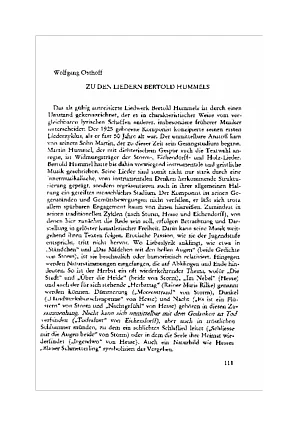
Since the late 1980s, Bertold Hummel has also written vocal cycles that depart from the traditional piano accompaniment. Guitar accompaniment, which was very popular in the late 18th and early 19th centuries in the German lied repertoire, can be seen as a variation on this. Hummel uses it in his song cycle "Phantasus" on freely chosen poems from the collection of the same name by Arno Holz. Although the possibilities of polyphonic composition on the guitar are drastically reduced, Hummel basically sticks to the structure of his piano songs. However, typical guitar techniques such as the rasgado (permanent arpeggiation with the fingernails, usually from top to bottom and back) are found very frequently, for example at the beginning of the third song ("See, See, sonnigste See"). Hummel captures Holzen's artistic neo-romanticism with its rococo nostalgia (his naturalistic modernisms are left out) in a somewhat tongue-in-cheek musical way, for example when in the first song, on relatively simply named flowers , there is a circular variation of the same musical motif with blinking. The instrumental introduction to this song, "In meinem schwarzen Taxuswald" (In my black taxus forest), returns at the beginning of the last song, "In meinem grünen Steinwald" (In my green stone forest), rounding off the cycle. Hummel renders the ballad-like third song, "See, See, sonnigste See", with realistic humour, which leads to glissandi and trills in the voice part and even to the kind of speaking on implied pitches that was first used by Engelbert Humperdinck in the early version of his "Königskinder" . However, if the triads in the passage where the old gods dwell in the second song ("Aus weißen Wolken") still seem ironic, their reappearance in the last song gives the impression that the moon and the sunlit lake, the blue flowers and the harp are taken so seriously as a mood that the (again open) ending in the C major fourth sixth or sixth chord is convincing - all the more so as the note E can be heard throughout the entire song (apart from the aforementioned instrumental prelude).
Wolfgang Osthoff (in "Zu den Liedern Bertold Hummels", Tutzing 1998)