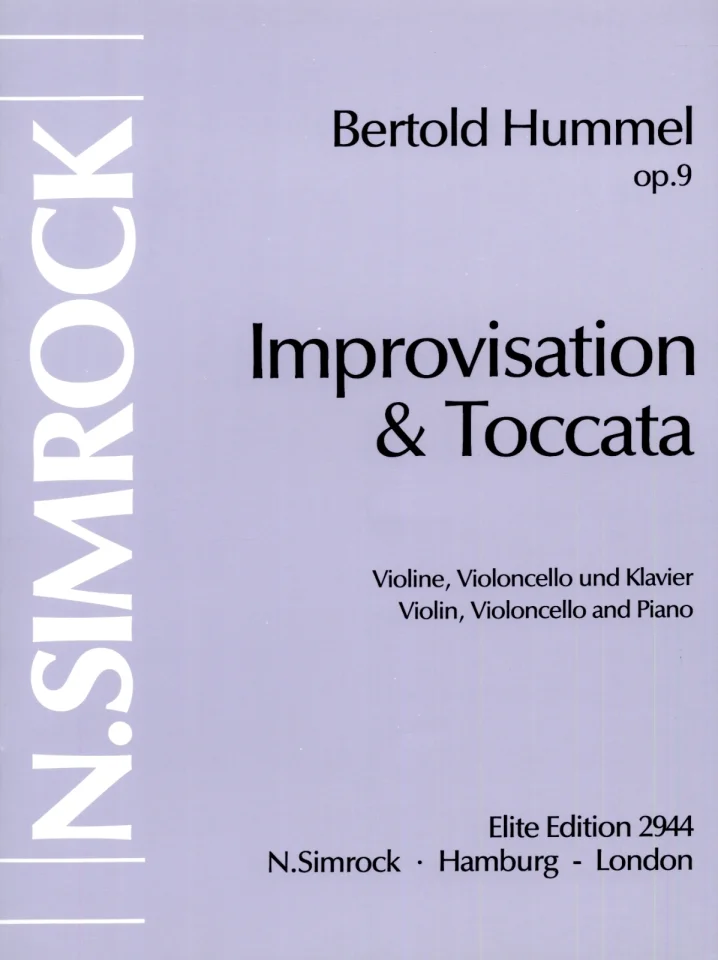
Improvisation and Toccata for piano trio (op. 9, 1954)
Movement titles
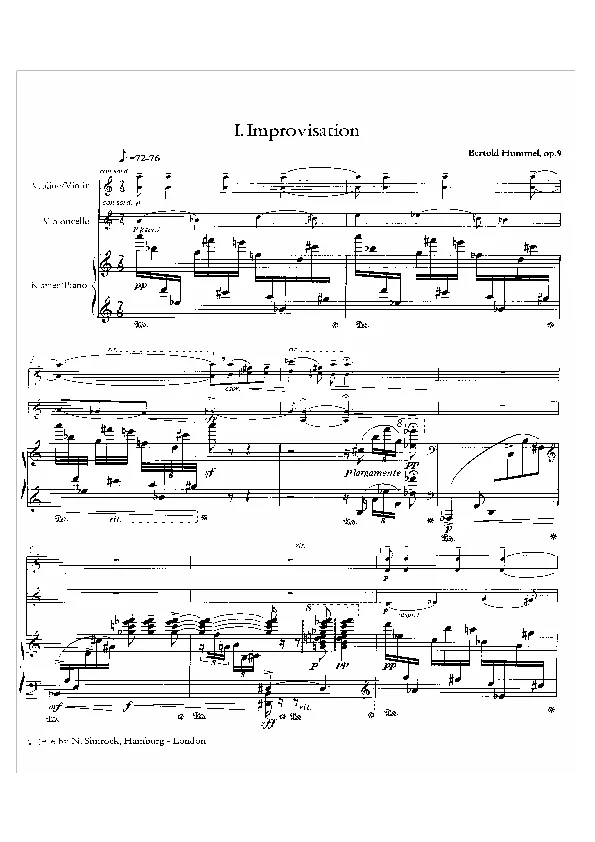
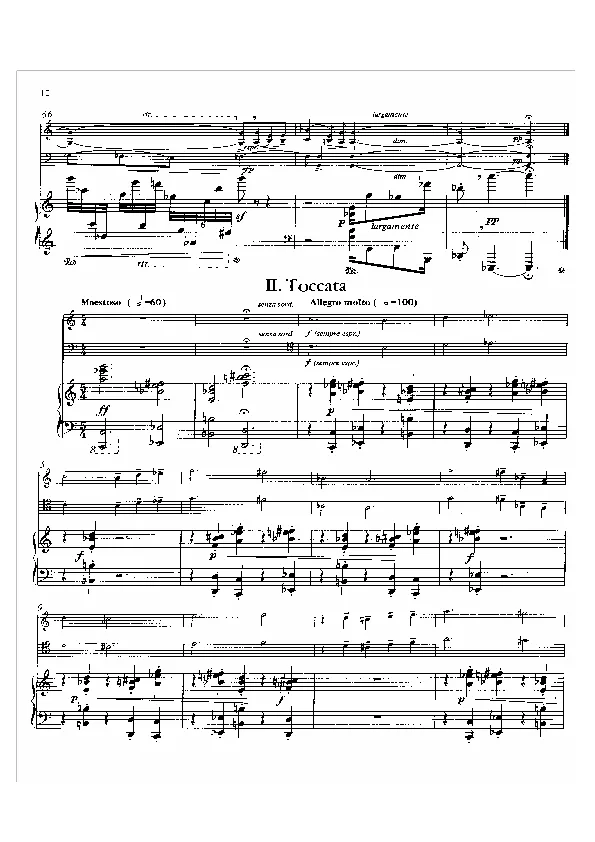
I. Improvisation, II. Toccata
Instrumentation
Violin, violoncello, piano
Duration: 12 minutes
Premiere
21 June 1955 (Toccata),
Cape Town (S.A.), Hiddingh Hall
Inken Hummel-Steffen | Bertold Hummel | Virginia Fortescue
First Performance
6 April 1961 (Improvisation),
Darmstadt, Main Auditorium of the LGG
Jürgen Weimer | Bertold Hummel | Roland Weber
Autograph
Title: Improvisation and Toccata for piano trio - Length: 30 pages - Date: - - Location: Bavarian State Library, Munich
Publisher
N. Simrock Hamburg-London (Boosey & Hawkes) EE 2944 / ISMN M-2211-0846-3

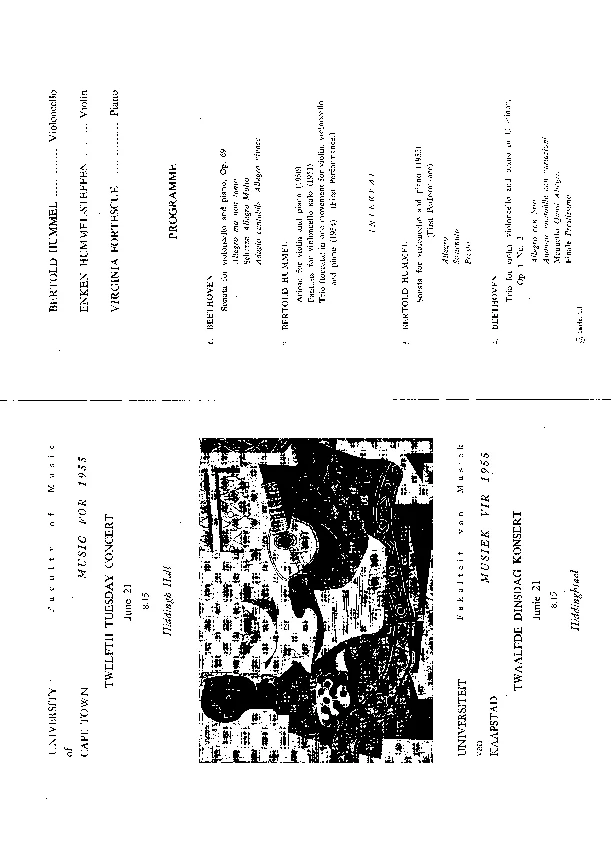
Programme for the world premiere of Op. 9, Toccata
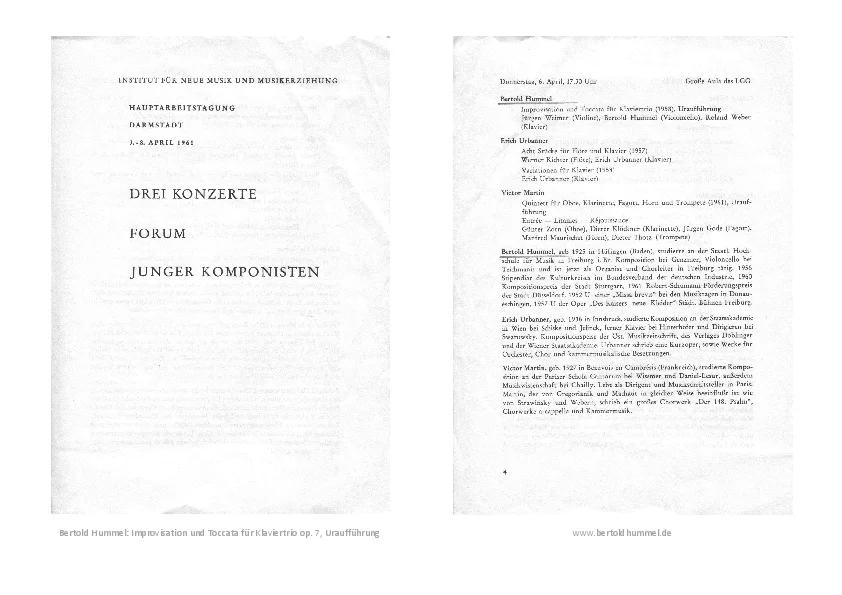
Programme for the world premiere of Op. 9, Improvisation
Der Tagesspiegel, Berlin, 3 December 1955
In Bertold Hummel’s austere, intense Toccata, a unique power seems to be emerging.




In "Improvisation and Toccata" for piano trio, the composer explores the ordering principles of the modal technique, which uses a limited number of tones as working material in a similar way to the twelve-tone technique. By constantly modifying these, the greatest possible compositional unity is achieved.
Bertold Hummel (Programme booklet "Studio für Neue Musik" Würzburg / 10.7.1963)
Bertold Hummel's Piano Trio op. 9, composed in 1954, breaks with the traditions of the classical-romantic piano trio in that it combines two movements of different types, whose thematic substance is derived from a single original row, without using traditional formal models. This trio differs from the twelve-tone works of the Schönberg school through a kind of cell technique in which smaller particles are extracted from the overall row and used independently of the twelve-tone total, particles that are similar in their third-second structure to the BACH motif, but contain more third combinations and reveal their true origin in the second movement: the fugue from Stravinsky's Symphony of Psalms. The constant transformation of the tone steps into octave displacement and inversion creates a variety of constellations that lend themselves to flexible shaping. The opening movement, entitled"Improvisation", unfolds a rhapsodic sequence of arabesques within its cyclical setting, which presents the row in the cello at the beginning and end of the movement. The 2nd movement, entitled"Toccata", stands out from this sound filigree with its powerful chord blocks and linear rigour. Its form is a sequence of metamorphosed sections derived from the beginning, structured by a fifth-transposed reprise of the opening movement.
Klaus Hinrich Stahmer
Bertold Hummel's trio was composed in 1954. The first movement, Improvisation, exposes a twelve-tone row, but its further use is shaped less by the linear sequence of notes 1 - 12 than by their chromatic frictions a - b; d - c sharp; e - e flat; c - b; a flat - s flat - f - g, which lend Hummel's carpet of sound, notated in a weightless 7/5 time signature, a bittersweet sonority. The instrument-specific playing technique with its layer and repetition effects is in keeping with the improvisatory character of the first movement. In contrast, the second movement, Toccata, has a striking approach and arranges powerful chord blocks in 5/4 time in a somewhat static grouping method that is based on the historical type of toccata. The cell from which the beginning unfolds and from which interjections are derived in the further course is taken from the fugue in Stravinsky's Symphony of Psalms.