Ten songs after poems by Theodor Storm (op. 71b, 1975/76/83)
for medium voice and piano
for my son Martin
1. the city, 2. over the heath, 3. seashore, 4. song of the harp girl, 5. serenade, 6. it is a whisper, 7. the girl with the bright eyes, 8. the seagull and my heart, 9. moonlight, 10. close my eyes both
Middle voice, piano
Duration: 25 minutes
Martin Hummel | Thomas Hitzlberger
Title: -
Scope: 1. 8 pp. / 2. 4 pp. / 3. 4 pp. / 4. 4 pp. / 5. 6 pp. / 6. 4 pp. / 7. 8 pp. / 8. 4 pp. / 9. 2 pp. / 10. 4 pp.
Dated: 1. 13.2.1983 / 2. 1975 / 3. 76 / 4. Dorfgastein 14.III.76 / 5. 2./3.Jan.76 / 6. 23.II.76 / 7. 26.Aug.75 Dorfgastein / 8. 12.III.76 / 9. for Martin on his 15th birthday on 21.8.75 Dorfgastein / 10. 12.III.76 Dorfgastein
Storage location:
Schott Music ED 20288 / ISMN: M-001-14993-8
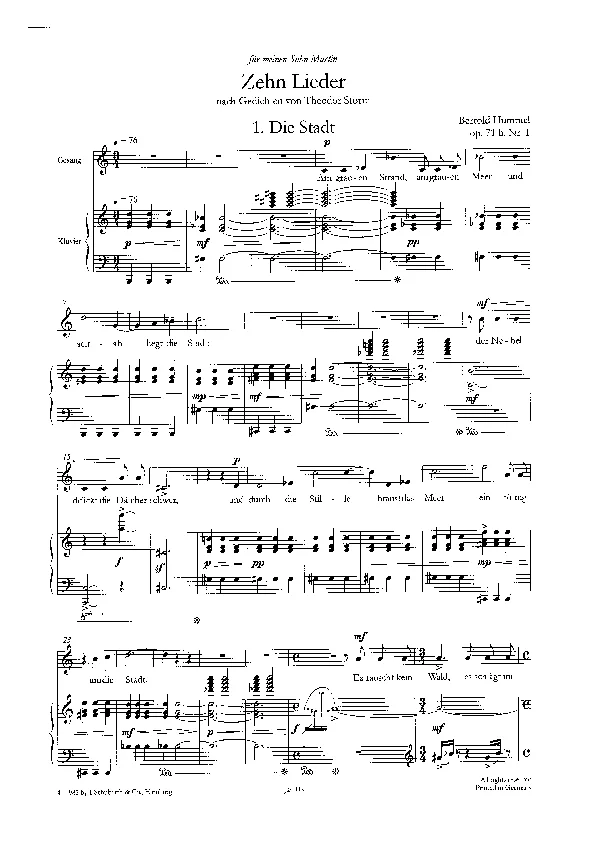
The city
On the grey beach, on the grey sea
and off to the side lies the city;
the fog weighs down the roofs
and through the silence the sea roars
monotonously around the city.
No forest rustles, no bird strikes in May
no bird without ceasing:
the migrating goose with a harsh cry
only flies by in the autumn night,
The grass blows on the beach.
But my whole heart is attached to you,
you grey city by the sea;
the magic of youth for and for
rests smiling on you, on you,
you grey city by the sea.
Over the heath
Over the heath my step echoes;
Muffled from the earth it wanders along.
Autumn has come, spring is far away, -
Was there once a blissful time?
Brewing fogs are swirling around,
The foliage is black and the sky so empty.
If only I hadn't left here in May!
Life and love - how it flew by!
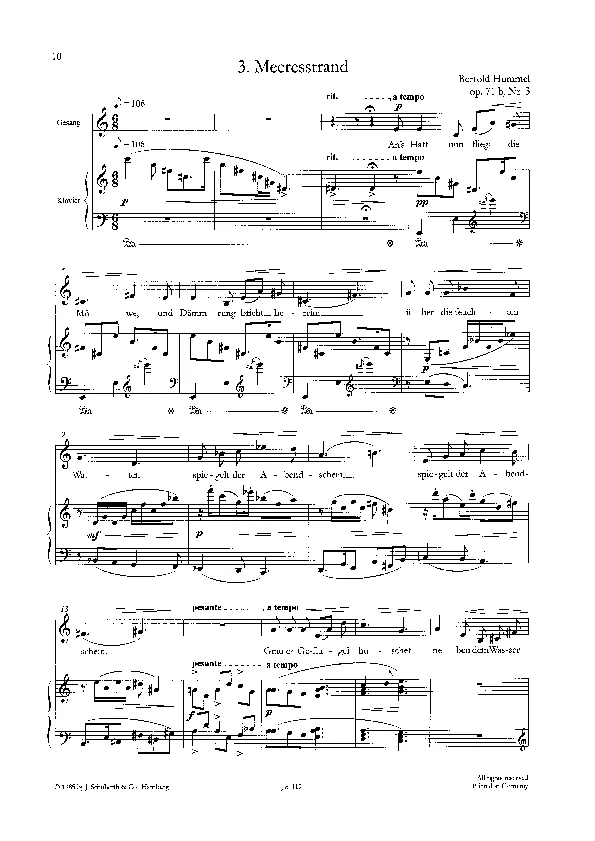
Seashore
To the lagoon now the gull flies,
And dusk falls;
Over the damp mudflats
Reflects the evening light.
Grey fowl scurry
Beside the water;
The islands lie like dreams
In the mist on the sea.
I hear the fermenting mud
Mysterious sound,
Lonely birds calling -
It has always been like this.
Song of the harp girl
Today, only today I am so beautiful,
tomorrow, oh, tomorrow everything must fade away,
Only these hours you are still mine,
I shall die, oh, I shall die alone.
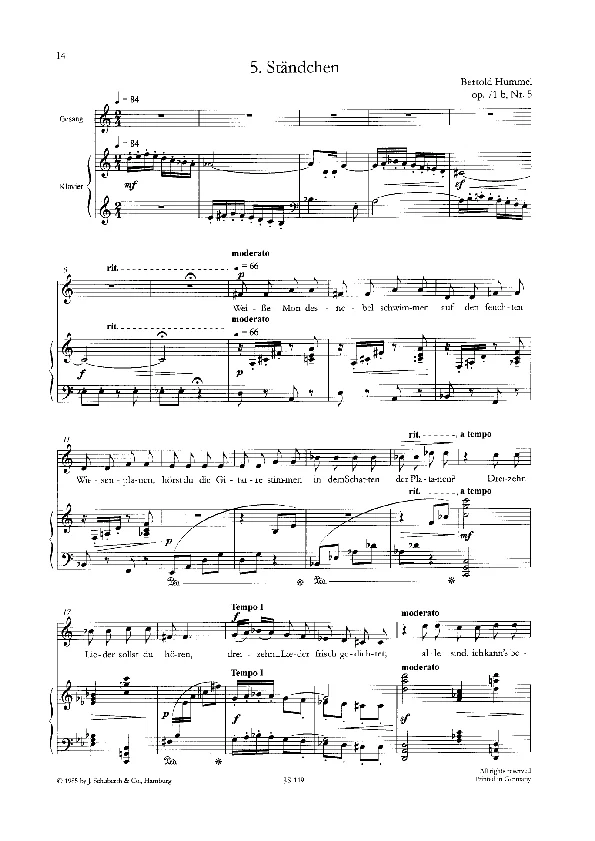
Serenade
White moon mists float
On the damp meadow awnings;
Can you hear the guitar tune
In the shade of the plane trees?
Thirteen songs you shall hear,
Thirteen songs, freshly composed;
All are, I can swear it,
All addressed only to you.
On the delicate slender body
Up and down to the forehead,
Every little spark, every little dust,
All my songs praise.
Truly, child, I have at times
High-spirited thoughts!
Tireless are the strings,
And the mouth is without bounds.
From the most secret pressure of the hands
To the insatiable kissing!
Yes, I myself know in the end
Not what you will have to hear.
Let me warn you, let me be silent,
Let me exchange song for love;
For the leaves on the branches
Wake up and want to listen.
White moon mists float
On the damp meadow canopies;
Can you hear the guitar tune
In the shade of the plane trees?
It is a whisper
It's a whisper in the night,
It has put me to sleep:
I feel it, it wants to announce itself
And can't find its way to me.
Are they words of love, trusted to the wind,
That are lingering on the way?
Or is it doom from days to come,
That urges eagerly to announce itself?
The girl with the bright eyes
The girl with the bright eyes,
She didn't want to be anyone's favourite;
She jumped and let her pigtails fly,
The suitors looked behind.
The suitors stood afar off
In sheer skirts in praise.
"Mother, oh, speak a word
And tame the dear child!"
The mother clapped her hands together,
The mother cried: "You foolish child,
Take hold, take hold! The years are coming,
The suitors are going fast!"
But she let the pigtails fly
And laughed at all wisdom;
Then through the frightened suitors jumped
A wild boy into the house.
And how she bent her wild head,
And how her little foot struck the ground,
He clasped her tightly in his arms
And kissed her red mouth.
The suitors stood afar off,
The mother cried out in amazement:
"God save thee from the rude one,
O'er the rough cavalier!"
The seagull and my heart
The seagull is travelling north,
Towards the north goes my heart;
Both fly out together,
Both fly homewards.
Calm, heart! you are at hand;
You flew the long way so quickly -
And the gull is still rowing
Over the wide ocean.
Moonlight
How in the moonlight lies
Buried now the world;
How blessed is the peace
That holds it in its embrace!
The winds must be silent,
So gentle is this glow;
They only whisper and weave
And fall asleep at last.
And what in the day's glow
Does not awaken to bloom,
It opens its chalices
And perfumes the night.
How am I used to such peace
For a long time not used to!
Be thou in my life
The loving moon!
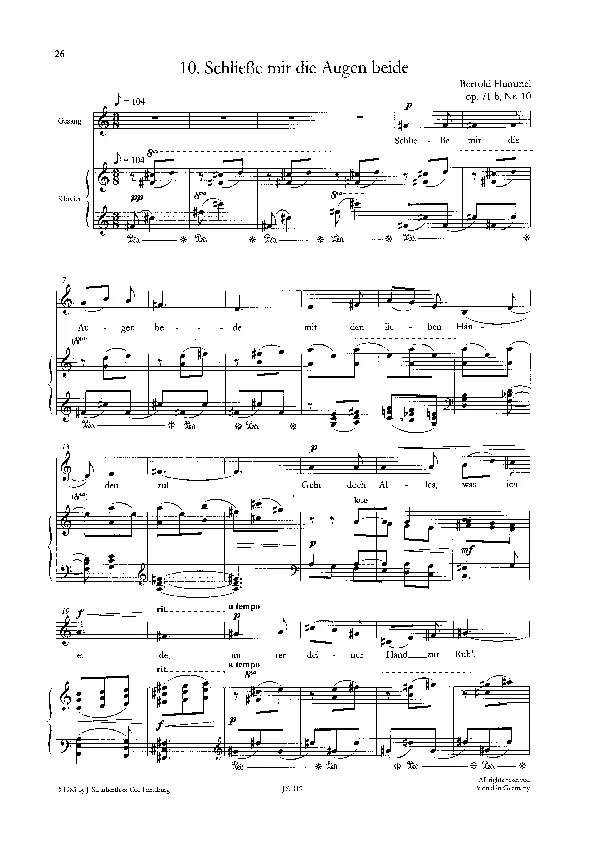
Close both my eyes
Close both my eyes
with your loving hands;
all that I suffer
Under your hand to rest.
And how quietly the pain
Well' lays to sleep wave by wave,
as the last beat stirs,
you fill my whole heart.
Theodor Storm
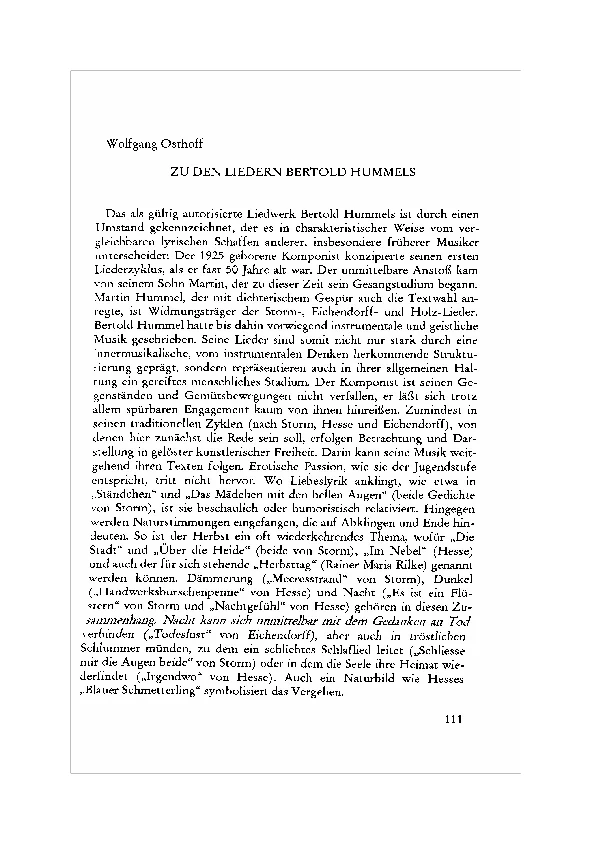
It is very interesting that in 1975 Hummel knew how to write a song cycle based on poems by Theodor Storm, whose melodies were in a quasi-Romantic "folk tone", but whose accompaniment was more reminiscent of early Bartok or even led back to Impressionism.

Hummel from Baden is naturally close to the linguistic directness and thoughtfulness of the Alemannic Hermann Hesse. However, there are also close family ties to northern Germany, whose harsh poetry captured by Theodor Storm finds a musical echo in Hummel. "Towards the north goes the seagull, / Towards the north goes my heart" begins one of these songs ("Die Möwe und mein Herz"). The barren nature and landscape is musically reduced here in a peculiar expressiveness to a monotonously repeated two-part accompanying motif, over which the song rises in clear intervals that manage with a total of four different notes. The Storm settings - with the exception of "Die Stadt" (1983) - were all composed in 1975/76 and are not only the simplest, but probably also the most catchy of Bertold Hummel's songs. Their folk-song-like approach sometimes allows - as in earlier times - a unique notation of the music for several verses of the poem, for example in the particularly graceful "Das Mädchen mit den hellen Augen", in "Mondlicht" and in the tender "Über die Heide". This heath song by Hummel, which trusts completely in the simple melody, can dispense with interpretations of details such as the echoing footsteps or the brewing wafts of mist - interpretations that can even be found in the simple composition of the text by Brahms (op. 86/4)
Wolfgang Osthoff (in "Zu den Liedern Bertold Hummels", Tutzing 1998)